{"title":"Effects of polystyrene fragments on the transport of Pb2+ in saturated porous media: the role of microplastics characteristics and flow velocity","authors":"Yining Ji, Kaiwen Yang, Xiaohui Li, Lizhu Wang, Hongxia Xu, Jichun Wu","doi":"10.1016/j.jhazmat.2025.138362","DOIUrl":null,"url":null,"abstract":"Microplastics (MPs) could interact with heavy metals via multiple mechanisms in subsurface environment. Understanding the effect of MPs on the fate of heavy metals is essential for the prediction of their ecological impacts. In this study, laboratory columns were conducted to investigate the effects of pristine/aged secondary polystyrene fragments of different sizes and dosages on the transport of Pb<sup>2+</sup> in saturated porous media. MPs generally promoted Pb<sup>2+</sup> mobility, and the promotion degree was greater with increasing MP size and dosage. The enhancement of Pb<sup>2+</sup> mobility by naturally aged MPs was slightly weaker than that by pristine MPs. The sensitivity of Pb<sup>2+</sup> mobility to MPs was correlated with the flow velocity, the promotion impact was more significant at larger flow velocity. The enhanced MPs mobility of Pb<sup>2+</sup> was mainly attributed to the decrease Pb<sup>2+</sup>sorption capacity of the media resulting from dilution effect, as well as alterations in pore structure and porosity caused by the high heterogeneity of MP fragments. Findings of this study indicated that the fate and transport of heavy metals are strongly influenced by the co-contamination with MPs. Evaluation of their cotransport in the subsurface is essential for accurately predicting their environmental risks.","PeriodicalId":361,"journal":{"name":"Journal of Hazardous Materials","volume":"24 1","pages":""},"PeriodicalIF":11.3000,"publicationDate":"2025-04-22","publicationTypes":"Journal Article","fieldsOfStudy":null,"isOpenAccess":false,"openAccessPdf":"","citationCount":"0","resultStr":null,"platform":"Semanticscholar","paperid":null,"PeriodicalName":"Journal of Hazardous Materials","FirstCategoryId":"93","ListUrlMain":"https://doi.org/10.1016/j.jhazmat.2025.138362","RegionNum":1,"RegionCategory":"环境科学与生态学","ArticlePicture":[],"TitleCN":null,"AbstractTextCN":null,"PMCID":null,"EPubDate":"","PubModel":"","JCR":"Q1","JCRName":"ENGINEERING, ENVIRONMENTAL","Score":null,"Total":0}
引用次数: 0
Abstract
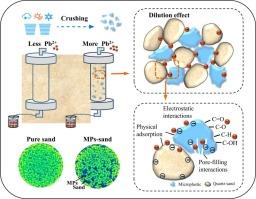
Microplastics (MPs) could interact with heavy metals via multiple mechanisms in subsurface environment. Understanding the effect of MPs on the fate of heavy metals is essential for the prediction of their ecological impacts. In this study, laboratory columns were conducted to investigate the effects of pristine/aged secondary polystyrene fragments of different sizes and dosages on the transport of Pb2+ in saturated porous media. MPs generally promoted Pb2+ mobility, and the promotion degree was greater with increasing MP size and dosage. The enhancement of Pb2+ mobility by naturally aged MPs was slightly weaker than that by pristine MPs. The sensitivity of Pb2+ mobility to MPs was correlated with the flow velocity, the promotion impact was more significant at larger flow velocity. The enhanced MPs mobility of Pb2+ was mainly attributed to the decrease Pb2+sorption capacity of the media resulting from dilution effect, as well as alterations in pore structure and porosity caused by the high heterogeneity of MP fragments. Findings of this study indicated that the fate and transport of heavy metals are strongly influenced by the co-contamination with MPs. Evaluation of their cotransport in the subsurface is essential for accurately predicting their environmental risks.
期刊介绍:
The Journal of Hazardous Materials serves as a global platform for promoting cutting-edge research in the field of Environmental Science and Engineering. Our publication features a wide range of articles, including full-length research papers, review articles, and perspectives, with the aim of enhancing our understanding of the dangers and risks associated with various materials concerning public health and the environment. It is important to note that the term "environmental contaminants" refers specifically to substances that pose hazardous effects through contamination, while excluding those that do not have such impacts on the environment or human health. Moreover, we emphasize the distinction between wastes and hazardous materials in order to provide further clarity on the scope of the journal. We have a keen interest in exploring specific compounds and microbial agents that have adverse effects on the environment.



 京公网安备 11010802042870号
京ICP备2023020795号-1
京公网安备 11010802042870号
京ICP备2023020795号-1

 分享
分享
 求助内容:
求助内容: 应助结果提醒方式:
 扫码关注我们
