Xinxu Niu , Jian Liu , Shaohua Chen , Bin Jiang , Jianzhi Huang
{"title":"Molecular insights into dissolved organic matter post electrokinetic-persulfate treatment: Heteroatom induced resistance","authors":"Xinxu Niu , Jian Liu , Shaohua Chen , Bin Jiang , Jianzhi Huang","doi":"10.1016/j.jhazmat.2025.138374","DOIUrl":null,"url":null,"abstract":"<div><div>The application of electrokinetic-enhanced <em>in situ</em> chemical oxidation remediation of contaminated sediments has attracted increasing attention. However, the molecular changes in dissolved organic matter (DOM) during these remediation processes remain unexplored. To address the gap, we explored the molecular transformation of DOM subjected to electrokinetic (EK)-persulfate treatment. The findings revealed that DOM transitioned from a reduced to an oxidized state, marked by the removal of low O/C molecules and the formation of high O/C molecules. Heteroatom-containing molecules accumulated and constituted the dominant fraction among the resistant molecules post-treatment. N-containing and Cl-containing molecules displayed elevated N/C and Cl/C ratios during the treatment, decomposing into smaller and N-rich or Cl-rich molecules, while S-containing molecules exhibited a decrease in S/O ratios. Oxygen addition reaction and dealkyl group reaction were identified as the two most common transformation pathways, contributing to the increased oxidation and resistance of DOM molecules. This study deepens our understanding of DOM transformation using EK-persulfate treatment and aids in assessing the potential risks associated with resistant molecules in its practical application.</div></div>","PeriodicalId":361,"journal":{"name":"Journal of Hazardous Materials","volume":"493 ","pages":"Article 138374"},"PeriodicalIF":11.3000,"publicationDate":"2025-08-05","publicationTypes":"Journal Article","fieldsOfStudy":null,"isOpenAccess":false,"openAccessPdf":"","citationCount":"0","resultStr":null,"platform":"Semanticscholar","paperid":null,"PeriodicalName":"Journal of Hazardous Materials","FirstCategoryId":"93","ListUrlMain":"https://www.sciencedirect.com/science/article/pii/S0304389425012890","RegionNum":1,"RegionCategory":"环境科学与生态学","ArticlePicture":[],"TitleCN":null,"AbstractTextCN":null,"PMCID":null,"EPubDate":"2025/4/22 0:00:00","PubModel":"Epub","JCR":"Q1","JCRName":"ENGINEERING, ENVIRONMENTAL","Score":null,"Total":0}
引用次数: 0
Abstract
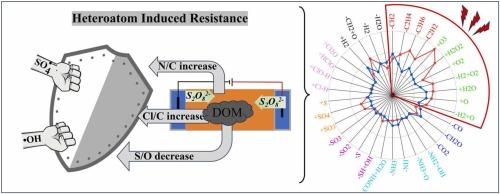
The application of electrokinetic-enhanced in situ chemical oxidation remediation of contaminated sediments has attracted increasing attention. However, the molecular changes in dissolved organic matter (DOM) during these remediation processes remain unexplored. To address the gap, we explored the molecular transformation of DOM subjected to electrokinetic (EK)-persulfate treatment. The findings revealed that DOM transitioned from a reduced to an oxidized state, marked by the removal of low O/C molecules and the formation of high O/C molecules. Heteroatom-containing molecules accumulated and constituted the dominant fraction among the resistant molecules post-treatment. N-containing and Cl-containing molecules displayed elevated N/C and Cl/C ratios during the treatment, decomposing into smaller and N-rich or Cl-rich molecules, while S-containing molecules exhibited a decrease in S/O ratios. Oxygen addition reaction and dealkyl group reaction were identified as the two most common transformation pathways, contributing to the increased oxidation and resistance of DOM molecules. This study deepens our understanding of DOM transformation using EK-persulfate treatment and aids in assessing the potential risks associated with resistant molecules in its practical application.
期刊介绍:
The Journal of Hazardous Materials serves as a global platform for promoting cutting-edge research in the field of Environmental Science and Engineering. Our publication features a wide range of articles, including full-length research papers, review articles, and perspectives, with the aim of enhancing our understanding of the dangers and risks associated with various materials concerning public health and the environment. It is important to note that the term "environmental contaminants" refers specifically to substances that pose hazardous effects through contamination, while excluding those that do not have such impacts on the environment or human health. Moreover, we emphasize the distinction between wastes and hazardous materials in order to provide further clarity on the scope of the journal. We have a keen interest in exploring specific compounds and microbial agents that have adverse effects on the environment.



 京公网安备 11010802042870号
京ICP备2023020795号-1
京公网安备 11010802042870号
京ICP备2023020795号-1

 分享
分享
 求助内容:
求助内容: 应助结果提醒方式:
 扫码关注我们
