Facile synthesis of fluorine-functionalized long-chain metal–organic frameworks for highly efficient enrichment and sensitive detection of bisphenols in water samples
Ning Zhang, Yingying Li, Mengyuan Liu, Miaojia Hu, Huifeng Wang, Wende Ma, Minghua Lu
{"title":"Facile synthesis of fluorine-functionalized long-chain metal–organic frameworks for highly efficient enrichment and sensitive detection of bisphenols in water samples","authors":"Ning Zhang, Yingying Li, Mengyuan Liu, Miaojia Hu, Huifeng Wang, Wende Ma, Minghua Lu","doi":"10.1016/j.jhazmat.2025.138382","DOIUrl":null,"url":null,"abstract":"<div><div>The exceptional stability of long-chain metal–organic framework materials (MOFs) is crucial for preserving their adsorption capabilities and practical applications. Herein, a well-defined material (50.0 %4F-BDC@UiO-67) with enhanced stability and pollutant adsorption was successfully synthesized through a straightforward one-step method, utilizing Zr<sup>4+</sup> as the metal ion and employing 4,4′-biphenyldicarboxylic acid, which contains two benzene rings, alongside tetrafluoroterephthalic acid (4F-BDC), which contains one benzene ring, as dual ligands. The 50.0 %4F-BDC@UiO-67 material was utilized for the enrichment of harmful bisphenol pollutants (BPs) from the environment. Experimental results demonstrated that the synthesized 50.0 %4F-BDC@UiO-67 sorbent exhibited significantly improved adsorptive capacity, with its enrichment performance for BPs being 1.5–6.3 times greater than that of pristine UiO-67. The interactions between the material and BPs were explored using density functional theory calculations and experimental characterization. Findings indicated that the incorporation of fluorine enhanced the π–π and coordination interactions between 50.0 %4F-BDC@UiO-67 and BPs, while also introducing additional hydrogen bonding interactions. This outcome offers insights for the future design of materials with superior enrichment capabilities. Leveraging multiple synergistic forces, and in conjunction with high-performance liquid chromatography-diode array detection, the developed method exhibited a broad linear range (0.1–200 ng mL<sup>−1</sup>), excellent correlation coefficients (0.9992–0.9996), and low detection limits (0.1–0.5 ng mL<sup>−1</sup>) for BPs. Satisfactory recoveries were achieved for actual water samples (82.9–105.9 %). This work presents a strategy for enhancing the stability and adsorption performance of long-chain MOFs.</div></div>","PeriodicalId":361,"journal":{"name":"Journal of Hazardous Materials","volume":"493 ","pages":"Article 138382"},"PeriodicalIF":11.3000,"publicationDate":"2025-08-05","publicationTypes":"Journal Article","fieldsOfStudy":null,"isOpenAccess":false,"openAccessPdf":"","citationCount":"0","resultStr":null,"platform":"Semanticscholar","paperid":null,"PeriodicalName":"Journal of Hazardous Materials","FirstCategoryId":"93","ListUrlMain":"https://www.sciencedirect.com/science/article/pii/S030438942501297X","RegionNum":1,"RegionCategory":"环境科学与生态学","ArticlePicture":[],"TitleCN":null,"AbstractTextCN":null,"PMCID":null,"EPubDate":"2025/4/22 0:00:00","PubModel":"Epub","JCR":"Q1","JCRName":"ENGINEERING, ENVIRONMENTAL","Score":null,"Total":0}
引用次数: 0
Abstract
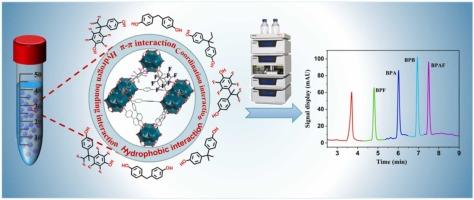
The exceptional stability of long-chain metal–organic framework materials (MOFs) is crucial for preserving their adsorption capabilities and practical applications. Herein, a well-defined material (50.0 %4F-BDC@UiO-67) with enhanced stability and pollutant adsorption was successfully synthesized through a straightforward one-step method, utilizing Zr4+ as the metal ion and employing 4,4′-biphenyldicarboxylic acid, which contains two benzene rings, alongside tetrafluoroterephthalic acid (4F-BDC), which contains one benzene ring, as dual ligands. The 50.0 %4F-BDC@UiO-67 material was utilized for the enrichment of harmful bisphenol pollutants (BPs) from the environment. Experimental results demonstrated that the synthesized 50.0 %4F-BDC@UiO-67 sorbent exhibited significantly improved adsorptive capacity, with its enrichment performance for BPs being 1.5–6.3 times greater than that of pristine UiO-67. The interactions between the material and BPs were explored using density functional theory calculations and experimental characterization. Findings indicated that the incorporation of fluorine enhanced the π–π and coordination interactions between 50.0 %4F-BDC@UiO-67 and BPs, while also introducing additional hydrogen bonding interactions. This outcome offers insights for the future design of materials with superior enrichment capabilities. Leveraging multiple synergistic forces, and in conjunction with high-performance liquid chromatography-diode array detection, the developed method exhibited a broad linear range (0.1–200 ng mL−1), excellent correlation coefficients (0.9992–0.9996), and low detection limits (0.1–0.5 ng mL−1) for BPs. Satisfactory recoveries were achieved for actual water samples (82.9–105.9 %). This work presents a strategy for enhancing the stability and adsorption performance of long-chain MOFs.
期刊介绍:
The Journal of Hazardous Materials serves as a global platform for promoting cutting-edge research in the field of Environmental Science and Engineering. Our publication features a wide range of articles, including full-length research papers, review articles, and perspectives, with the aim of enhancing our understanding of the dangers and risks associated with various materials concerning public health and the environment. It is important to note that the term "environmental contaminants" refers specifically to substances that pose hazardous effects through contamination, while excluding those that do not have such impacts on the environment or human health. Moreover, we emphasize the distinction between wastes and hazardous materials in order to provide further clarity on the scope of the journal. We have a keen interest in exploring specific compounds and microbial agents that have adverse effects on the environment.




 京公网安备 11010802042870号
京ICP备2023020795号-1
京公网安备 11010802042870号
京ICP备2023020795号-1

 分享
分享
 求助内容:
求助内容: 应助结果提醒方式:
 扫码关注我们
