Lei Zhou , Fengbin Ji , Zhiling Wang , Junkang Fan , Heng Chen , Manyun Xu , Zhe Liu , Liming Yang , Xubiao Luo
{"title":"Emission characteristics of VOCs from the typical spent lithium-ion battery recycling industry","authors":"Lei Zhou , Fengbin Ji , Zhiling Wang , Junkang Fan , Heng Chen , Manyun Xu , Zhe Liu , Liming Yang , Xubiao Luo","doi":"10.1016/j.jhazmat.2025.138381","DOIUrl":null,"url":null,"abstract":"<div><div>In recent years, with the rapid rise in electric vehicles and renewable energy storage solutions, decommissioning spent lithium-ion batteries (LIBs) has become an increasingly pressing issue. The volatile organic compounds (VOCs) generated during the recycling of LIBs caused environmental pollution and health hazards. This work investigated the emission characteristics of VOCs from two typical spent LIB recycling plants. The findings indicated that the total VOC emission concentrations from plants A and B were 54.24 mg/m³ and 322.51 mg/m³ , respectively. The predominant VOCs identified across different processing stages were ethyl acetate in the crushing stage, 1,2-dichloroethane and epichlorohydrin in the pyrolysis stage, chloromethane and 1,2-dichloroethane in the alkaline leaching stage, and acetaldehyde and cyclohexane in the acid leaching stage. Halogenated hydrocarbons and oxygenated VOCs were the dominant categories of gaseous pollutants. These compounds represent key species within the VOCs profile emitted while recycling spent LIBs. Moreover, the study assessed the potential risk of ozone formation associated with VOC emissions during recycling. The results highlighted that oxygenated VOCs and alkanes were the main contributors to ozone formation in this industry, accounting for 47 %-95 % of total ozone-forming potential. Key compounds contributing to ozone formation included acetaldehyde, n-hexane, propanal, p-xylene, ethylene, and cyclohexane. This work systematically examined the characteristics of VOC emissions throughout the recycling process of spent LIBs, providing essential data and guidance for more sustainable recycling and utilization practices.</div></div>","PeriodicalId":361,"journal":{"name":"Journal of Hazardous Materials","volume":"493 ","pages":"Article 138381"},"PeriodicalIF":11.3000,"publicationDate":"2025-08-05","publicationTypes":"Journal Article","fieldsOfStudy":null,"isOpenAccess":false,"openAccessPdf":"","citationCount":"0","resultStr":null,"platform":"Semanticscholar","paperid":null,"PeriodicalName":"Journal of Hazardous Materials","FirstCategoryId":"93","ListUrlMain":"https://www.sciencedirect.com/science/article/pii/S0304389425012968","RegionNum":1,"RegionCategory":"环境科学与生态学","ArticlePicture":[],"TitleCN":null,"AbstractTextCN":null,"PMCID":null,"EPubDate":"2025/4/22 0:00:00","PubModel":"Epub","JCR":"Q1","JCRName":"ENGINEERING, ENVIRONMENTAL","Score":null,"Total":0}
引用次数: 0
Abstract
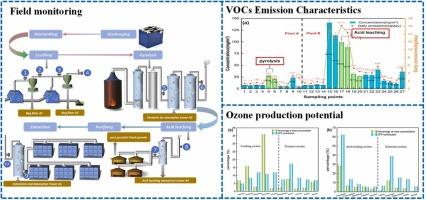
In recent years, with the rapid rise in electric vehicles and renewable energy storage solutions, decommissioning spent lithium-ion batteries (LIBs) has become an increasingly pressing issue. The volatile organic compounds (VOCs) generated during the recycling of LIBs caused environmental pollution and health hazards. This work investigated the emission characteristics of VOCs from two typical spent LIB recycling plants. The findings indicated that the total VOC emission concentrations from plants A and B were 54.24 mg/m³ and 322.51 mg/m³ , respectively. The predominant VOCs identified across different processing stages were ethyl acetate in the crushing stage, 1,2-dichloroethane and epichlorohydrin in the pyrolysis stage, chloromethane and 1,2-dichloroethane in the alkaline leaching stage, and acetaldehyde and cyclohexane in the acid leaching stage. Halogenated hydrocarbons and oxygenated VOCs were the dominant categories of gaseous pollutants. These compounds represent key species within the VOCs profile emitted while recycling spent LIBs. Moreover, the study assessed the potential risk of ozone formation associated with VOC emissions during recycling. The results highlighted that oxygenated VOCs and alkanes were the main contributors to ozone formation in this industry, accounting for 47 %-95 % of total ozone-forming potential. Key compounds contributing to ozone formation included acetaldehyde, n-hexane, propanal, p-xylene, ethylene, and cyclohexane. This work systematically examined the characteristics of VOC emissions throughout the recycling process of spent LIBs, providing essential data and guidance for more sustainable recycling and utilization practices.
期刊介绍:
The Journal of Hazardous Materials serves as a global platform for promoting cutting-edge research in the field of Environmental Science and Engineering. Our publication features a wide range of articles, including full-length research papers, review articles, and perspectives, with the aim of enhancing our understanding of the dangers and risks associated with various materials concerning public health and the environment. It is important to note that the term "environmental contaminants" refers specifically to substances that pose hazardous effects through contamination, while excluding those that do not have such impacts on the environment or human health. Moreover, we emphasize the distinction between wastes and hazardous materials in order to provide further clarity on the scope of the journal. We have a keen interest in exploring specific compounds and microbial agents that have adverse effects on the environment.



 京公网安备 11010802042870号
京ICP备2023020795号-1
京公网安备 11010802042870号
京ICP备2023020795号-1

 分享
分享
 求助内容:
求助内容: 应助结果提醒方式:
 扫码关注我们
