Lukas Schulz, Kien Lam Ung, Lorena Zuzic, Sarah Koutnik-Abele, Birgit Schiøtt, David L. Stokes, Bjørn Panyella Pedersen, Ulrich Z. Hammes
{"title":"Transport of phenoxyacetic acid herbicides by PIN-FORMED auxin transporters","authors":"Lukas Schulz, Kien Lam Ung, Lorena Zuzic, Sarah Koutnik-Abele, Birgit Schiøtt, David L. Stokes, Bjørn Panyella Pedersen, Ulrich Z. Hammes","doi":"10.1038/s41477-025-01984-0","DOIUrl":null,"url":null,"abstract":"Auxins are a group of phytohormones that control plant growth and development. Their crucial role in plant physiology has inspired development of potent synthetic auxins that can be used as herbicides. Phenoxyacetic acid derivatives are a widely used group of auxin herbicides in agriculture and research. Despite their prevalence, the identity of the transporters required for distribution of these herbicides in plants is both poorly understood and the subject of controversial debate. Here we show that PIN-FORMED auxin transporters transport a range of phenoxyacetic acid herbicides across the membrane. We go on to characterize the molecular determinants of substrate specificity using a variety of different substrates as well as protein mutagenesis to probe the binding site. Finally, we present cryogenic electron microscopy structures of Arabidopsis thaliana PIN8 bound to either 2,4-dichlorophenoxyacetic acid or 4-chlorophenoxyacetic acid. These structures represent five key states from the transport cycle, allowing us to describe conformational changes associated with the transport cycle. Overall, our results reveal that phenoxyacetic acid herbicides use the same export machinery as endogenous auxins and exemplify how transporter binding sites undergo transformations that dictate substrate specificity. These results provide a foundation for future development of novel synthetic auxins and for precision breeding of herbicide-resistant crop plants. PIN transporters are key players in distributing phenoxyacetic acid herbicides. Mutagenesis and cryo-EM structures elucidate substrate specificity and transport mechanisms, paving the way for improved synthetic auxin development and herbicide-resistant crops.","PeriodicalId":18904,"journal":{"name":"Nature Plants","volume":"11 5","pages":"1049-1059"},"PeriodicalIF":13.6000,"publicationDate":"2025-04-22","publicationTypes":"Journal Article","fieldsOfStudy":null,"isOpenAccess":false,"openAccessPdf":"https://www.nature.comhttps://www.nature.com/articles/s41477-025-01984-0.pdf","citationCount":"0","resultStr":null,"platform":"Semanticscholar","paperid":null,"PeriodicalName":"Nature Plants","FirstCategoryId":"99","ListUrlMain":"https://www.nature.com/articles/s41477-025-01984-0","RegionNum":1,"RegionCategory":"生物学","ArticlePicture":[],"TitleCN":null,"AbstractTextCN":null,"PMCID":null,"EPubDate":"","PubModel":"","JCR":"Q1","JCRName":"PLANT SCIENCES","Score":null,"Total":0}
引用次数: 0
Abstract
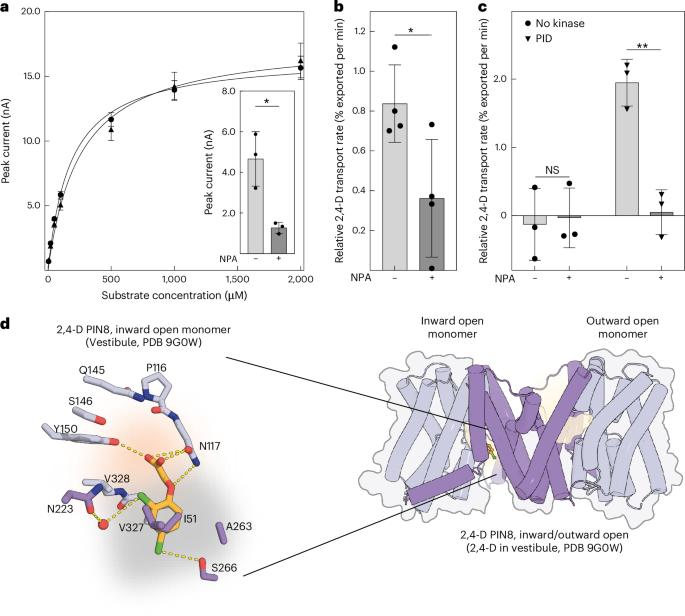
Auxins are a group of phytohormones that control plant growth and development. Their crucial role in plant physiology has inspired development of potent synthetic auxins that can be used as herbicides. Phenoxyacetic acid derivatives are a widely used group of auxin herbicides in agriculture and research. Despite their prevalence, the identity of the transporters required for distribution of these herbicides in plants is both poorly understood and the subject of controversial debate. Here we show that PIN-FORMED auxin transporters transport a range of phenoxyacetic acid herbicides across the membrane. We go on to characterize the molecular determinants of substrate specificity using a variety of different substrates as well as protein mutagenesis to probe the binding site. Finally, we present cryogenic electron microscopy structures of Arabidopsis thaliana PIN8 bound to either 2,4-dichlorophenoxyacetic acid or 4-chlorophenoxyacetic acid. These structures represent five key states from the transport cycle, allowing us to describe conformational changes associated with the transport cycle. Overall, our results reveal that phenoxyacetic acid herbicides use the same export machinery as endogenous auxins and exemplify how transporter binding sites undergo transformations that dictate substrate specificity. These results provide a foundation for future development of novel synthetic auxins and for precision breeding of herbicide-resistant crop plants. PIN transporters are key players in distributing phenoxyacetic acid herbicides. Mutagenesis and cryo-EM structures elucidate substrate specificity and transport mechanisms, paving the way for improved synthetic auxin development and herbicide-resistant crops.
期刊介绍:
Nature Plants is an online-only, monthly journal publishing the best research on plants — from their evolution, development, metabolism and environmental interactions to their societal significance.




 京公网安备 11010802042870号
京ICP备2023020795号-1
京公网安备 11010802042870号
京ICP备2023020795号-1

 分享
分享
 求助内容:
求助内容: 应助结果提醒方式:
 扫码关注我们
