Tian Xie, Rikuto Fukumori, Jiahui Li, Andrei Faraon
{"title":"Scalable microwave-to-optical transducers at the single-photon level with spins","authors":"Tian Xie, Rikuto Fukumori, Jiahui Li, Andrei Faraon","doi":"10.1038/s41567-025-02884-y","DOIUrl":null,"url":null,"abstract":"Microwave-to-optical transduction of single photons will play an essential role in interconnecting future superconducting quantum devices. Various transducers have been developed that couple microwave and optical modes by utilizing nonlinear phenomena such as the Pockels effect and a combination of electromechanical, piezoelectric and optomechanical couplings. However, the limited strength of these nonlinearities necessitates the use of high-quality-factor resonators that can require sophisticated nanofabrication methods. Rare-earth-ion-doped crystals have high-quality atomic resonances that result in effective second-order nonlinearities that are many orders of magnitude stronger than those in conventional materials. Here we use ytterbium-171 ions doped in an YVO4 crystal to implement an on-chip microwave-to-optical transducer. Without an engineered optical cavity, we achieve per-cent-level efficiencies with an added noise referred to the input as low as 1.24(9) photons. We demonstrate the interference of photons originating from two simultaneously operated transducers, enabled by the inherently matching frequencies of the atomic transitions. Our results establish rare-earth-ion-based devices as a competitive platform for transduction and pave the way towards the remote transducer-assisted entanglement of superconducting quantum machines. Converting photons from one frequency range to another uses nonlinear effects that are often weak. Strong nonlinearities in rare-earth-ion-doped crystals have now been used to perform microwave-to-optical transduction at the single-photon level.","PeriodicalId":19100,"journal":{"name":"Nature Physics","volume":"21 6","pages":"931-937"},"PeriodicalIF":18.4000,"publicationDate":"2025-04-22","publicationTypes":"Journal Article","fieldsOfStudy":null,"isOpenAccess":false,"openAccessPdf":"","citationCount":"0","resultStr":null,"platform":"Semanticscholar","paperid":null,"PeriodicalName":"Nature Physics","FirstCategoryId":"101","ListUrlMain":"https://www.nature.com/articles/s41567-025-02884-y","RegionNum":1,"RegionCategory":"物理与天体物理","ArticlePicture":[],"TitleCN":null,"AbstractTextCN":null,"PMCID":null,"EPubDate":"","PubModel":"","JCR":"Q1","JCRName":"PHYSICS, MULTIDISCIPLINARY","Score":null,"Total":0}
引用次数: 0
Abstract
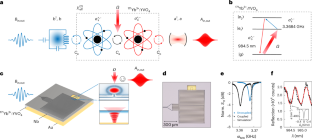
Microwave-to-optical transduction of single photons will play an essential role in interconnecting future superconducting quantum devices. Various transducers have been developed that couple microwave and optical modes by utilizing nonlinear phenomena such as the Pockels effect and a combination of electromechanical, piezoelectric and optomechanical couplings. However, the limited strength of these nonlinearities necessitates the use of high-quality-factor resonators that can require sophisticated nanofabrication methods. Rare-earth-ion-doped crystals have high-quality atomic resonances that result in effective second-order nonlinearities that are many orders of magnitude stronger than those in conventional materials. Here we use ytterbium-171 ions doped in an YVO4 crystal to implement an on-chip microwave-to-optical transducer. Without an engineered optical cavity, we achieve per-cent-level efficiencies with an added noise referred to the input as low as 1.24(9) photons. We demonstrate the interference of photons originating from two simultaneously operated transducers, enabled by the inherently matching frequencies of the atomic transitions. Our results establish rare-earth-ion-based devices as a competitive platform for transduction and pave the way towards the remote transducer-assisted entanglement of superconducting quantum machines. Converting photons from one frequency range to another uses nonlinear effects that are often weak. Strong nonlinearities in rare-earth-ion-doped crystals have now been used to perform microwave-to-optical transduction at the single-photon level.
期刊介绍:
Nature Physics is dedicated to publishing top-tier original research in physics with a fair and rigorous review process. It provides high visibility and access to a broad readership, maintaining high standards in copy editing and production, ensuring rapid publication, and maintaining independence from academic societies and other vested interests.
The journal presents two main research paper formats: Letters and Articles. Alongside primary research, Nature Physics serves as a central source for valuable information within the physics community through Review Articles, News & Views, Research Highlights covering crucial developments across the physics literature, Commentaries, Book Reviews, and Correspondence.





 京公网安备 11010802042870号
京ICP备2023020795号-1
京公网安备 11010802042870号
京ICP备2023020795号-1

 分享
分享
 求助内容:
求助内容: 应助结果提醒方式:
 扫码关注我们
