Pengxin Chai, Jun Yang, Indigo C. Geohring, Steven M. Markus, Yue Wang, Kai Zhang
{"title":"The mechanochemical cycle of reactive full-length human dynein 1","authors":"Pengxin Chai, Jun Yang, Indigo C. Geohring, Steven M. Markus, Yue Wang, Kai Zhang","doi":"10.1038/s41594-025-01543-3","DOIUrl":null,"url":null,"abstract":"Dynein-driven cargo transport has a pivotal role in diverse cellular activities, central to which is dynein’s mechanochemical cycle. Here, we performed a systematic cryo-electron microscopic investigation of the conformational landscape of full-length human dynein 1 in reaction, in various nucleotide conditions, on and off microtubules. Our approach reveals over 40 high-resolution structures, categorized into eight states, providing a dynamic and comprehensive view of dynein throughout its mechanochemical cycle. The described intermediate states reveal mechanistic insights into dynein function, including a ‘backdoor’ phosphate release model that coordinates linker straightening, how microtubule binding enhances adenosine triphosphatase activity through a two-way communication mechanism and the crosstalk mechanism between AAA1 and the regulatory AAA3 site. Our findings also lead to a revised model for the force-generating powerstroke and reveal means by which dynein exhibits unidirectional stepping. These results improve our understanding of dynein and provide a more complete model of its mechanochemical cycle. Chai et al. use cryo-electron microscopy to systematically interrogate the conformational landscape of motor protein dynein. The reported structures reveal intermediate states in the mechanochemical cycle of dynein, the role of adenosine triphosphate and the communication mechanism with microtubules.","PeriodicalId":49141,"journal":{"name":"Nature Structural & Molecular Biology","volume":"32 8","pages":"1383-1395"},"PeriodicalIF":10.1000,"publicationDate":"2025-04-22","publicationTypes":"Journal Article","fieldsOfStudy":null,"isOpenAccess":false,"openAccessPdf":"","citationCount":"0","resultStr":null,"platform":"Semanticscholar","paperid":null,"PeriodicalName":"Nature Structural & Molecular Biology","FirstCategoryId":"99","ListUrlMain":"https://www.nature.com/articles/s41594-025-01543-3","RegionNum":1,"RegionCategory":"生物学","ArticlePicture":[],"TitleCN":null,"AbstractTextCN":null,"PMCID":null,"EPubDate":"","PubModel":"","JCR":"Q1","JCRName":"BIOCHEMISTRY & MOLECULAR BIOLOGY","Score":null,"Total":0}
引用次数: 0
Abstract
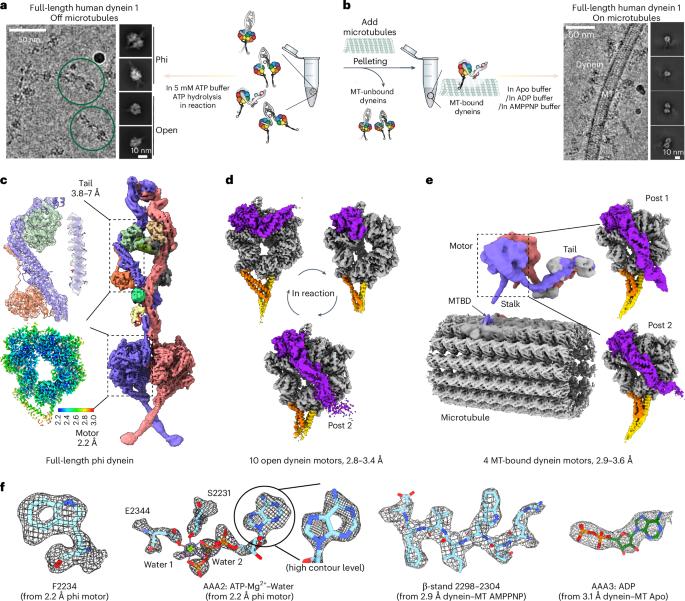
Dynein-driven cargo transport has a pivotal role in diverse cellular activities, central to which is dynein’s mechanochemical cycle. Here, we performed a systematic cryo-electron microscopic investigation of the conformational landscape of full-length human dynein 1 in reaction, in various nucleotide conditions, on and off microtubules. Our approach reveals over 40 high-resolution structures, categorized into eight states, providing a dynamic and comprehensive view of dynein throughout its mechanochemical cycle. The described intermediate states reveal mechanistic insights into dynein function, including a ‘backdoor’ phosphate release model that coordinates linker straightening, how microtubule binding enhances adenosine triphosphatase activity through a two-way communication mechanism and the crosstalk mechanism between AAA1 and the regulatory AAA3 site. Our findings also lead to a revised model for the force-generating powerstroke and reveal means by which dynein exhibits unidirectional stepping. These results improve our understanding of dynein and provide a more complete model of its mechanochemical cycle. Chai et al. use cryo-electron microscopy to systematically interrogate the conformational landscape of motor protein dynein. The reported structures reveal intermediate states in the mechanochemical cycle of dynein, the role of adenosine triphosphate and the communication mechanism with microtubules.
期刊介绍:
Nature Structural & Molecular Biology is a comprehensive platform that combines structural and molecular research. Our journal focuses on exploring the functional and mechanistic aspects of biological processes, emphasizing how molecular components collaborate to achieve a particular function. While structural data can shed light on these insights, our publication does not require them as a prerequisite.




 京公网安备 11010802042870号
京ICP备2023020795号-1
京公网安备 11010802042870号
京ICP备2023020795号-1

 分享
分享
 求助内容:
求助内容: 应助结果提醒方式:
 扫码关注我们
