{"title":"Metal-based activation of periodate as an advanced oxidation process for water decontamination: A critical review","authors":"Yun Shen , Jinjing Huang , Junlian Qiao , Jiabin Chen , Egshiglen Batjargal , Baigal-Amar Tuulaikhuu , Yajie Qian , Xuefei Zhou , Yalei Zhang","doi":"10.1016/j.cej.2025.162949","DOIUrl":null,"url":null,"abstract":"<div><div>Periodate (PI, IO<sub>4</sub><sup>−</sup>)-based advanced oxidation processes (AOPs) have recently received increasing attention in water treatment. The activation of PI to generate different reactive species is crucial for decontaminants in PI-AOPs. This review provides a comprehensive experimental data and analysis information in metal-activated PI processes for the contaminant degradation. Various categories of metals for PI activation, including single metal and bimetals with their activation mechanisms were discussed. Among them, manganese (Mn) and iron (Fe) were the two dominant activators in PI activation. Noble metals including ruthenium (Ru), osmium (Os) and metal-complexes also showed promising prospects in PI activation, which was first noticed in this review. The importance of external and internal metal complexes in metal-activated PI activation was perceived for the first time, especially distinct production pathways of reactive species (i.e high-valent manganese-oxygen species and generated reactive complexes) produced by different metal complex sources. The identification of various reactive species was defined in details. Besides, the potential risks and strategies for iodine-containing disinfection by-products (I-DBPs) reduction were summarized for the first time. Ultimately, the challenges, knowledge gaps and future development are proposed to facilitate the metal-activated PI technology to take a step further for practical application.</div></div>","PeriodicalId":270,"journal":{"name":"Chemical Engineering Journal","volume":"513 ","pages":"Article 162949"},"PeriodicalIF":13.2000,"publicationDate":"2025-06-01","publicationTypes":"Journal Article","fieldsOfStudy":null,"isOpenAccess":false,"openAccessPdf":"","citationCount":"0","resultStr":null,"platform":"Semanticscholar","paperid":null,"PeriodicalName":"Chemical Engineering Journal","FirstCategoryId":"5","ListUrlMain":"https://www.sciencedirect.com/science/article/pii/S1385894725037830","RegionNum":1,"RegionCategory":"工程技术","ArticlePicture":[],"TitleCN":null,"AbstractTextCN":null,"PMCID":null,"EPubDate":"2025/4/22 0:00:00","PubModel":"Epub","JCR":"Q1","JCRName":"ENGINEERING, CHEMICAL","Score":null,"Total":0}
引用次数: 0
Abstract
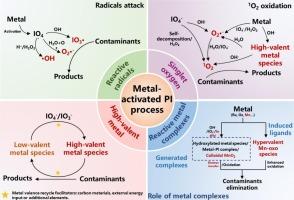
Periodate (PI, IO4−)-based advanced oxidation processes (AOPs) have recently received increasing attention in water treatment. The activation of PI to generate different reactive species is crucial for decontaminants in PI-AOPs. This review provides a comprehensive experimental data and analysis information in metal-activated PI processes for the contaminant degradation. Various categories of metals for PI activation, including single metal and bimetals with their activation mechanisms were discussed. Among them, manganese (Mn) and iron (Fe) were the two dominant activators in PI activation. Noble metals including ruthenium (Ru), osmium (Os) and metal-complexes also showed promising prospects in PI activation, which was first noticed in this review. The importance of external and internal metal complexes in metal-activated PI activation was perceived for the first time, especially distinct production pathways of reactive species (i.e high-valent manganese-oxygen species and generated reactive complexes) produced by different metal complex sources. The identification of various reactive species was defined in details. Besides, the potential risks and strategies for iodine-containing disinfection by-products (I-DBPs) reduction were summarized for the first time. Ultimately, the challenges, knowledge gaps and future development are proposed to facilitate the metal-activated PI technology to take a step further for practical application.
期刊介绍:
The Chemical Engineering Journal is an international research journal that invites contributions of original and novel fundamental research. It aims to provide an international platform for presenting original fundamental research, interpretative reviews, and discussions on new developments in chemical engineering. The journal welcomes papers that describe novel theory and its practical application, as well as those that demonstrate the transfer of techniques from other disciplines. It also welcomes reports on carefully conducted experimental work that is soundly interpreted. The main focus of the journal is on original and rigorous research results that have broad significance. The Catalysis section within the Chemical Engineering Journal focuses specifically on Experimental and Theoretical studies in the fields of heterogeneous catalysis, molecular catalysis, and biocatalysis. These studies have industrial impact on various sectors such as chemicals, energy, materials, foods, healthcare, and environmental protection.




 京公网安备 11010802042870号
京ICP备2023020795号-1
京公网安备 11010802042870号
京ICP备2023020795号-1

 分享
分享
 求助内容:
求助内容: 应助结果提醒方式:
 扫码关注我们
