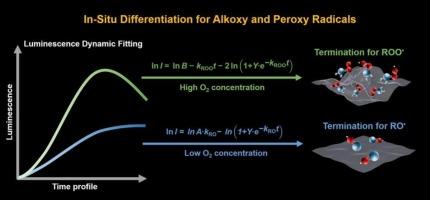
{"title":"Unraveling thermo-oxidation degradation pathways of polymers by in-situ differentiating the alkyl-related reactive oxygen radicals","authors":"Yue Hou, Jiao Li, Guofeng Tian, Rui Tian, Chao Lu","doi":"10.1016/j.cej.2025.162951","DOIUrl":null,"url":null,"abstract":"Alkoxy radicals (RO•) and peroxy radicals (ROO•) are generated during thermo-oxidation of polymers under oxygen environment, leading to RO•-dominated or ROO•-dominated reaction pathways with severely deteriorated polymer chains or terminated reaction. However, it has been a long-standing challenge to in-situ distinguish RO• and ROO• radicals due to their short-lived lifetime. In principle, chemiluminescence (CL) deserves to become an efficient strategy for in-situ monitoring for various radicals. However, it fails to differentiate RO• and ROO• radicals due to their fully overlapping emission wavelengths. In this contribution, we have proposed a CL dynamic fitting strategy to distinguish RO• and ROO• radicals of in-situ production during thermal oxidation under the different oxygen-containing environment. Based on two equations, <span><span style=\"\"><math><mrow is=\"true\"><mi is=\"true\">ln</mi><mi is=\"true\">I</mi><mspace is=\"true\" width=\"3.33333pt\"></mspace><mo is=\"true\" linebreak=\"goodbreak\" linebreakstyle=\"after\">=</mo><mspace is=\"true\" width=\"3.33333pt\"></mspace><mi is=\"true\">ln</mi><mi is=\"true\">A</mi><mo is=\"true\">·</mo><msub is=\"true\"><mi is=\"true\">k</mi><mrow is=\"true\"><mi is=\"true\" mathvariant=\"italic\">RO</mi></mrow></msub><mspace is=\"true\" width=\"3.33333pt\"></mspace><mo is=\"true\" linebreak=\"badbreak\" linebreakstyle=\"after\">-</mo><mspace is=\"true\" width=\"3.33333pt\"></mspace><mi is=\"true\">ln</mi><mfenced close=\")\" is=\"true\" open=\"(\"><mrow is=\"true\"><mrow is=\"true\"><mn is=\"true\">1</mn><mspace is=\"true\" width=\"3.33333pt\"></mspace><mo is=\"true\">+</mo><mspace is=\"true\" width=\"3.33333pt\"></mspace><mi is=\"true\">Y</mi><mo is=\"true\">·</mo><msup is=\"true\"><mi is=\"true\">e</mi><mrow is=\"true\"><mo is=\"true\">-</mo><msub is=\"true\"><mi is=\"true\">k</mi><mrow is=\"true\"><mi is=\"true\" mathvariant=\"italic\">RO</mi></mrow></msub><mi is=\"true\">t</mi></mrow></msup></mrow></mrow></mfenced><mo is=\"true\">,</mo><mspace is=\"true\" width=\"3.33333pt\"></mspace><mi is=\"true\">a</mi><mi is=\"true\">n</mi><mi is=\"true\">d</mi><mspace is=\"true\" width=\"3.33333pt\"></mspace><mi is=\"true\">ln</mi><mi is=\"true\">I</mi><mspace is=\"true\" width=\"3.33333pt\"></mspace><mo is=\"true\" linebreak=\"goodbreak\" linebreakstyle=\"after\">=</mo><mspace is=\"true\" width=\"3.33333pt\"></mspace><mi is=\"true\">ln</mi><mi is=\"true\">B</mi><mspace is=\"true\" width=\"3.33333pt\"></mspace><mo is=\"true\" linebreak=\"badbreak\" linebreakstyle=\"after\">-</mo><mspace is=\"true\" width=\"3.33333pt\"></mspace><msub is=\"true\"><mi is=\"true\">k</mi><mrow is=\"true\"><mi is=\"true\" mathvariant=\"italic\">ROO</mi></mrow></msub><mi is=\"true\">t</mi><mspace is=\"true\" width=\"3.33333pt\"></mspace><mo is=\"true\" linebreak=\"badbreak\" linebreakstyle=\"after\">-</mo><mspace is=\"true\" width=\"3.33333pt\"></mspace><mn is=\"true\">2</mn><mi is=\"true\">ln</mi><mfenced close=\")\" is=\"true\" open=\"(\"><mrow is=\"true\"><mrow is=\"true\"><mn is=\"true\">1</mn><mspace is=\"true\" width=\"3.33333pt\"></mspace><mo is=\"true\">+</mo><mspace is=\"true\" width=\"3.33333pt\"></mspace><mi is=\"true\">Y</mi><mo is=\"true\">·</mo><msup is=\"true\"><mi is=\"true\">e</mi><mrow is=\"true\"><mo is=\"true\">-</mo><msub is=\"true\"><mi is=\"true\">k</mi><mrow is=\"true\"><mi is=\"true\" mathvariant=\"italic\">ROO</mi></mrow></msub><mi is=\"true\">t</mi></mrow></msup></mrow></mrow></mfenced></mrow></math></span><span style=\"font-size: 90%; display: inline-block;\" tabindex=\"0\"></span><script type=\"math/mml\"><math><mrow is=\"true\"><mi is=\"true\">ln</mi><mi is=\"true\">I</mi><mspace width=\"3.33333pt\" is=\"true\"></mspace><mo linebreak=\"goodbreak\" linebreakstyle=\"after\" is=\"true\">=</mo><mspace width=\"3.33333pt\" is=\"true\"></mspace><mi is=\"true\">ln</mi><mi is=\"true\">A</mi><mo is=\"true\">·</mo><msub is=\"true\"><mi is=\"true\">k</mi><mrow is=\"true\"><mi mathvariant=\"italic\" is=\"true\">RO</mi></mrow></msub><mspace width=\"3.33333pt\" is=\"true\"></mspace><mo linebreak=\"badbreak\" linebreakstyle=\"after\" is=\"true\">-</mo><mspace width=\"3.33333pt\" is=\"true\"></mspace><mi is=\"true\">ln</mi><mfenced close=\")\" open=\"(\" is=\"true\"><mrow is=\"true\"><mrow is=\"true\"><mn is=\"true\">1</mn><mspace width=\"3.33333pt\" is=\"true\"></mspace><mo is=\"true\">+</mo><mspace width=\"3.33333pt\" is=\"true\"></mspace><mi is=\"true\">Y</mi><mo is=\"true\">·</mo><msup is=\"true\"><mi is=\"true\">e</mi><mrow is=\"true\"><mo is=\"true\">-</mo><msub is=\"true\"><mi is=\"true\">k</mi><mrow is=\"true\"><mi mathvariant=\"italic\" is=\"true\">RO</mi></mrow></msub><mi is=\"true\">t</mi></mrow></msup></mrow></mrow></mfenced><mo is=\"true\">,</mo><mspace width=\"3.33333pt\" is=\"true\"></mspace><mi is=\"true\">a</mi><mi is=\"true\">n</mi><mi is=\"true\">d</mi><mspace width=\"3.33333pt\" is=\"true\"></mspace><mi is=\"true\">ln</mi><mi is=\"true\">I</mi><mspace width=\"3.33333pt\" is=\"true\"></mspace><mo linebreak=\"goodbreak\" linebreakstyle=\"after\" is=\"true\">=</mo><mspace width=\"3.33333pt\" is=\"true\"></mspace><mi is=\"true\">ln</mi><mi is=\"true\">B</mi><mspace width=\"3.33333pt\" is=\"true\"></mspace><mo linebreak=\"badbreak\" linebreakstyle=\"after\" is=\"true\">-</mo><mspace width=\"3.33333pt\" is=\"true\"></mspace><msub is=\"true\"><mi is=\"true\">k</mi><mrow is=\"true\"><mi mathvariant=\"italic\" is=\"true\">ROO</mi></mrow></msub><mi is=\"true\">t</mi><mspace width=\"3.33333pt\" is=\"true\"></mspace><mo linebreak=\"badbreak\" linebreakstyle=\"after\" is=\"true\">-</mo><mspace width=\"3.33333pt\" is=\"true\"></mspace><mn is=\"true\">2</mn><mi is=\"true\">ln</mi><mfenced close=\")\" open=\"(\" is=\"true\"><mrow is=\"true\"><mrow is=\"true\"><mn is=\"true\">1</mn><mspace width=\"3.33333pt\" is=\"true\"></mspace><mo is=\"true\">+</mo><mspace width=\"3.33333pt\" is=\"true\"></mspace><mi is=\"true\">Y</mi><mo is=\"true\">·</mo><msup is=\"true\"><mi is=\"true\">e</mi><mrow is=\"true\"><mo is=\"true\">-</mo><msub is=\"true\"><mi is=\"true\">k</mi><mrow is=\"true\"><mi mathvariant=\"italic\" is=\"true\">ROO</mi></mrow></msub><mi is=\"true\">t</mi></mrow></msup></mrow></mrow></mfenced></mrow></math></script></span>, respectively, the CL dynamic fitting was implemented to identify RO• and ROO• generated during the oxidative reactions of polymers. It is anticipated that the proposed strategy could be further explored for the identification of other radicals during thermo-oxidation, providing possibilities for regulating oxidative reaction pathways of polymers.","PeriodicalId":270,"journal":{"name":"Chemical Engineering Journal","volume":"219 1","pages":""},"PeriodicalIF":13.2000,"publicationDate":"2025-04-22","publicationTypes":"Journal Article","fieldsOfStudy":null,"isOpenAccess":false,"openAccessPdf":"","citationCount":"0","resultStr":null,"platform":"Semanticscholar","paperid":null,"PeriodicalName":"Chemical Engineering Journal","FirstCategoryId":"5","ListUrlMain":"https://doi.org/10.1016/j.cej.2025.162951","RegionNum":1,"RegionCategory":"工程技术","ArticlePicture":[],"TitleCN":null,"AbstractTextCN":null,"PMCID":null,"EPubDate":"","PubModel":"","JCR":"Q1","JCRName":"ENGINEERING, CHEMICAL","Score":null,"Total":0}
引用次数: 0
Abstract
Alkoxy radicals (RO•) and peroxy radicals (ROO•) are generated during thermo-oxidation of polymers under oxygen environment, leading to RO•-dominated or ROO•-dominated reaction pathways with severely deteriorated polymer chains or terminated reaction. However, it has been a long-standing challenge to in-situ distinguish RO• and ROO• radicals due to their short-lived lifetime. In principle, chemiluminescence (CL) deserves to become an efficient strategy for in-situ monitoring for various radicals. However, it fails to differentiate RO• and ROO• radicals due to their fully overlapping emission wavelengths. In this contribution, we have proposed a CL dynamic fitting strategy to distinguish RO• and ROO• radicals of in-situ production during thermal oxidation under the different oxygen-containing environment. Based on two equations, , respectively, the CL dynamic fitting was implemented to identify RO• and ROO• generated during the oxidative reactions of polymers. It is anticipated that the proposed strategy could be further explored for the identification of other radicals during thermo-oxidation, providing possibilities for regulating oxidative reaction pathways of polymers.
期刊介绍:
The Chemical Engineering Journal is an international research journal that invites contributions of original and novel fundamental research. It aims to provide an international platform for presenting original fundamental research, interpretative reviews, and discussions on new developments in chemical engineering. The journal welcomes papers that describe novel theory and its practical application, as well as those that demonstrate the transfer of techniques from other disciplines. It also welcomes reports on carefully conducted experimental work that is soundly interpreted. The main focus of the journal is on original and rigorous research results that have broad significance. The Catalysis section within the Chemical Engineering Journal focuses specifically on Experimental and Theoretical studies in the fields of heterogeneous catalysis, molecular catalysis, and biocatalysis. These studies have industrial impact on various sectors such as chemicals, energy, materials, foods, healthcare, and environmental protection.





 京公网安备 11010802042870号
京ICP备2023020795号-1
京公网安备 11010802042870号
京ICP备2023020795号-1

 分享
分享
 求助内容:
求助内容: 应助结果提醒方式:
 扫码关注我们
