Photothermal catalytic synthesis of DMC from CO2 and CH3OH at atmospheric pressure: Synergistic effect of surface hydroxyl groups and oxygen vacancies on spindle-like CeO2-x
Guoqiang Zhang , Xiya Zhao , Xiushuai Guan , Xiaokun Wang , Xiaoyang Wang , Xiaochao Zhang
{"title":"Photothermal catalytic synthesis of DMC from CO2 and CH3OH at atmospheric pressure: Synergistic effect of surface hydroxyl groups and oxygen vacancies on spindle-like CeO2-x","authors":"Guoqiang Zhang , Xiya Zhao , Xiushuai Guan , Xiaokun Wang , Xiaoyang Wang , Xiaochao Zhang","doi":"10.1016/j.seppur.2025.133166","DOIUrl":null,"url":null,"abstract":"<div><div>The light-driven conversion of CO<sub>2</sub> to dimethyl carbonate (DMC) represents a promising green and sustainable pathway for achieving dual-carbon goals. However, the inherent difficulty in activating CO<sub>2</sub> molecules results in low DMC yields when synthesizing DMC from CO<sub>2</sub> and methanol (CH<sub>3</sub>OH) under light-driven conditions. In this study, the activation of CO<sub>2</sub> and CH<sub>3</sub>OH is enhanced by modulating the number of hydroxyl groups and the concentration of oxygen vacancies on the surface of spindle-like CeO<sub>2-x</sub> through the introduction of cetyltrimethylammonium bromide (CTAB). Photothermal catalytic experiments show that the optimal CTAB-modified CeO<sub>2-x</sub> achieves excellent DMC yield of 5.26 mmol·g<sup>−1</sup> under mild conditions (0.1 MPa, 120℃). The X-ray photoelectron spectroscopy and CO<sub>2</sub> temperature-programmed desorption results demonstrate that CTAB modification increases the number of hydroxyl groups and oxygen vacancies on the CeO<sub>2-x</sub> surface, which improves the effective activation of CO<sub>2</sub> to form the reactive intermediates such as *HCO<sub>3</sub><sup>–</sup> and *CO<sub>2</sub>. Notably, the increased hydroxyl groups promote the dissociation of CH<sub>3</sub>OH into *CH<sub>3</sub>O. Meanwhile, isotopic labeling and in situ infrared characterization confirm the light-driven reaction pathway of CO<sub>2</sub> and CH<sub>3</sub>OH, involving the oxidation of CH<sub>3</sub>OH to *CH<sub>2</sub>OH via photogenerated holes, followed by rapid coupling with *CO<sub>2</sub> to generate the reactive intermediate (CH<sub>3</sub>OCOO*). These findings provide new insights into the rational design and construction of CeO<sub>2</sub>-based catalysts to achieve high yields of DMC under mild conditions.</div></div>","PeriodicalId":427,"journal":{"name":"Separation and Purification Technology","volume":"369 ","pages":"Article 133166"},"PeriodicalIF":9.0000,"publicationDate":"2025-04-22","publicationTypes":"Journal Article","fieldsOfStudy":null,"isOpenAccess":false,"openAccessPdf":"","citationCount":"0","resultStr":null,"platform":"Semanticscholar","paperid":null,"PeriodicalName":"Separation and Purification Technology","FirstCategoryId":"5","ListUrlMain":"https://www.sciencedirect.com/science/article/pii/S1383586625017630","RegionNum":1,"RegionCategory":"工程技术","ArticlePicture":[],"TitleCN":null,"AbstractTextCN":null,"PMCID":null,"EPubDate":"","PubModel":"","JCR":"Q1","JCRName":"ENGINEERING, CHEMICAL","Score":null,"Total":0}
引用次数: 0
Abstract
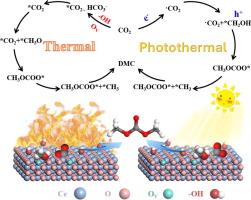
The light-driven conversion of CO2 to dimethyl carbonate (DMC) represents a promising green and sustainable pathway for achieving dual-carbon goals. However, the inherent difficulty in activating CO2 molecules results in low DMC yields when synthesizing DMC from CO2 and methanol (CH3OH) under light-driven conditions. In this study, the activation of CO2 and CH3OH is enhanced by modulating the number of hydroxyl groups and the concentration of oxygen vacancies on the surface of spindle-like CeO2-x through the introduction of cetyltrimethylammonium bromide (CTAB). Photothermal catalytic experiments show that the optimal CTAB-modified CeO2-x achieves excellent DMC yield of 5.26 mmol·g−1 under mild conditions (0.1 MPa, 120℃). The X-ray photoelectron spectroscopy and CO2 temperature-programmed desorption results demonstrate that CTAB modification increases the number of hydroxyl groups and oxygen vacancies on the CeO2-x surface, which improves the effective activation of CO2 to form the reactive intermediates such as *HCO3– and *CO2. Notably, the increased hydroxyl groups promote the dissociation of CH3OH into *CH3O. Meanwhile, isotopic labeling and in situ infrared characterization confirm the light-driven reaction pathway of CO2 and CH3OH, involving the oxidation of CH3OH to *CH2OH via photogenerated holes, followed by rapid coupling with *CO2 to generate the reactive intermediate (CH3OCOO*). These findings provide new insights into the rational design and construction of CeO2-based catalysts to achieve high yields of DMC under mild conditions.
期刊介绍:
Separation and Purification Technology is a premier journal committed to sharing innovative methods for separation and purification in chemical and environmental engineering, encompassing both homogeneous solutions and heterogeneous mixtures. Our scope includes the separation and/or purification of liquids, vapors, and gases, as well as carbon capture and separation techniques. However, it's important to note that methods solely intended for analytical purposes are not within the scope of the journal. Additionally, disciplines such as soil science, polymer science, and metallurgy fall outside the purview of Separation and Purification Technology. Join us in advancing the field of separation and purification methods for sustainable solutions in chemical and environmental engineering.




 京公网安备 11010802042870号
京ICP备2023020795号-1
京公网安备 11010802042870号
京ICP备2023020795号-1

 分享
分享
 求助内容:
求助内容: 应助结果提醒方式:
 扫码关注我们
