R. Priyadharshini , S.SD. Elanchezhiyan , Subbaiah Muthu Prabhu , S. Meenakshi
{"title":"Bimetallic oxide integrated chitosan matrix for adsorption coupled reduction of Cr(VI) from aqueous solution","authors":"R. Priyadharshini , S.SD. Elanchezhiyan , Subbaiah Muthu Prabhu , S. Meenakshi","doi":"10.1016/j.seppur.2025.133158","DOIUrl":null,"url":null,"abstract":"<div><div>In an aqueous environment, chromium is often recognized as a toxic oxyanion that poses a significant threat to living organisms because of its carcinogenic nature. The removal of hexavalent chromium (Cr(VI)) from an aqueous medium is essential to protect the environment and human health. This investigation explores the elimination of Cr(VI) ions from water by employing an adsorption technique utilizing a biopolymeric hybrid composite consisting of copper-incorporated lanthanum oxide@Chitosan (Cu<sub>x</sub>La<sub>2-x</sub>O<sub>3</sub>@Chi). The as-prepared materials were comprehensively analyzed using SEM, EDX, FTIR, XRD, BET, TGA, and XPS analysis. A systematic approach was used to optimize the batch adsorption parameters in order to ensure the maximum adsorption capacity of prepared adsorbent materials. The prepared Cu<sub>x</sub>La<sub>2-x</sub>O<sub>3</sub>@Chi composite exhibited a prominent adsorption capacity of 123.45 mg/g at pH 4.0 within 120 min. Adsorption kinetics and isotherm studies reveal that the adsorption of Cr(VI) process follows pseudo-second-order kinetics and Langmuir isotherm models, respectively. This suggests that the adsorption process occurs in a monolayer formation and involves a chemisorption mechanism. Mechanistic investigations reveal that the synergistic effect of electrostatic attraction, surface complexation, and adsorption-coupled reduction mechanism enhanced the adsorption of Cr(VI) ions from aqueous media. The selectivity and stability of the Cu<sub>x</sub>La<sub>2-x</sub>O<sub>3</sub>@Chi composite were investigated through competing and reusability experiments. The findings demonstrated outstanding selectivity in the presence of various competing ions and maintained good stability over five consecutive cycles. Therefore, the prepared Cu<sub>x</sub>La<sub>2-x</sub>O<sub>3</sub>@Chi composite proved outstanding adsorption ability against Cr(VI) ions and can be used as a technological reference in real-world water treatment.</div></div>","PeriodicalId":427,"journal":{"name":"Separation and Purification Technology","volume":"370 ","pages":"Article 133158"},"PeriodicalIF":9.0000,"publicationDate":"2025-04-22","publicationTypes":"Journal Article","fieldsOfStudy":null,"isOpenAccess":false,"openAccessPdf":"","citationCount":"0","resultStr":null,"platform":"Semanticscholar","paperid":null,"PeriodicalName":"Separation and Purification Technology","FirstCategoryId":"5","ListUrlMain":"https://www.sciencedirect.com/science/article/pii/S1383586625017551","RegionNum":1,"RegionCategory":"工程技术","ArticlePicture":[],"TitleCN":null,"AbstractTextCN":null,"PMCID":null,"EPubDate":"","PubModel":"","JCR":"Q1","JCRName":"ENGINEERING, CHEMICAL","Score":null,"Total":0}
引用次数: 0
Abstract
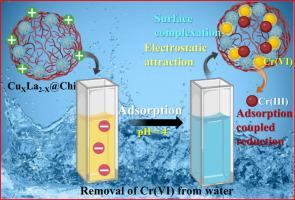
In an aqueous environment, chromium is often recognized as a toxic oxyanion that poses a significant threat to living organisms because of its carcinogenic nature. The removal of hexavalent chromium (Cr(VI)) from an aqueous medium is essential to protect the environment and human health. This investigation explores the elimination of Cr(VI) ions from water by employing an adsorption technique utilizing a biopolymeric hybrid composite consisting of copper-incorporated lanthanum oxide@Chitosan (CuxLa2-xO3@Chi). The as-prepared materials were comprehensively analyzed using SEM, EDX, FTIR, XRD, BET, TGA, and XPS analysis. A systematic approach was used to optimize the batch adsorption parameters in order to ensure the maximum adsorption capacity of prepared adsorbent materials. The prepared CuxLa2-xO3@Chi composite exhibited a prominent adsorption capacity of 123.45 mg/g at pH 4.0 within 120 min. Adsorption kinetics and isotherm studies reveal that the adsorption of Cr(VI) process follows pseudo-second-order kinetics and Langmuir isotherm models, respectively. This suggests that the adsorption process occurs in a monolayer formation and involves a chemisorption mechanism. Mechanistic investigations reveal that the synergistic effect of electrostatic attraction, surface complexation, and adsorption-coupled reduction mechanism enhanced the adsorption of Cr(VI) ions from aqueous media. The selectivity and stability of the CuxLa2-xO3@Chi composite were investigated through competing and reusability experiments. The findings demonstrated outstanding selectivity in the presence of various competing ions and maintained good stability over five consecutive cycles. Therefore, the prepared CuxLa2-xO3@Chi composite proved outstanding adsorption ability against Cr(VI) ions and can be used as a technological reference in real-world water treatment.
期刊介绍:
Separation and Purification Technology is a premier journal committed to sharing innovative methods for separation and purification in chemical and environmental engineering, encompassing both homogeneous solutions and heterogeneous mixtures. Our scope includes the separation and/or purification of liquids, vapors, and gases, as well as carbon capture and separation techniques. However, it's important to note that methods solely intended for analytical purposes are not within the scope of the journal. Additionally, disciplines such as soil science, polymer science, and metallurgy fall outside the purview of Separation and Purification Technology. Join us in advancing the field of separation and purification methods for sustainable solutions in chemical and environmental engineering.




 京公网安备 11010802042870号
京ICP备2023020795号-1
京公网安备 11010802042870号
京ICP备2023020795号-1

 分享
分享
 求助内容:
求助内容: 应助结果提醒方式:
 扫码关注我们
