Mohammad Furquan , Zahid Manzoor Bhat , Mohammad Qamar
{"title":"Electrolyte engineering beyond the conventional alkaline concentration for high-capacity retention of aqueous redox flow batteries","authors":"Mohammad Furquan , Zahid Manzoor Bhat , Mohammad Qamar","doi":"10.1016/j.electacta.2025.146286","DOIUrl":null,"url":null,"abstract":"<div><div>Electrolyte formulation significantly impacts the electrochemical performance of redox flow batteries (RFBs) in an alkaline medium. We demonstrate that the voltage, reversibility, and galvanostatic cyclic stability of RFBs improve with a potassium hydroxide (KOH) concentration beyond 1 M (pH 14). The study shows that a high KOH concentration is more critical for catholyte-potassium ferrocyanide (PF) than anolyte-Alizarin to maintain high capacity retention in full-cell, confirmed via symmetric (x M KOH-Alizarin || x M KOH-PF) and asymmetric (x M KOH-Alizarin || y M KOH-PF) KOH concentrations. Asymmetric high KOH concentration (4 M KOH-Alizarin || 3 M KOH-PF) compared to conventional symmetric (1 M KOH-Alizarin || 1 M KOH-PF) exhibits higher discharge capacity retention (∼ 32%) after 200 cycles at 100% state of charge (SOC) with ∼ 5% higher energy efficiency at 30°C. Furthermore, our cyclic voltammetry experiments reveal that the separation (ΔE) between cathodic and anodic peaks decreases significantly with high KOH concentration at the graphite felt compared to the glassy carbon electrode, enhancing the redox couple's reversibility, therefore emphasizing its crucial role in the RFBs.</div></div>","PeriodicalId":305,"journal":{"name":"Electrochimica Acta","volume":"529 ","pages":"Article 146286"},"PeriodicalIF":5.6000,"publicationDate":"2025-04-22","publicationTypes":"Journal Article","fieldsOfStudy":null,"isOpenAccess":false,"openAccessPdf":"","citationCount":"0","resultStr":null,"platform":"Semanticscholar","paperid":null,"PeriodicalName":"Electrochimica Acta","FirstCategoryId":"88","ListUrlMain":"https://www.sciencedirect.com/science/article/pii/S0013468625006474","RegionNum":3,"RegionCategory":"材料科学","ArticlePicture":[],"TitleCN":null,"AbstractTextCN":null,"PMCID":null,"EPubDate":"","PubModel":"","JCR":"Q1","JCRName":"ELECTROCHEMISTRY","Score":null,"Total":0}
引用次数: 0
Abstract
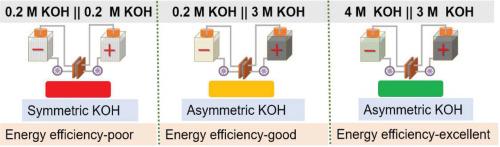
Electrolyte formulation significantly impacts the electrochemical performance of redox flow batteries (RFBs) in an alkaline medium. We demonstrate that the voltage, reversibility, and galvanostatic cyclic stability of RFBs improve with a potassium hydroxide (KOH) concentration beyond 1 M (pH 14). The study shows that a high KOH concentration is more critical for catholyte-potassium ferrocyanide (PF) than anolyte-Alizarin to maintain high capacity retention in full-cell, confirmed via symmetric (x M KOH-Alizarin || x M KOH-PF) and asymmetric (x M KOH-Alizarin || y M KOH-PF) KOH concentrations. Asymmetric high KOH concentration (4 M KOH-Alizarin || 3 M KOH-PF) compared to conventional symmetric (1 M KOH-Alizarin || 1 M KOH-PF) exhibits higher discharge capacity retention (∼ 32%) after 200 cycles at 100% state of charge (SOC) with ∼ 5% higher energy efficiency at 30°C. Furthermore, our cyclic voltammetry experiments reveal that the separation (ΔE) between cathodic and anodic peaks decreases significantly with high KOH concentration at the graphite felt compared to the glassy carbon electrode, enhancing the redox couple's reversibility, therefore emphasizing its crucial role in the RFBs.
电解质配方对氧化还原液流电池在碱性介质中的电化学性能有显著影响。我们证明,当氢氧化钾(KOH)浓度超过1 M (pH 14)时,rfb的电压、可逆性和恒流循环稳定性得到改善。通过对称(x M KOH-茜素b| | × M KOH-PF)和不对称(x M KOH-茜素|| × M KOH-PF)的KOH浓度证实,高KOH浓度对阴极-铁氰化钾(PF)比阳极-茜素(PF)在全细胞内保持高容量更重要。不对称高KOH浓度(4 M KOH- alizarin b| | 3 M KOH- pf)与常规对称(1 M KOH- alizarin || 1 M KOH- pf)相比,在30°C下,在100%充电状态(SOC)下循环200次后,放电容量保持率(~ 32%)更高,能量效率提高~ 5%。此外,我们的循环伏安实验表明,与玻碳电极相比,高KOH浓度的石墨毡阴极和阳极峰之间的分离(ΔE)显著减少,增强了氧化还原对的可逆性,因此强调了其在rfb中的关键作用。
期刊介绍:
Electrochimica Acta is an international journal. It is intended for the publication of both original work and reviews in the field of electrochemistry. Electrochemistry should be interpreted to mean any of the research fields covered by the Divisions of the International Society of Electrochemistry listed below, as well as emerging scientific domains covered by ISE New Topics Committee.



 京公网安备 11010802042870号
京ICP备2023020795号-1
京公网安备 11010802042870号
京ICP备2023020795号-1

 分享
分享
 求助内容:
求助内容: 应助结果提醒方式:
 扫码关注我们
