Lukas Kogler , Sarah Stellnberger , Verena Schwingenschlögl-Maisetschläger , Lisa Aichinger , Verena Kopatz , Andreas H. Teuschl-Woller , Lukas Kenner , Verena Pichler
{"title":"Production of detergent-free PET and biodegradable PBAT micro- and nanoplastics","authors":"Lukas Kogler , Sarah Stellnberger , Verena Schwingenschlögl-Maisetschläger , Lisa Aichinger , Verena Kopatz , Andreas H. Teuschl-Woller , Lukas Kenner , Verena Pichler","doi":"10.1016/j.jhazmat.2025.138371","DOIUrl":null,"url":null,"abstract":"<div><div>Microplastics comprise a heterogeneous group of polymer particles that vary in chemical properties, size, and shape, that may influence their environmental and <em>in vivo</em> behavior. Numerous <em>in vitro</em> and <em>in vivo</em> studies show induction of oxidative stress and metabolic disturbances. Valid critique regarding unrealistically high concentrations or additives within standard materials calls some results into question. Here, we present a novel protocol for the detergent-free production of polyethylene terephthalate (PET) and biodegradable poly(butylenadipat-co-terephthalat) (PBAT) micro- and nanoplastic particles (MNPs) as model microplastics for research. The particles were produced by dissolution precipitation from trifluoroacetic acid (TFA) for PET or tetrahydrofuran (THF)/ethanol for PBAT. Different PET sources were investigated for MNPs production. PET MNPs in the size range of 170–1000 nm with up to 80 % yield were produced from pellets as starting material. Particle size can be adjusted by ultrasounding. The non-toxic concentration range for two commonly used detergents was assessed by means of MTT assay. PET particles with a Zeta-potential of −45 were stable in aqueous suspension with and without detergents at neutral pH. Biodegradable PBAT particles in the micro- and nanometer range were produced by adapting the PET precipitation protocol. These high-yield production protocols provide additive-free authentic PET and PBAT MNPs for research.</div></div>","PeriodicalId":361,"journal":{"name":"Journal of Hazardous Materials","volume":"493 ","pages":"Article 138371"},"PeriodicalIF":11.3000,"publicationDate":"2025-08-05","publicationTypes":"Journal Article","fieldsOfStudy":null,"isOpenAccess":false,"openAccessPdf":"","citationCount":"0","resultStr":null,"platform":"Semanticscholar","paperid":null,"PeriodicalName":"Journal of Hazardous Materials","FirstCategoryId":"93","ListUrlMain":"https://www.sciencedirect.com/science/article/pii/S0304389425012865","RegionNum":1,"RegionCategory":"环境科学与生态学","ArticlePicture":[],"TitleCN":null,"AbstractTextCN":null,"PMCID":null,"EPubDate":"2025/4/22 0:00:00","PubModel":"Epub","JCR":"Q1","JCRName":"ENGINEERING, ENVIRONMENTAL","Score":null,"Total":0}
引用次数: 0
Abstract
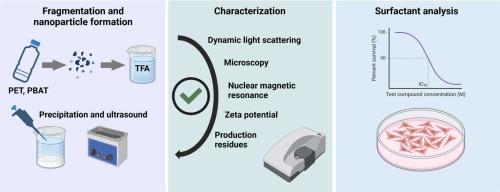
Microplastics comprise a heterogeneous group of polymer particles that vary in chemical properties, size, and shape, that may influence their environmental and in vivo behavior. Numerous in vitro and in vivo studies show induction of oxidative stress and metabolic disturbances. Valid critique regarding unrealistically high concentrations or additives within standard materials calls some results into question. Here, we present a novel protocol for the detergent-free production of polyethylene terephthalate (PET) and biodegradable poly(butylenadipat-co-terephthalat) (PBAT) micro- and nanoplastic particles (MNPs) as model microplastics for research. The particles were produced by dissolution precipitation from trifluoroacetic acid (TFA) for PET or tetrahydrofuran (THF)/ethanol for PBAT. Different PET sources were investigated for MNPs production. PET MNPs in the size range of 170–1000 nm with up to 80 % yield were produced from pellets as starting material. Particle size can be adjusted by ultrasounding. The non-toxic concentration range for two commonly used detergents was assessed by means of MTT assay. PET particles with a Zeta-potential of −45 were stable in aqueous suspension with and without detergents at neutral pH. Biodegradable PBAT particles in the micro- and nanometer range were produced by adapting the PET precipitation protocol. These high-yield production protocols provide additive-free authentic PET and PBAT MNPs for research.
期刊介绍:
The Journal of Hazardous Materials serves as a global platform for promoting cutting-edge research in the field of Environmental Science and Engineering. Our publication features a wide range of articles, including full-length research papers, review articles, and perspectives, with the aim of enhancing our understanding of the dangers and risks associated with various materials concerning public health and the environment. It is important to note that the term "environmental contaminants" refers specifically to substances that pose hazardous effects through contamination, while excluding those that do not have such impacts on the environment or human health. Moreover, we emphasize the distinction between wastes and hazardous materials in order to provide further clarity on the scope of the journal. We have a keen interest in exploring specific compounds and microbial agents that have adverse effects on the environment.



 京公网安备 11010802042870号
京ICP备2023020795号-1
京公网安备 11010802042870号
京ICP备2023020795号-1

 分享
分享
 求助内容:
求助内容: 应助结果提醒方式:
 扫码关注我们
