Comparative assessment of different alternatives to animal models for developmental toxicity prediction using physiologically based toxicokinetic modelling approach: A case study of hexaconazole, an azole fungicide
C. Yahavi , Manisha Bhateria , Sheelendra Pratap Singh
{"title":"Comparative assessment of different alternatives to animal models for developmental toxicity prediction using physiologically based toxicokinetic modelling approach: A case study of hexaconazole, an azole fungicide","authors":"C. Yahavi , Manisha Bhateria , Sheelendra Pratap Singh","doi":"10.1016/j.jhazmat.2025.138375","DOIUrl":null,"url":null,"abstract":"<div><div>The 21<sup>st</sup>-century risk assessment is gradually moving from animal-based toxicity studies to <em>in vitro</em> alternative assays that are sustainable and ethically acceptable. Alternative assays, such as rat whole embryo culture test (WEC), mouse embryonic stem cell test (EST), zebrafish embryotoxicity test (ZET), and ToxCast assays, are widely used for screening the chemicals for developmental toxicity. However, for use in risk assessment, these assays require integration with the predictive approaches, such as physiologically based toxicokinetic (PBTK) model. Using PBTK-facilitated reverse dosimetry approach, we translated the <em>in vitro</em> assay concentration to human equivalent doses (HEDs) using hexaconazole (HEX, a widely used fungicide) as the model compound. For this, a rat PBTK model was developed and verified using <em>in-house</em> generated toxicokinetic data. Based on the rat model, human PBTK model was developed to translate the <em>in vitro</em> concentrations of various alternative assays into HEDs (0.16–7850 mg/kg/day). These HEDs were compared with the HED derived using the traditional approach based on rat toxicity data. The HEDs derived from the alternative assays (WEC, EST and ZET) showed poor correlation with the HED derived from the traditional approach. However, most of the HEDs derived from the ToxCast assays were close to the traditional HED. This indicated that the PBTK model-facilitated reverse dosimetry approach could derive the HEDs directly from <em>in vitro</em> assays when sufficient animal data is lacking.</div></div>","PeriodicalId":361,"journal":{"name":"Journal of Hazardous Materials","volume":"493 ","pages":"Article 138375"},"PeriodicalIF":11.3000,"publicationDate":"2025-08-05","publicationTypes":"Journal Article","fieldsOfStudy":null,"isOpenAccess":false,"openAccessPdf":"","citationCount":"0","resultStr":null,"platform":"Semanticscholar","paperid":null,"PeriodicalName":"Journal of Hazardous Materials","FirstCategoryId":"93","ListUrlMain":"https://www.sciencedirect.com/science/article/pii/S0304389425012907","RegionNum":1,"RegionCategory":"环境科学与生态学","ArticlePicture":[],"TitleCN":null,"AbstractTextCN":null,"PMCID":null,"EPubDate":"2025/4/21 0:00:00","PubModel":"Epub","JCR":"Q1","JCRName":"ENGINEERING, ENVIRONMENTAL","Score":null,"Total":0}
引用次数: 0
Abstract
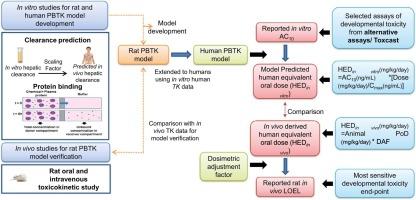
The 21st-century risk assessment is gradually moving from animal-based toxicity studies to in vitro alternative assays that are sustainable and ethically acceptable. Alternative assays, such as rat whole embryo culture test (WEC), mouse embryonic stem cell test (EST), zebrafish embryotoxicity test (ZET), and ToxCast assays, are widely used for screening the chemicals for developmental toxicity. However, for use in risk assessment, these assays require integration with the predictive approaches, such as physiologically based toxicokinetic (PBTK) model. Using PBTK-facilitated reverse dosimetry approach, we translated the in vitro assay concentration to human equivalent doses (HEDs) using hexaconazole (HEX, a widely used fungicide) as the model compound. For this, a rat PBTK model was developed and verified using in-house generated toxicokinetic data. Based on the rat model, human PBTK model was developed to translate the in vitro concentrations of various alternative assays into HEDs (0.16–7850 mg/kg/day). These HEDs were compared with the HED derived using the traditional approach based on rat toxicity data. The HEDs derived from the alternative assays (WEC, EST and ZET) showed poor correlation with the HED derived from the traditional approach. However, most of the HEDs derived from the ToxCast assays were close to the traditional HED. This indicated that the PBTK model-facilitated reverse dosimetry approach could derive the HEDs directly from in vitro assays when sufficient animal data is lacking.
期刊介绍:
The Journal of Hazardous Materials serves as a global platform for promoting cutting-edge research in the field of Environmental Science and Engineering. Our publication features a wide range of articles, including full-length research papers, review articles, and perspectives, with the aim of enhancing our understanding of the dangers and risks associated with various materials concerning public health and the environment. It is important to note that the term "environmental contaminants" refers specifically to substances that pose hazardous effects through contamination, while excluding those that do not have such impacts on the environment or human health. Moreover, we emphasize the distinction between wastes and hazardous materials in order to provide further clarity on the scope of the journal. We have a keen interest in exploring specific compounds and microbial agents that have adverse effects on the environment.



 京公网安备 11010802042870号
京ICP备2023020795号-1
京公网安备 11010802042870号
京ICP备2023020795号-1

 分享
分享
 求助内容:
求助内容: 应助结果提醒方式:
 扫码关注我们
