Zhou-Yang Li , Min Li , Bin Liu , Xue-Ning Zhang , Shan Yi , Wei-Qin Zhuang , Wen Wang , Yi-Lu Sun , Ai-Jie Wang
{"title":"Cumulative inhibitory effect of 6:2 chlorinated polyfluorooctane ether sulfonate in anaerobic digestion processes","authors":"Zhou-Yang Li , Min Li , Bin Liu , Xue-Ning Zhang , Shan Yi , Wei-Qin Zhuang , Wen Wang , Yi-Lu Sun , Ai-Jie Wang","doi":"10.1016/j.jhazmat.2025.138372","DOIUrl":null,"url":null,"abstract":"<div><div>Microbial anaerobic metabolism is crucial for biogeochemical cycles, impacting both natural and engineered ecosystems. However, the increasing emissions of 6:2 Cl-PFESA, an alternative to PFOS, pose significant risks. In this study, long-term high 6:2 Cl-PFESA concentration level of 10 µg/g TS exposure led to a substantial decrease in methane production from 204.8 ± 4.8 mL/g VS to 143.6 ± 3.5 mL/g VS, indicating a cumulative inhibitory effect on carbohydrate-related anaerobic digestion. Key processes such as polysaccharide release, hydrolysis, acetogenesis, and acetoclastic methanogenesis were contributed by 28.6 %, 9.3 %, 8.9 %, and 11.7 % of significant reduction, respectively, correlating with inhibition in relevant enzymatic activities and gene expressions. Hydrolytic bacteria such as <em>Rectinema</em> and <em>Defluviitoga</em> declined to 11.7 % from 14.3 % and 20.9 % from 23.9 %, reflecting decreased hydrolysis efficiency. Reduced transcription levels of acetogenesis- and acidogenesis-related genes further inhibited these processes. Conversely, methanogens <em>Methanolinea</em> and <em>Methanothrix</em> increased from 35.8 % to 55.7 % and 10.9–40.8 %, suggesting enzyme inhibition rather than methanogen abundance reduction. Additionally, 6:2 Cl-PFESA partially biotransformed into 6:2H-PFESA, facilitated by species like <em>Dechloromonas</em>, unclassified <em>Xanthomonadales</em>, and Betaproteobacteria. These findings confirm that the limited degradation and cumulative inhibitory effects of 6:2 Cl-PFESA during anaerobic digestion highlight its significant disruption to carbon cycling stability within ecosystems.</div></div>","PeriodicalId":361,"journal":{"name":"Journal of Hazardous Materials","volume":"493 ","pages":"Article 138372"},"PeriodicalIF":11.3000,"publicationDate":"2025-08-05","publicationTypes":"Journal Article","fieldsOfStudy":null,"isOpenAccess":false,"openAccessPdf":"","citationCount":"0","resultStr":null,"platform":"Semanticscholar","paperid":null,"PeriodicalName":"Journal of Hazardous Materials","FirstCategoryId":"93","ListUrlMain":"https://www.sciencedirect.com/science/article/pii/S0304389425012877","RegionNum":1,"RegionCategory":"环境科学与生态学","ArticlePicture":[],"TitleCN":null,"AbstractTextCN":null,"PMCID":null,"EPubDate":"2025/4/21 0:00:00","PubModel":"Epub","JCR":"Q1","JCRName":"ENGINEERING, ENVIRONMENTAL","Score":null,"Total":0}
引用次数: 0
Abstract
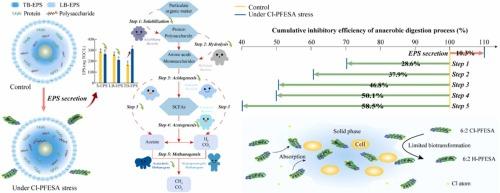
Microbial anaerobic metabolism is crucial for biogeochemical cycles, impacting both natural and engineered ecosystems. However, the increasing emissions of 6:2 Cl-PFESA, an alternative to PFOS, pose significant risks. In this study, long-term high 6:2 Cl-PFESA concentration level of 10 µg/g TS exposure led to a substantial decrease in methane production from 204.8 ± 4.8 mL/g VS to 143.6 ± 3.5 mL/g VS, indicating a cumulative inhibitory effect on carbohydrate-related anaerobic digestion. Key processes such as polysaccharide release, hydrolysis, acetogenesis, and acetoclastic methanogenesis were contributed by 28.6 %, 9.3 %, 8.9 %, and 11.7 % of significant reduction, respectively, correlating with inhibition in relevant enzymatic activities and gene expressions. Hydrolytic bacteria such as Rectinema and Defluviitoga declined to 11.7 % from 14.3 % and 20.9 % from 23.9 %, reflecting decreased hydrolysis efficiency. Reduced transcription levels of acetogenesis- and acidogenesis-related genes further inhibited these processes. Conversely, methanogens Methanolinea and Methanothrix increased from 35.8 % to 55.7 % and 10.9–40.8 %, suggesting enzyme inhibition rather than methanogen abundance reduction. Additionally, 6:2 Cl-PFESA partially biotransformed into 6:2H-PFESA, facilitated by species like Dechloromonas, unclassified Xanthomonadales, and Betaproteobacteria. These findings confirm that the limited degradation and cumulative inhibitory effects of 6:2 Cl-PFESA during anaerobic digestion highlight its significant disruption to carbon cycling stability within ecosystems.
期刊介绍:
The Journal of Hazardous Materials serves as a global platform for promoting cutting-edge research in the field of Environmental Science and Engineering. Our publication features a wide range of articles, including full-length research papers, review articles, and perspectives, with the aim of enhancing our understanding of the dangers and risks associated with various materials concerning public health and the environment. It is important to note that the term "environmental contaminants" refers specifically to substances that pose hazardous effects through contamination, while excluding those that do not have such impacts on the environment or human health. Moreover, we emphasize the distinction between wastes and hazardous materials in order to provide further clarity on the scope of the journal. We have a keen interest in exploring specific compounds and microbial agents that have adverse effects on the environment.




 京公网安备 11010802042870号
京ICP备2023020795号-1
京公网安备 11010802042870号
京ICP备2023020795号-1

 分享
分享
 求助内容:
求助内容: 应助结果提醒方式:
 扫码关注我们
