Yihan Chen , Han Ye , Yingying Xie , Haiming Cai , Zhi Dang , Guining Lu
{"title":"Ascorbic acid-induced digenite (Cu9S5) formation: A strategy to enhance sulfidation efficiency for copper recovery from acidic wastewater","authors":"Yihan Chen , Han Ye , Yingying Xie , Haiming Cai , Zhi Dang , Guining Lu","doi":"10.1016/j.watres.2025.123703","DOIUrl":null,"url":null,"abstract":"<div><div>Sulfide precipitation is an effective method for copper recovery from acidic wastewater. However, excessive use of sulfide reagents leads to secondary pollution, which poses a significant challenge. This study demonstrates that leveraging the reducing properties of ascorbic acid (AA) and adding Na<sub>2</sub>S to acidic copper-containing solutions (pH 2–4) at a Cu:S molar ratio of 1.6:0.8 enhances Cu(II) removal efficiency from 50 % to 100 %, doubling sulfide reagent utilization. Solution chemistry, electron microscopy, and X-ray spectroscopy analyses indicate that AA primarily promotes copper sulfide precipitation with higher copper content. Addition of AA at pH 2 at a Cu:S:AA molar ratio of 1.6:0.8:1 lowers the oxidation–reduction potential (ORP) from 0.5 V to 0.1 V, forming digenite (Cu<sub>9</sub>S<sub>5</sub>). Compared to covellite (CuS) formed without AA, digenite exhibits a higher Cu oxidation state and a lower S oxidation state. Furthermore, coagulation kinetics studies show that solution pH, Na<sub>2</sub>SO<sub>4</sub>, and FeCl<sub>2</sub> concentrations influence copper sulfide aggregation. At pH 2, Cu<sub>9</sub>S<sub>5</sub> coagulates at least 4.2 times faster than CuS within 20 min. Cost analysis shows that the cost per ton of copper recovered from wastewater using this method is about one-third of the cost of conventional methods. More importantly, this study minimizes residual sulfide, offering a novel strategy for dose control in copper sulfide recovery.</div></div>","PeriodicalId":443,"journal":{"name":"Water Research","volume":"281 ","pages":"Article 123703"},"PeriodicalIF":12.4000,"publicationDate":"2025-08-01","publicationTypes":"Journal Article","fieldsOfStudy":null,"isOpenAccess":false,"openAccessPdf":"","citationCount":"0","resultStr":null,"platform":"Semanticscholar","paperid":null,"PeriodicalName":"Water Research","FirstCategoryId":"93","ListUrlMain":"https://www.sciencedirect.com/science/article/pii/S0043135425006128","RegionNum":1,"RegionCategory":"环境科学与生态学","ArticlePicture":[],"TitleCN":null,"AbstractTextCN":null,"PMCID":null,"EPubDate":"2025/4/22 0:00:00","PubModel":"Epub","JCR":"Q1","JCRName":"ENGINEERING, ENVIRONMENTAL","Score":null,"Total":0}
引用次数: 0
Abstract
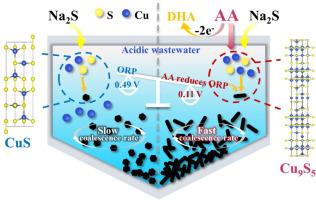
Sulfide precipitation is an effective method for copper recovery from acidic wastewater. However, excessive use of sulfide reagents leads to secondary pollution, which poses a significant challenge. This study demonstrates that leveraging the reducing properties of ascorbic acid (AA) and adding Na2S to acidic copper-containing solutions (pH 2–4) at a Cu:S molar ratio of 1.6:0.8 enhances Cu(II) removal efficiency from 50 % to 100 %, doubling sulfide reagent utilization. Solution chemistry, electron microscopy, and X-ray spectroscopy analyses indicate that AA primarily promotes copper sulfide precipitation with higher copper content. Addition of AA at pH 2 at a Cu:S:AA molar ratio of 1.6:0.8:1 lowers the oxidation–reduction potential (ORP) from 0.5 V to 0.1 V, forming digenite (Cu9S5). Compared to covellite (CuS) formed without AA, digenite exhibits a higher Cu oxidation state and a lower S oxidation state. Furthermore, coagulation kinetics studies show that solution pH, Na2SO4, and FeCl2 concentrations influence copper sulfide aggregation. At pH 2, Cu9S5 coagulates at least 4.2 times faster than CuS within 20 min. Cost analysis shows that the cost per ton of copper recovered from wastewater using this method is about one-third of the cost of conventional methods. More importantly, this study minimizes residual sulfide, offering a novel strategy for dose control in copper sulfide recovery.
期刊介绍:
Water Research, along with its open access companion journal Water Research X, serves as a platform for publishing original research papers covering various aspects of the science and technology related to the anthropogenic water cycle, water quality, and its management worldwide. The audience targeted by the journal comprises biologists, chemical engineers, chemists, civil engineers, environmental engineers, limnologists, and microbiologists. The scope of the journal include:
•Treatment processes for water and wastewaters (municipal, agricultural, industrial, and on-site treatment), including resource recovery and residuals management;
•Urban hydrology including sewer systems, stormwater management, and green infrastructure;
•Drinking water treatment and distribution;
•Potable and non-potable water reuse;
•Sanitation, public health, and risk assessment;
•Anaerobic digestion, solid and hazardous waste management, including source characterization and the effects and control of leachates and gaseous emissions;
•Contaminants (chemical, microbial, anthropogenic particles such as nanoparticles or microplastics) and related water quality sensing, monitoring, fate, and assessment;
•Anthropogenic impacts on inland, tidal, coastal and urban waters, focusing on surface and ground waters, and point and non-point sources of pollution;
•Environmental restoration, linked to surface water, groundwater and groundwater remediation;
•Analysis of the interfaces between sediments and water, and between water and atmosphere, focusing specifically on anthropogenic impacts;
•Mathematical modelling, systems analysis, machine learning, and beneficial use of big data related to the anthropogenic water cycle;
•Socio-economic, policy, and regulations studies.




 京公网安备 11010802042870号
京ICP备2023020795号-1
京公网安备 11010802042870号
京ICP备2023020795号-1

 分享
分享
 求助内容:
求助内容: 应助结果提醒方式:
 扫码关注我们
