Bowei Ouyang , Ziyue Lv , Cui Gan , Cong Yang , Lei Tong , Jianbo Shi
{"title":"Molecular mechanisms of antibiotic inhibition on microbial dissimilatory iron reduction","authors":"Bowei Ouyang , Ziyue Lv , Cui Gan , Cong Yang , Lei Tong , Jianbo Shi","doi":"10.1016/j.jhazmat.2025.138348","DOIUrl":null,"url":null,"abstract":"<div><div>Microbe-mediated iron cycling plays a pivotal role in biogeochemical processes. However, the impact of trace-level antibiotics on microbially mediated dissimilatory iron reduction (DIR) remains unexplored. In this study, we investigated the effects of four typical antibiotics on DIR mediated by <em>Shewanella oneidensis</em> MR-1, with a focus on their inhibitory effects on three extracellular electron transfer (EET) pathways: 1) direct EET, 2) soluble redox mediator-dependent EET, and 3) nanowire-mediated EET. Our findings demonstrate a concentration-dependent decline in DIR activity with increasing ceftizoxime concentrations, culminating in complete suppression at 64 μg/L. Polymyxin disrupts the cell membrane, causing structural damage that subsequently impairs the electron transport chain (ETC), leading to a reversible reduction in DIR activity. In contrast, ofloxacin and tetracycline directly down-regulated genes associated with electron production and transfer, thereby suppressing both electron transport system activity and the synthesis of NADH dehydrogenase and c-type cytochromes. This irreversibly disrupts ETC function, blocking <em>S. oneidensis</em> MR-1 from conducting EET and impairing DIR activity. This finding reveals antibiotic-induced alterations in microbial iron metabolism and provides new insights into their potential impact on the environmental iron cycling.</div></div>","PeriodicalId":361,"journal":{"name":"Journal of Hazardous Materials","volume":"493 ","pages":"Article 138348"},"PeriodicalIF":11.3000,"publicationDate":"2025-08-05","publicationTypes":"Journal Article","fieldsOfStudy":null,"isOpenAccess":false,"openAccessPdf":"","citationCount":"0","resultStr":null,"platform":"Semanticscholar","paperid":null,"PeriodicalName":"Journal of Hazardous Materials","FirstCategoryId":"93","ListUrlMain":"https://www.sciencedirect.com/science/article/pii/S0304389425012634","RegionNum":1,"RegionCategory":"环境科学与生态学","ArticlePicture":[],"TitleCN":null,"AbstractTextCN":null,"PMCID":null,"EPubDate":"2025/4/22 0:00:00","PubModel":"Epub","JCR":"Q1","JCRName":"ENGINEERING, ENVIRONMENTAL","Score":null,"Total":0}
引用次数: 0
Abstract
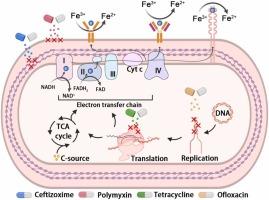
Microbe-mediated iron cycling plays a pivotal role in biogeochemical processes. However, the impact of trace-level antibiotics on microbially mediated dissimilatory iron reduction (DIR) remains unexplored. In this study, we investigated the effects of four typical antibiotics on DIR mediated by Shewanella oneidensis MR-1, with a focus on their inhibitory effects on three extracellular electron transfer (EET) pathways: 1) direct EET, 2) soluble redox mediator-dependent EET, and 3) nanowire-mediated EET. Our findings demonstrate a concentration-dependent decline in DIR activity with increasing ceftizoxime concentrations, culminating in complete suppression at 64 μg/L. Polymyxin disrupts the cell membrane, causing structural damage that subsequently impairs the electron transport chain (ETC), leading to a reversible reduction in DIR activity. In contrast, ofloxacin and tetracycline directly down-regulated genes associated with electron production and transfer, thereby suppressing both electron transport system activity and the synthesis of NADH dehydrogenase and c-type cytochromes. This irreversibly disrupts ETC function, blocking S. oneidensis MR-1 from conducting EET and impairing DIR activity. This finding reveals antibiotic-induced alterations in microbial iron metabolism and provides new insights into their potential impact on the environmental iron cycling.
期刊介绍:
The Journal of Hazardous Materials serves as a global platform for promoting cutting-edge research in the field of Environmental Science and Engineering. Our publication features a wide range of articles, including full-length research papers, review articles, and perspectives, with the aim of enhancing our understanding of the dangers and risks associated with various materials concerning public health and the environment. It is important to note that the term "environmental contaminants" refers specifically to substances that pose hazardous effects through contamination, while excluding those that do not have such impacts on the environment or human health. Moreover, we emphasize the distinction between wastes and hazardous materials in order to provide further clarity on the scope of the journal. We have a keen interest in exploring specific compounds and microbial agents that have adverse effects on the environment.




 京公网安备 11010802042870号
京ICP备2023020795号-1
京公网安备 11010802042870号
京ICP备2023020795号-1

 分享
分享
 求助内容:
求助内容: 应助结果提醒方式:
 扫码关注我们
