Lei Zhao , Congcong Zhu , Jiale Ji , Mengyuan Li , Zhongyi Kou , Wenzhu Li , Fengshi Cai , Libei Yuan
{"title":"Advanced self-charging aqueous battery with rapid charging capability and a high open-circuit voltage","authors":"Lei Zhao , Congcong Zhu , Jiale Ji , Mengyuan Li , Zhongyi Kou , Wenzhu Li , Fengshi Cai , Libei Yuan","doi":"10.1016/j.ensm.2025.104273","DOIUrl":null,"url":null,"abstract":"<div><div>Air self-charging aqueous Zn-ion batteries (AZBs) integrating advantages of aqueous batteries and self-charging have attracted significant attention. However, they suffer from the time-consuming cathodic self-charging process and low capacity, limiting their real application. Herein, we report a donor-acceptor typed covalent organic framework incorporating naphthalenediimide and triphenylamine units (NT-COF) as an advanced cathode for self-charging AZBs. NT-COF features a porous structure with abundant redox-active sites and a narrow bandgap, which significantly boosts electron/ion transport properties and O<sub>2</sub> diffusion. Upon exposure to air, the OCV of Zn//NT-COF battery rapidly increases from 0.2 to 1.03 V within 1 min, followed by a gradual rise to 1.25 V within 1 h. The battery also shows a 100% self-charging efficiency even under a current density of 0.5 A g<sup>−1</sup>, while maintaining a stable average discharge capacity of 109.4 mAh g<sup>−1</sup> at 0.2 A g<sup>−1</sup> after 1 h of self-charging upon cycling. Despite self-charging and galvanostatic charging modes, Zn//NT-COF batteries exhibit high performance in hybrid configurations. Experimental and stimulation results reveal the NT-COF cathode experiences the co-insertion of Zn<sup>2+</sup>/H<sup>+</sup> with H<sup>+</sup> ions playing a dominant role. The rapid kinetics of H<sup>+</sup> removal during the air-oxidation process are critical in enabling the ultrafast air self-charging capability of Zn//NT-COF batteries. This study advances the development of sustainable and efficient self-powered devices.</div></div>","PeriodicalId":306,"journal":{"name":"Energy Storage Materials","volume":"78 ","pages":"Article 104273"},"PeriodicalIF":20.2000,"publicationDate":"2025-05-01","publicationTypes":"Journal Article","fieldsOfStudy":null,"isOpenAccess":false,"openAccessPdf":"","citationCount":"0","resultStr":null,"platform":"Semanticscholar","paperid":null,"PeriodicalName":"Energy Storage Materials","FirstCategoryId":"88","ListUrlMain":"https://www.sciencedirect.com/science/article/pii/S2405829725002715","RegionNum":1,"RegionCategory":"材料科学","ArticlePicture":[],"TitleCN":null,"AbstractTextCN":null,"PMCID":null,"EPubDate":"2025/4/21 0:00:00","PubModel":"Epub","JCR":"Q1","JCRName":"CHEMISTRY, PHYSICAL","Score":null,"Total":0}
引用次数: 0
Abstract
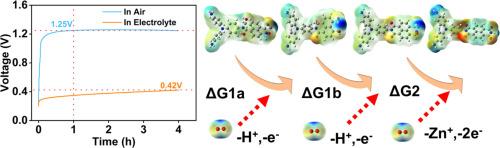
Air self-charging aqueous Zn-ion batteries (AZBs) integrating advantages of aqueous batteries and self-charging have attracted significant attention. However, they suffer from the time-consuming cathodic self-charging process and low capacity, limiting their real application. Herein, we report a donor-acceptor typed covalent organic framework incorporating naphthalenediimide and triphenylamine units (NT-COF) as an advanced cathode for self-charging AZBs. NT-COF features a porous structure with abundant redox-active sites and a narrow bandgap, which significantly boosts electron/ion transport properties and O2 diffusion. Upon exposure to air, the OCV of Zn//NT-COF battery rapidly increases from 0.2 to 1.03 V within 1 min, followed by a gradual rise to 1.25 V within 1 h. The battery also shows a 100% self-charging efficiency even under a current density of 0.5 A g−1, while maintaining a stable average discharge capacity of 109.4 mAh g−1 at 0.2 A g−1 after 1 h of self-charging upon cycling. Despite self-charging and galvanostatic charging modes, Zn//NT-COF batteries exhibit high performance in hybrid configurations. Experimental and stimulation results reveal the NT-COF cathode experiences the co-insertion of Zn2+/H+ with H+ ions playing a dominant role. The rapid kinetics of H+ removal during the air-oxidation process are critical in enabling the ultrafast air self-charging capability of Zn//NT-COF batteries. This study advances the development of sustainable and efficient self-powered devices.
期刊介绍:
Energy Storage Materials is a global interdisciplinary journal dedicated to sharing scientific and technological advancements in materials and devices for advanced energy storage and related energy conversion, such as in metal-O2 batteries. The journal features comprehensive research articles, including full papers and short communications, as well as authoritative feature articles and reviews by leading experts in the field.
Energy Storage Materials covers a wide range of topics, including the synthesis, fabrication, structure, properties, performance, and technological applications of energy storage materials. Additionally, the journal explores strategies, policies, and developments in the field of energy storage materials and devices for sustainable energy.
Published papers are selected based on their scientific and technological significance, their ability to provide valuable new knowledge, and their relevance to the international research community.




 京公网安备 11010802042870号
京ICP备2023020795号-1
京公网安备 11010802042870号
京ICP备2023020795号-1

 分享
分享
 求助内容:
求助内容: 应助结果提醒方式:
 扫码关注我们
