Regulation of CO2 Pressure-Induced Flexibility of Zeolitic Imidazolate Framework-7 Using a Mixed Linker Strategy: An In Situ Positron Annihilation Spectroscopy Study
Renjith B. Nelliyil, Jaideep Mor, Amit Kaushal, Sandeep Kumar Sharma
{"title":"Regulation of CO2 Pressure-Induced Flexibility of Zeolitic Imidazolate Framework-7 Using a Mixed Linker Strategy: An In Situ Positron Annihilation Spectroscopy Study","authors":"Renjith B. Nelliyil, Jaideep Mor, Amit Kaushal, Sandeep Kumar Sharma","doi":"10.1021/acs.langmuir.5c00473","DOIUrl":null,"url":null,"abstract":"The external stimuli-induced framework flexibility of zeolitic imidazolate frameworks (ZIFs) is a fascinating physical phenomenon. Flexible ZIFs offer varying pore aperture under gas pressures leading to inferior separation selectivity because the flexibility-induced enlargement in the aperture size allows diffusion of larger size gas molecules. Desolvated ZIF-7 crystals show high flexibility and phase transformation from the narrow pore (<i>np</i>) to the open pore (<i>op</i>) phase under CO<sub>2</sub> pressure. Regulation of the gas-framework-induced flexibility of ZIF-7 is of paramount importance for enhancing its selectivity for gas separation and storage. Herein, we have exchanged the benzimidazole linker of ZIF-7 with varying amount (up to 62%) of 4,5-dichloroimidazole (dcIm), maintaining the sodalite topology and intracrystalline porosity. As a result of loading of the halogenated linker, the <i>op</i> phase of ZIF-7 can be obtained at room temperature in a desolvated form, which is otherwise exhibited only by the solvated ZIF-7. Using positron annihilation lifetime spectroscopy (PALS), it has been established that the pore architecture is significantly varied depending on the extent of linker mixing. The framework flexibility of ZIF-7 is determined by indexing the vacant volume available at the pore sites under the increasing CO<sub>2</sub> pressure using in situ PALS. The flexibility of the mixed linker framework indexed through vacant volume evolution at pore sites under CO<sub>2</sub> pressure is observed to be drastically reduced as compared to that of ZIF-7 due to the presence of the halogenated linker in the framework. The present study confirms that the pore architecture and flexibility of ZIF-7 can be efficiently regulated by incorporating varying amounts of dcIm in ZIF-7 frameworks.","PeriodicalId":50,"journal":{"name":"Langmuir","volume":"260 1","pages":""},"PeriodicalIF":3.9000,"publicationDate":"2025-04-21","publicationTypes":"Journal Article","fieldsOfStudy":null,"isOpenAccess":false,"openAccessPdf":"","citationCount":"0","resultStr":null,"platform":"Semanticscholar","paperid":null,"PeriodicalName":"Langmuir","FirstCategoryId":"92","ListUrlMain":"https://doi.org/10.1021/acs.langmuir.5c00473","RegionNum":2,"RegionCategory":"化学","ArticlePicture":[],"TitleCN":null,"AbstractTextCN":null,"PMCID":null,"EPubDate":"","PubModel":"","JCR":"Q2","JCRName":"CHEMISTRY, MULTIDISCIPLINARY","Score":null,"Total":0}
引用次数: 0
Abstract
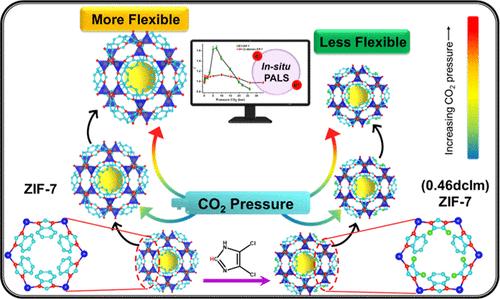
The external stimuli-induced framework flexibility of zeolitic imidazolate frameworks (ZIFs) is a fascinating physical phenomenon. Flexible ZIFs offer varying pore aperture under gas pressures leading to inferior separation selectivity because the flexibility-induced enlargement in the aperture size allows diffusion of larger size gas molecules. Desolvated ZIF-7 crystals show high flexibility and phase transformation from the narrow pore (np) to the open pore (op) phase under CO2 pressure. Regulation of the gas-framework-induced flexibility of ZIF-7 is of paramount importance for enhancing its selectivity for gas separation and storage. Herein, we have exchanged the benzimidazole linker of ZIF-7 with varying amount (up to 62%) of 4,5-dichloroimidazole (dcIm), maintaining the sodalite topology and intracrystalline porosity. As a result of loading of the halogenated linker, the op phase of ZIF-7 can be obtained at room temperature in a desolvated form, which is otherwise exhibited only by the solvated ZIF-7. Using positron annihilation lifetime spectroscopy (PALS), it has been established that the pore architecture is significantly varied depending on the extent of linker mixing. The framework flexibility of ZIF-7 is determined by indexing the vacant volume available at the pore sites under the increasing CO2 pressure using in situ PALS. The flexibility of the mixed linker framework indexed through vacant volume evolution at pore sites under CO2 pressure is observed to be drastically reduced as compared to that of ZIF-7 due to the presence of the halogenated linker in the framework. The present study confirms that the pore architecture and flexibility of ZIF-7 can be efficiently regulated by incorporating varying amounts of dcIm in ZIF-7 frameworks.
期刊介绍:
Langmuir is an interdisciplinary journal publishing articles in the following subject categories:
Colloids: surfactants and self-assembly, dispersions, emulsions, foams
Interfaces: adsorption, reactions, films, forces
Biological Interfaces: biocolloids, biomolecular and biomimetic materials
Materials: nano- and mesostructured materials, polymers, gels, liquid crystals
Electrochemistry: interfacial charge transfer, charge transport, electrocatalysis, electrokinetic phenomena, bioelectrochemistry
Devices and Applications: sensors, fluidics, patterning, catalysis, photonic crystals
However, when high-impact, original work is submitted that does not fit within the above categories, decisions to accept or decline such papers will be based on one criteria: What Would Irving Do?
Langmuir ranks #2 in citations out of 136 journals in the category of Physical Chemistry with 113,157 total citations. The journal received an Impact Factor of 4.384*.
This journal is also indexed in the categories of Materials Science (ranked #1) and Multidisciplinary Chemistry (ranked #5).



 京公网安备 11010802042870号
京ICP备2023020795号-1
京公网安备 11010802042870号
京ICP备2023020795号-1

 分享
分享
 求助内容:
求助内容: 应助结果提醒方式:
 扫码关注我们
