{"title":"Recent Progress of Modulating Pristine Metal–Organic Frameworks for Oxygen Reaction Revolution","authors":"Gaoshuang Zuo, Hong Wang, Yanzhong Wang","doi":"10.1021/acs.langmuir.5c00009","DOIUrl":null,"url":null,"abstract":"Highly efficient and stable oxygen evolution reaction (OER) electrocatalysts are essential for electrochemical water splitting. Among non-noble metal-based catalysts, metal–organic frameworks (MOFs) have recently emerged as particularly promising candidates due to their exceptional surface areas, hierarchical porous structures, and tunable morphologies and compositions. The rational regulation of the morphology and electronic structure of pristine MOFs is considered a critical pathway for enhancing active sites and structural stability, thereby significantly boosting the OER catalytic performance. This review systematically presents the recent advancements in modulating pristine MOFs via heterogeneous metal doping, ligand substitution, and hybrid composite construction. With particular emphasis on synthetic methods, modification mechanisms, and the OER properties of MOFs, we analyze the fundamental relationships between structural modifications and electrocatalytic performance. Through the systematic analysis of existing research achievements, this review provides a holistic assessment of current state-of-the-art developments, identifies critical challenges, and proposes future research directions with practical implications for OER electrocatalyst design.","PeriodicalId":50,"journal":{"name":"Langmuir","volume":"16 1","pages":""},"PeriodicalIF":3.9000,"publicationDate":"2025-04-22","publicationTypes":"Journal Article","fieldsOfStudy":null,"isOpenAccess":false,"openAccessPdf":"","citationCount":"0","resultStr":null,"platform":"Semanticscholar","paperid":null,"PeriodicalName":"Langmuir","FirstCategoryId":"92","ListUrlMain":"https://doi.org/10.1021/acs.langmuir.5c00009","RegionNum":2,"RegionCategory":"化学","ArticlePicture":[],"TitleCN":null,"AbstractTextCN":null,"PMCID":null,"EPubDate":"","PubModel":"","JCR":"Q2","JCRName":"CHEMISTRY, MULTIDISCIPLINARY","Score":null,"Total":0}
引用次数: 0
Abstract
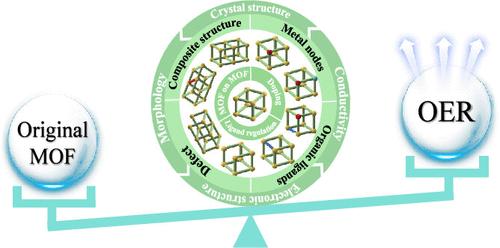
Highly efficient and stable oxygen evolution reaction (OER) electrocatalysts are essential for electrochemical water splitting. Among non-noble metal-based catalysts, metal–organic frameworks (MOFs) have recently emerged as particularly promising candidates due to their exceptional surface areas, hierarchical porous structures, and tunable morphologies and compositions. The rational regulation of the morphology and electronic structure of pristine MOFs is considered a critical pathway for enhancing active sites and structural stability, thereby significantly boosting the OER catalytic performance. This review systematically presents the recent advancements in modulating pristine MOFs via heterogeneous metal doping, ligand substitution, and hybrid composite construction. With particular emphasis on synthetic methods, modification mechanisms, and the OER properties of MOFs, we analyze the fundamental relationships between structural modifications and electrocatalytic performance. Through the systematic analysis of existing research achievements, this review provides a holistic assessment of current state-of-the-art developments, identifies critical challenges, and proposes future research directions with practical implications for OER electrocatalyst design.
高效稳定的氧进化反应(OER)电催化剂对于电化学水分离至关重要。在以非贵金属为基础的催化剂中,金属有机框架(MOFs)因其特殊的比表面积、分层多孔结构、可调控的形态和组成,最近已成为特别有前途的候选催化剂。合理调节原始 MOF 的形态和电子结构被认为是增强活性位点和结构稳定性的关键途径,从而显著提高 OER 的催化性能。本综述系统地介绍了通过异质金属掺杂、配体置换和混合复合构建来调节原始 MOFs 的最新进展。我们特别强调了 MOFs 的合成方法、改性机制和 OER 特性,分析了结构改性与电催化性能之间的基本关系。通过对现有研究成果的系统分析,本综述全面评估了当前的最新发展,指出了关键挑战,并提出了对 OER 电催化剂设计具有实际意义的未来研究方向。
期刊介绍:
Langmuir is an interdisciplinary journal publishing articles in the following subject categories:
Colloids: surfactants and self-assembly, dispersions, emulsions, foams
Interfaces: adsorption, reactions, films, forces
Biological Interfaces: biocolloids, biomolecular and biomimetic materials
Materials: nano- and mesostructured materials, polymers, gels, liquid crystals
Electrochemistry: interfacial charge transfer, charge transport, electrocatalysis, electrokinetic phenomena, bioelectrochemistry
Devices and Applications: sensors, fluidics, patterning, catalysis, photonic crystals
However, when high-impact, original work is submitted that does not fit within the above categories, decisions to accept or decline such papers will be based on one criteria: What Would Irving Do?
Langmuir ranks #2 in citations out of 136 journals in the category of Physical Chemistry with 113,157 total citations. The journal received an Impact Factor of 4.384*.
This journal is also indexed in the categories of Materials Science (ranked #1) and Multidisciplinary Chemistry (ranked #5).



 京公网安备 11010802042870号
京ICP备2023020795号-1
京公网安备 11010802042870号
京ICP备2023020795号-1

 分享
分享
 求助内容:
求助内容: 应助结果提醒方式:
 扫码关注我们
