Dingcen Duan, Sen Ren, Yatian Huang, Zhanglong Tang, Yan Wang, Xin Chen, Xingbo Ge
{"title":"One-Step Electrodeposition of Ternary Metal Sulfide Composite Nanorod Arrays as a Self-Supported Electrocatalyst for the Hydrogen Evolution Reaction","authors":"Dingcen Duan, Sen Ren, Yatian Huang, Zhanglong Tang, Yan Wang, Xin Chen, Xingbo Ge","doi":"10.1021/acs.langmuir.5c00087","DOIUrl":null,"url":null,"abstract":"In this study, a self-supported material with a unique ternary metal sulfide nanorod array structure was fabricated in situ on copper foam via a facile one-step electrodeposition approach ((NiCo–Cu)S<sub><i>x</i></sub>/CF). The electrochemically driven rapid generation of abundant S<sup>2–</sup> ions from thiourea accelerates their combination with Ni<sup>2+</sup> and Co<sup>2+</sup>, resulting in a catalytically enriched surface on the nanorod array. The high-density nanorod arrays provide maximally accessible active sites, thereby enhancing the hydrogen evolution reaction (HER). The in situ grown self-supported structure effectively eliminates the need for binders (common in conventional catalysts), avoids additional interfacial resistance, and ensures long-term stability during electrocatalytic operation. The synergistic interactions among the metal components (Ni, Co, and Cu) optimize the local electronic environment, creating favorable conditions for catalytic hydrogen evolution. The experimental results demonstrate that the ternary metal sulfide nanocomposite (denoted as (NiCo–Cu)S<sub><i>x</i></sub>/CF) exhibits superior hydrogen evolution reaction performance compared to its binary counterparts. Remarkably, the catalyst required only 42 and 161 mV overpotential to deliver 10 mA·cm<sup>–2</sup> and 100 mA·cm<sup>–2</sup> current densities in 1 M KOH, respectively, with 100 h operational stability. This work provides a viable strategy for developing self-supported ternary non-noble metal catalysts for energy conversion applications.","PeriodicalId":50,"journal":{"name":"Langmuir","volume":"6 1","pages":""},"PeriodicalIF":3.9000,"publicationDate":"2025-04-21","publicationTypes":"Journal Article","fieldsOfStudy":null,"isOpenAccess":false,"openAccessPdf":"","citationCount":"0","resultStr":null,"platform":"Semanticscholar","paperid":null,"PeriodicalName":"Langmuir","FirstCategoryId":"92","ListUrlMain":"https://doi.org/10.1021/acs.langmuir.5c00087","RegionNum":2,"RegionCategory":"化学","ArticlePicture":[],"TitleCN":null,"AbstractTextCN":null,"PMCID":null,"EPubDate":"","PubModel":"","JCR":"Q2","JCRName":"CHEMISTRY, MULTIDISCIPLINARY","Score":null,"Total":0}
引用次数: 0
Abstract
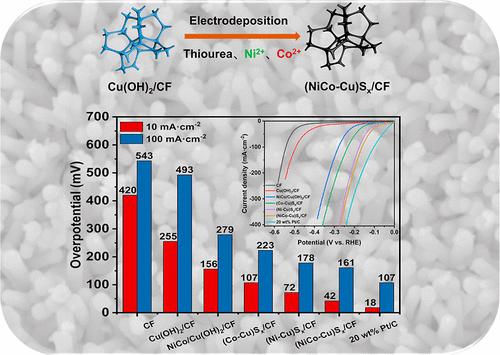
In this study, a self-supported material with a unique ternary metal sulfide nanorod array structure was fabricated in situ on copper foam via a facile one-step electrodeposition approach ((NiCo–Cu)Sx/CF). The electrochemically driven rapid generation of abundant S2– ions from thiourea accelerates their combination with Ni2+ and Co2+, resulting in a catalytically enriched surface on the nanorod array. The high-density nanorod arrays provide maximally accessible active sites, thereby enhancing the hydrogen evolution reaction (HER). The in situ grown self-supported structure effectively eliminates the need for binders (common in conventional catalysts), avoids additional interfacial resistance, and ensures long-term stability during electrocatalytic operation. The synergistic interactions among the metal components (Ni, Co, and Cu) optimize the local electronic environment, creating favorable conditions for catalytic hydrogen evolution. The experimental results demonstrate that the ternary metal sulfide nanocomposite (denoted as (NiCo–Cu)Sx/CF) exhibits superior hydrogen evolution reaction performance compared to its binary counterparts. Remarkably, the catalyst required only 42 and 161 mV overpotential to deliver 10 mA·cm–2 and 100 mA·cm–2 current densities in 1 M KOH, respectively, with 100 h operational stability. This work provides a viable strategy for developing self-supported ternary non-noble metal catalysts for energy conversion applications.
期刊介绍:
Langmuir is an interdisciplinary journal publishing articles in the following subject categories:
Colloids: surfactants and self-assembly, dispersions, emulsions, foams
Interfaces: adsorption, reactions, films, forces
Biological Interfaces: biocolloids, biomolecular and biomimetic materials
Materials: nano- and mesostructured materials, polymers, gels, liquid crystals
Electrochemistry: interfacial charge transfer, charge transport, electrocatalysis, electrokinetic phenomena, bioelectrochemistry
Devices and Applications: sensors, fluidics, patterning, catalysis, photonic crystals
However, when high-impact, original work is submitted that does not fit within the above categories, decisions to accept or decline such papers will be based on one criteria: What Would Irving Do?
Langmuir ranks #2 in citations out of 136 journals in the category of Physical Chemistry with 113,157 total citations. The journal received an Impact Factor of 4.384*.
This journal is also indexed in the categories of Materials Science (ranked #1) and Multidisciplinary Chemistry (ranked #5).




 京公网安备 11010802042870号
京ICP备2023020795号-1
京公网安备 11010802042870号
京ICP备2023020795号-1

 分享
分享
 求助内容:
求助内容: 应助结果提醒方式:
 扫码关注我们
