{"title":"Dual Field Passivation Strategy for High-Performance Wide-Bandgap Perovskite Solar Cells","authors":"Xuzheng Feng, Xing Li, Zhuoxin Li, Yufei Xue, Xianggang Chen, Xiaoxu Sun, Jixiang Tang, Shuyi Liu, Zishuo Wang, Yuhang Xie, Rui Jia, Songyuan Dai, Guoping Gao, Molang Cai","doi":"10.1021/acsami.4c20406","DOIUrl":null,"url":null,"abstract":"Wide-bandgap perovskite solar cells (WBG PSCs) have been receiving increasing focus due to the ideal application in tandem photovoltaics. Nonetheless, WBG perovskites tend to form high-density trap states, causing serious nonradiative recombination and phase segregation, which is detrimental to the efficiency and stability of WBG PSCs. In this work, a dual-field passivation strategy facilitated by isopropylamine hydroiodide (i-PAI) is introduced, in effect, showing both the molecular dipole field passivation and interface electric field passivation. This strategy reduces the charge trap density of WBG perovskite and suppresses the phase segregation, which is supported by the analysis of the experimental data and simulation results. Moreover, the dual functional passivation mitigates the open-circuit-voltage (<i>V</i><sub>OC</sub>) deficit of the WBG (1.65 eV) PSCs to 0.39 V and increases the efficiency to a competitive value of 22.21%. The device also exhibits excellent photostability, maintaining 84.2% of the initial efficiency after 1080 h of illumination under 1-sun white LED. This work showcases a pivotal pathway to defect passivation that can markedly enhancing both the efficiency and stability of wide-bandgap perovskite solar cells.","PeriodicalId":5,"journal":{"name":"ACS Applied Materials & Interfaces","volume":"46 1","pages":""},"PeriodicalIF":8.2000,"publicationDate":"2025-04-21","publicationTypes":"Journal Article","fieldsOfStudy":null,"isOpenAccess":false,"openAccessPdf":"","citationCount":"0","resultStr":null,"platform":"Semanticscholar","paperid":null,"PeriodicalName":"ACS Applied Materials & Interfaces","FirstCategoryId":"88","ListUrlMain":"https://doi.org/10.1021/acsami.4c20406","RegionNum":2,"RegionCategory":"材料科学","ArticlePicture":[],"TitleCN":null,"AbstractTextCN":null,"PMCID":null,"EPubDate":"","PubModel":"","JCR":"Q1","JCRName":"MATERIALS SCIENCE, MULTIDISCIPLINARY","Score":null,"Total":0}
引用次数: 0
Abstract
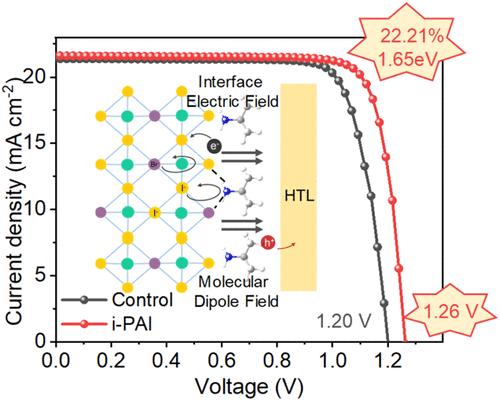
Wide-bandgap perovskite solar cells (WBG PSCs) have been receiving increasing focus due to the ideal application in tandem photovoltaics. Nonetheless, WBG perovskites tend to form high-density trap states, causing serious nonradiative recombination and phase segregation, which is detrimental to the efficiency and stability of WBG PSCs. In this work, a dual-field passivation strategy facilitated by isopropylamine hydroiodide (i-PAI) is introduced, in effect, showing both the molecular dipole field passivation and interface electric field passivation. This strategy reduces the charge trap density of WBG perovskite and suppresses the phase segregation, which is supported by the analysis of the experimental data and simulation results. Moreover, the dual functional passivation mitigates the open-circuit-voltage (VOC) deficit of the WBG (1.65 eV) PSCs to 0.39 V and increases the efficiency to a competitive value of 22.21%. The device also exhibits excellent photostability, maintaining 84.2% of the initial efficiency after 1080 h of illumination under 1-sun white LED. This work showcases a pivotal pathway to defect passivation that can markedly enhancing both the efficiency and stability of wide-bandgap perovskite solar cells.
期刊介绍:
ACS Applied Materials & Interfaces is a leading interdisciplinary journal that brings together chemists, engineers, physicists, and biologists to explore the development and utilization of newly-discovered materials and interfacial processes for specific applications. Our journal has experienced remarkable growth since its establishment in 2009, both in terms of the number of articles published and the impact of the research showcased. We are proud to foster a truly global community, with the majority of published articles originating from outside the United States, reflecting the rapid growth of applied research worldwide.



 京公网安备 11010802042870号
京ICP备2023020795号-1
京公网安备 11010802042870号
京ICP备2023020795号-1

 分享
分享
 求助内容:
求助内容: 应助结果提醒方式:
 扫码关注我们
