Gyoung Gug Jang, Jong K. Keum, Swapnamoy Dutta, Joshua T. Damron, Alexander I. Wiechert, Candice E. Halbert, James F. Browning, Dale K. Hensley, David Jassby, Marta C. Hatzell, Costas Tsouris
{"title":"Understanding the Dissolution and Passivation of an Aluminum Electrode during Electrocoagulation of Groundwater Using Neutron and X-ray Reflectometry","authors":"Gyoung Gug Jang, Jong K. Keum, Swapnamoy Dutta, Joshua T. Damron, Alexander I. Wiechert, Candice E. Halbert, James F. Browning, Dale K. Hensley, David Jassby, Marta C. Hatzell, Costas Tsouris","doi":"10.1021/acsami.5c02215","DOIUrl":null,"url":null,"abstract":"An aluminum (Al)-based electrocoagulation (EC) system can effectively remove dissolved silica and hardness in groundwater. The effectiveness of Al-EC in terms of pollutant removal, Faradaic efficiency, and energy consumption depends on the interfacial electrolysis or passivation of the electrode in water. Thus, understanding the electrolysis reaction at the liquid/electrode interface during operation is important for sustainable EC deployment. A continuous flow-through Al-EC system was tested with various groundwater simulants, i.e., chloride (Cl<sup>–</sup>)-based, sulfate (SO<sub>4</sub><sup>2–</sup>)-based, and mixed solutions. High pollutant removal with low energy consumption was observed in Cl<sup>–</sup>-based groundwater treatment, while low pollutant removal with high energy consumption was observed in SO<sub>4</sub><sup>2–</sup>-based groundwater. For example, the required energy per unit mass of Al dosing in SO<sub>4</sub><sup>2–</sup>-based groundwater is three times higher than that in Cl<sup>–</sup>-based groundwater at 10 mA/cm<sup>2</sup>. However, increasing the Cl<sup>–</sup> concentration significantly reduces this energy demand. In SO<sub>4</sub><sup>2–</sup>-based groundwater, the silicate removal efficiency drops from 85.1% to 24.0% compared to that for Cl<sup>–</sup>-based groundwater, while Mg<sup>2+</sup> and Ca<sup>2+</sup> removal efficiencies decrease to 0.6% from 15.8% and 5.7% from 44.8%, respectively. To better understand this EC performance, we used in situ neutron reflectometry (NR) to examine the interfacial dynamics of Al dissolution and passivation at a 100 nm scale occurring on the surface of the sacrificial Al electrodes during EC. Ex situ X-ray reflectometry (XRR) was also used to support the in situ NR results. Both NR and XRR results revealed that Al dissolution is influenced by the presence of Cl<sup>–</sup> in the simulants, while a passivating layer forms on the electrode in a SO<sub>4</sub><sup>2–</sup>-based solution. In the Cl<sup>–</sup>-based solution, anodic Al dissolution occurred locally and inhomogeneously across the surface of the Al anode film, resulting in a localized thickness reduction over time. In the SO<sub>4</sub><sup>2–</sup>-based solution, no apparent dissolution of the Al anode was identified. Instead, Al underwent oxidation, forming an amorphous Al<sub>2</sub>O<sub>3</sub> surface layer within the Al electrode film that increased in thickness over time. In the mixed solution, both anodic Al dissolution and surface Al<sub>2</sub>O<sub>3</sub> layer formation occurred, indicating that Al dissolution and surface Al<sub>2</sub>O<sub>3</sub> layer formation are attributable to the Cl<sup>–</sup> and SO<sub>4</sub><sup>2–</sup> ions, respectively.","PeriodicalId":5,"journal":{"name":"ACS Applied Materials & Interfaces","volume":"19 1","pages":""},"PeriodicalIF":7.8000,"publicationDate":"2025-04-21","publicationTypes":"Journal Article","fieldsOfStudy":null,"isOpenAccess":false,"openAccessPdf":"","citationCount":"0","resultStr":null,"platform":"Semanticscholar","paperid":null,"PeriodicalName":"ACS Applied Materials & Interfaces","FirstCategoryId":"88","ListUrlMain":"https://doi.org/10.1021/acsami.5c02215","RegionNum":2,"RegionCategory":"材料科学","ArticlePicture":[],"TitleCN":null,"AbstractTextCN":null,"PMCID":null,"EPubDate":"","PubModel":"","JCR":"Q1","JCRName":"MATERIALS SCIENCE, MULTIDISCIPLINARY","Score":null,"Total":0}
引用次数: 0
Abstract
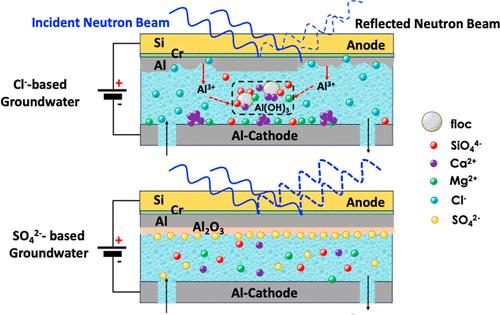
An aluminum (Al)-based electrocoagulation (EC) system can effectively remove dissolved silica and hardness in groundwater. The effectiveness of Al-EC in terms of pollutant removal, Faradaic efficiency, and energy consumption depends on the interfacial electrolysis or passivation of the electrode in water. Thus, understanding the electrolysis reaction at the liquid/electrode interface during operation is important for sustainable EC deployment. A continuous flow-through Al-EC system was tested with various groundwater simulants, i.e., chloride (Cl–)-based, sulfate (SO42–)-based, and mixed solutions. High pollutant removal with low energy consumption was observed in Cl–-based groundwater treatment, while low pollutant removal with high energy consumption was observed in SO42–-based groundwater. For example, the required energy per unit mass of Al dosing in SO42–-based groundwater is three times higher than that in Cl–-based groundwater at 10 mA/cm2. However, increasing the Cl– concentration significantly reduces this energy demand. In SO42–-based groundwater, the silicate removal efficiency drops from 85.1% to 24.0% compared to that for Cl–-based groundwater, while Mg2+ and Ca2+ removal efficiencies decrease to 0.6% from 15.8% and 5.7% from 44.8%, respectively. To better understand this EC performance, we used in situ neutron reflectometry (NR) to examine the interfacial dynamics of Al dissolution and passivation at a 100 nm scale occurring on the surface of the sacrificial Al electrodes during EC. Ex situ X-ray reflectometry (XRR) was also used to support the in situ NR results. Both NR and XRR results revealed that Al dissolution is influenced by the presence of Cl– in the simulants, while a passivating layer forms on the electrode in a SO42–-based solution. In the Cl–-based solution, anodic Al dissolution occurred locally and inhomogeneously across the surface of the Al anode film, resulting in a localized thickness reduction over time. In the SO42–-based solution, no apparent dissolution of the Al anode was identified. Instead, Al underwent oxidation, forming an amorphous Al2O3 surface layer within the Al electrode film that increased in thickness over time. In the mixed solution, both anodic Al dissolution and surface Al2O3 layer formation occurred, indicating that Al dissolution and surface Al2O3 layer formation are attributable to the Cl– and SO42– ions, respectively.
期刊介绍:
ACS Applied Materials & Interfaces is a leading interdisciplinary journal that brings together chemists, engineers, physicists, and biologists to explore the development and utilization of newly-discovered materials and interfacial processes for specific applications. Our journal has experienced remarkable growth since its establishment in 2009, both in terms of the number of articles published and the impact of the research showcased. We are proud to foster a truly global community, with the majority of published articles originating from outside the United States, reflecting the rapid growth of applied research worldwide.




 京公网安备 11010802042870号
京ICP备2023020795号-1
京公网安备 11010802042870号
京ICP备2023020795号-1

 分享
分享
 求助内容:
求助内容: 应助结果提醒方式:
 扫码关注我们
