{"title":"Antimony and arsenic interactions with iron oxides and aluminum oxides in surface environment: A review focused on processes and mechanisms","authors":"Shuo Xiang, Zhiyou Fu, Hongyue Lu, Yuwei Sun, Yimeng Shen, Fengchang Wu","doi":"10.1016/j.scitotenv.2025.179423","DOIUrl":null,"url":null,"abstract":"<div><div>It has been assumed and widely reported that arsenic (As) and antimony (Sb) share some similarities but also exhibit significant differences in their geochemical behaviors. Their environmental fates are generally controlled by iron (Fe) oxides and aluminum (Al) oxides. The mechanistic differences in their interactions, especially under dynamic environmental conditions, remain poorly understood, which hinders the development and implementation of effective pollution prevention and control measures. Therefore, this review focuses on the processes and mechanisms of interactions between As/Sb and Fe oxides/Al oxides. Antimony exhibits a higher susceptibility to oxidation than As due to its larger atomic radius and lower electronegativity. The property is an important basis for explaining the differences in their interactions in the environment. To obtain a clearer understanding of interactions, a detailed adsorption theory (charge distribution multi-site ion complexation) for the Fe oxides and Al oxides and three primary adsorption mechanisms (electrostatic adsorption, chemical adsorption, and coprecipitation) were explored. Furthermore, the effects of various factors (pH, redox, surface coverage, competing ions, and types of Fe oxides and Al oxides) on the adsorption efficiency were evaluated. We discussed the mechanisms and efficiency of Sb and As adsorption on Fe oxides and Al oxides, and the differences in Sb and As adsorption for various valence states. To efficiently control Sb and As pollution, some differences between Sb and As need to be taken into account.</div></div>","PeriodicalId":422,"journal":{"name":"Science of the Total Environment","volume":"979 ","pages":"Article 179423"},"PeriodicalIF":8.0000,"publicationDate":"2025-06-01","publicationTypes":"Journal Article","fieldsOfStudy":null,"isOpenAccess":false,"openAccessPdf":"","citationCount":"0","resultStr":null,"platform":"Semanticscholar","paperid":null,"PeriodicalName":"Science of the Total Environment","FirstCategoryId":"93","ListUrlMain":"https://www.sciencedirect.com/science/article/pii/S0048969725010605","RegionNum":1,"RegionCategory":"环境科学与生态学","ArticlePicture":[],"TitleCN":null,"AbstractTextCN":null,"PMCID":null,"EPubDate":"2025/4/22 0:00:00","PubModel":"Epub","JCR":"Q1","JCRName":"ENVIRONMENTAL SCIENCES","Score":null,"Total":0}
引用次数: 0
Abstract
It has been assumed and widely reported that arsenic (As) and antimony (Sb) share some similarities but also exhibit significant differences in their geochemical behaviors. Their environmental fates are generally controlled by iron (Fe) oxides and aluminum (Al) oxides. The mechanistic differences in their interactions, especially under dynamic environmental conditions, remain poorly understood, which hinders the development and implementation of effective pollution prevention and control measures. Therefore, this review focuses on the processes and mechanisms of interactions between As/Sb and Fe oxides/Al oxides. Antimony exhibits a higher susceptibility to oxidation than As due to its larger atomic radius and lower electronegativity. The property is an important basis for explaining the differences in their interactions in the environment. To obtain a clearer understanding of interactions, a detailed adsorption theory (charge distribution multi-site ion complexation) for the Fe oxides and Al oxides and three primary adsorption mechanisms (electrostatic adsorption, chemical adsorption, and coprecipitation) were explored. Furthermore, the effects of various factors (pH, redox, surface coverage, competing ions, and types of Fe oxides and Al oxides) on the adsorption efficiency were evaluated. We discussed the mechanisms and efficiency of Sb and As adsorption on Fe oxides and Al oxides, and the differences in Sb and As adsorption for various valence states. To efficiently control Sb and As pollution, some differences between Sb and As need to be taken into account.
期刊介绍:
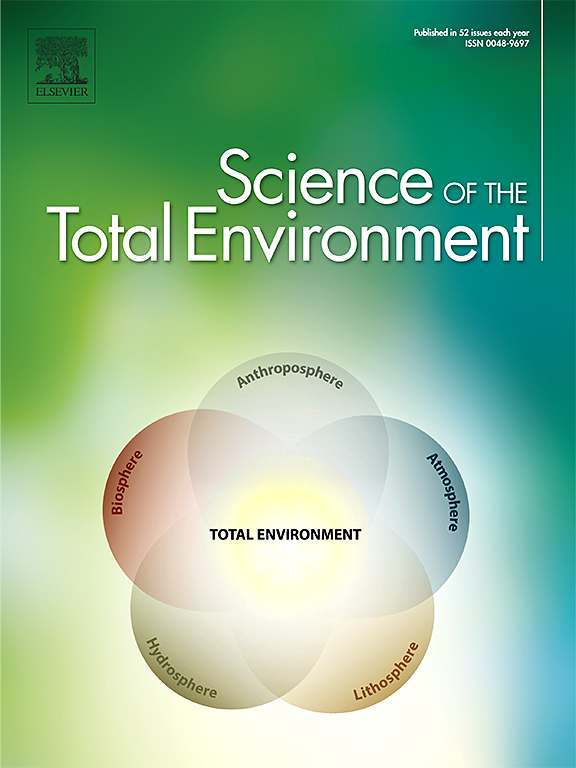
The Science of the Total Environment is an international journal dedicated to scientific research on the environment and its interaction with humanity. It covers a wide range of disciplines and seeks to publish innovative, hypothesis-driven, and impactful research that explores the entire environment, including the atmosphere, lithosphere, hydrosphere, biosphere, and anthroposphere.
The journal's updated Aims & Scope emphasizes the importance of interdisciplinary environmental research with broad impact. Priority is given to studies that advance fundamental understanding and explore the interconnectedness of multiple environmental spheres. Field studies are preferred, while laboratory experiments must demonstrate significant methodological advancements or mechanistic insights with direct relevance to the environment.





 京公网安备 11010802042870号
京ICP备2023020795号-1
京公网安备 11010802042870号
京ICP备2023020795号-1

 分享
分享
 求助内容:
求助内容: 应助结果提醒方式:
 扫码关注我们
