Copper(II) and Zinc(II) Coordination Compounds with 4-(Pyridin-2-yl)methyleneamino-1,2,4-triazole: Synthesis, Crystal Structure, Thermal Stability, and Antimicrobial Activity
Dr. Anna A. Bovkunova, Dr. Evgeniya S. Bazhina, Dr. Maxim A. Shmelev, Dr. Natalia V. Gogoleva, Natalia O. Andros, Dr. Alexander A. Zubenko, Dr. Danir D. Ismatullin, Prof. Dr. Artem V. Lyamin, Prof. Dr. Mikhail A. Kiskin, Prof. Dr. Igor L. Eremenko
{"title":"Copper(II) and Zinc(II) Coordination Compounds with 4-(Pyridin-2-yl)methyleneamino-1,2,4-triazole: Synthesis, Crystal Structure, Thermal Stability, and Antimicrobial Activity","authors":"Dr. Anna A. Bovkunova, Dr. Evgeniya S. Bazhina, Dr. Maxim A. Shmelev, Dr. Natalia V. Gogoleva, Natalia O. Andros, Dr. Alexander A. Zubenko, Dr. Danir D. Ismatullin, Prof. Dr. Artem V. Lyamin, Prof. Dr. Mikhail A. Kiskin, Prof. Dr. Igor L. Eremenko","doi":"10.1002/slct.202501964","DOIUrl":null,"url":null,"abstract":"<p>The reaction of copper(II) chloride with azomethine ligand 4-(pyridin-2-yl)methyleneamino-1,2,4-triazole (L) yielded crystals of a 1D coordination polymer [Cu(L)Cl<sub>2</sub>]<i><sub>n</sub></i> (<b>1</b>), in whose structure metal atoms are bound by L molecules due to nitrogen atoms of imine, pyridyl, and triazole moieties. In contrast to this process, the reaction of zinc(II) chloride with L resulted in the formation of mononuclear complex [Zn(L)<sub>2</sub>Cl<sub>2</sub>]·H<sub>2</sub>O (<b>2</b>), containing L molecules coordinated to the metal center in a monodentate mode due to triazole nitrogen atoms. The structures of the coordination compounds obtained were determined by single-crystal X-ray diffraction. The antimicrobial activity of <b>1</b> and <b>2</b> was assessed against the bacteria <i>Escherichia coli</i>, <i>Staphylococcus aureus</i>, <i>Streptococcus</i> spp., the fungi <i>Candida albicans</i>, <i>Candida glabrata</i>, <i>Aspergillus fumigatus</i>, <i>Rhizopus oryzae</i>, and the protozoa <i>Colpoda steinii</i>. Compound <b>1</b> showed high antiprotozoal activity, as well as significant antifungal activity against <i>C. glabrata</i>, and complex <b>2</b> demonstrated high bacteriostatic activity against <i>Streptococcus</i> spp. Thermal stability of <b>1</b> and <b>2</b> was studied by simultaneous thermal analysis under an argon atmosphere.</p>","PeriodicalId":146,"journal":{"name":"ChemistrySelect","volume":"10 16","pages":""},"PeriodicalIF":2.0000,"publicationDate":"2025-04-22","publicationTypes":"Journal Article","fieldsOfStudy":null,"isOpenAccess":false,"openAccessPdf":"","citationCount":"0","resultStr":null,"platform":"Semanticscholar","paperid":null,"PeriodicalName":"ChemistrySelect","FirstCategoryId":"92","ListUrlMain":"https://chemistry-europe.onlinelibrary.wiley.com/doi/10.1002/slct.202501964","RegionNum":4,"RegionCategory":"化学","ArticlePicture":[],"TitleCN":null,"AbstractTextCN":null,"PMCID":null,"EPubDate":"","PubModel":"","JCR":"Q3","JCRName":"CHEMISTRY, MULTIDISCIPLINARY","Score":null,"Total":0}
引用次数: 0
Abstract
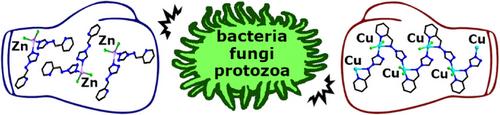
The reaction of copper(II) chloride with azomethine ligand 4-(pyridin-2-yl)methyleneamino-1,2,4-triazole (L) yielded crystals of a 1D coordination polymer [Cu(L)Cl2]n (1), in whose structure metal atoms are bound by L molecules due to nitrogen atoms of imine, pyridyl, and triazole moieties. In contrast to this process, the reaction of zinc(II) chloride with L resulted in the formation of mononuclear complex [Zn(L)2Cl2]·H2O (2), containing L molecules coordinated to the metal center in a monodentate mode due to triazole nitrogen atoms. The structures of the coordination compounds obtained were determined by single-crystal X-ray diffraction. The antimicrobial activity of 1 and 2 was assessed against the bacteria Escherichia coli, Staphylococcus aureus, Streptococcus spp., the fungi Candida albicans, Candida glabrata, Aspergillus fumigatus, Rhizopus oryzae, and the protozoa Colpoda steinii. Compound 1 showed high antiprotozoal activity, as well as significant antifungal activity against C. glabrata, and complex 2 demonstrated high bacteriostatic activity against Streptococcus spp. Thermal stability of 1 and 2 was studied by simultaneous thermal analysis under an argon atmosphere.
期刊介绍:
ChemistrySelect is the latest journal from ChemPubSoc Europe and Wiley-VCH. It offers researchers a quality society-owned journal in which to publish their work in all areas of chemistry. Manuscripts are evaluated by active researchers to ensure they add meaningfully to the scientific literature, and those accepted are processed quickly to ensure rapid online publication.






 京公网安备 11010802042870号
京ICP备2023020795号-1
京公网安备 11010802042870号
京ICP备2023020795号-1

 分享
分享
 求助内容:
求助内容: 应助结果提醒方式:
 扫码关注我们
