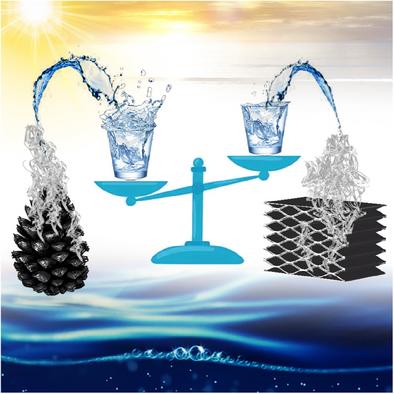
Bio-Inspired 3D Substrates for Efficient Interfacial Solar Steam Generation: FeNi Nanoparticles-Coated Wood Sponge and Pine Cone for Sustainable Desalination
Halimeh-Sadat Sajjadizadeh, Prof. Elaheh K. Goharshadi, Reyhaneh Dehghani
{"title":"Bio-Inspired 3D Substrates for Efficient Interfacial Solar Steam Generation: FeNi Nanoparticles-Coated Wood Sponge and Pine Cone for Sustainable Desalination","authors":"Halimeh-Sadat Sajjadizadeh, Prof. Elaheh K. Goharshadi, Reyhaneh Dehghani","doi":"10.1002/slct.202500243","DOIUrl":null,"url":null,"abstract":"<p>Interfacial solar steam generation (ISSG) is an emerging technology for sustainable water production, harnessing solar energy to desalinate seawater and treat wastewater. However, the development of efficient, cost-effective photothermal materials for these systems remains a challenge. This study investigates the use of FeNi nanoparticles (NPs) coated on bio-inspired substrates—wood sponge (WS) and pine cone (PC)—for ISSG. These substrates, enhanced for their high porosity and hydrophilicity, facilitate water transport via capillary action, whereas the FeNi NPs improve light absorption and photothermal conversion. Results show that both PC/FeNi and WS/FeNi demonstrate high evaporation efficiencies, with PC/FeNi outperforming WS/FeNi in terms of evaporation flux and stability across multiple cycles. The PC-based device achieved a solar evaporation flux of 1.73 kg m<sup>2</sup> h⁻¹ and an efficiency of 97.59% under 1 sun illumination, showing promise for large-scale desalination. Furthermore, both photoabsorbers effectively reduced ion concentrations in seawater, meeting WHO drinking water standards. This study highlights the potential of bio-inspired, 3D structured substrates like PC for efficient and sustainable ISSG applications.</p>","PeriodicalId":146,"journal":{"name":"ChemistrySelect","volume":"10 16","pages":""},"PeriodicalIF":2.0000,"publicationDate":"2025-04-22","publicationTypes":"Journal Article","fieldsOfStudy":null,"isOpenAccess":false,"openAccessPdf":"","citationCount":"0","resultStr":null,"platform":"Semanticscholar","paperid":null,"PeriodicalName":"ChemistrySelect","FirstCategoryId":"92","ListUrlMain":"https://chemistry-europe.onlinelibrary.wiley.com/doi/10.1002/slct.202500243","RegionNum":4,"RegionCategory":"化学","ArticlePicture":[],"TitleCN":null,"AbstractTextCN":null,"PMCID":null,"EPubDate":"","PubModel":"","JCR":"Q3","JCRName":"CHEMISTRY, MULTIDISCIPLINARY","Score":null,"Total":0}
引用次数: 0
Abstract
Interfacial solar steam generation (ISSG) is an emerging technology for sustainable water production, harnessing solar energy to desalinate seawater and treat wastewater. However, the development of efficient, cost-effective photothermal materials for these systems remains a challenge. This study investigates the use of FeNi nanoparticles (NPs) coated on bio-inspired substrates—wood sponge (WS) and pine cone (PC)—for ISSG. These substrates, enhanced for their high porosity and hydrophilicity, facilitate water transport via capillary action, whereas the FeNi NPs improve light absorption and photothermal conversion. Results show that both PC/FeNi and WS/FeNi demonstrate high evaporation efficiencies, with PC/FeNi outperforming WS/FeNi in terms of evaporation flux and stability across multiple cycles. The PC-based device achieved a solar evaporation flux of 1.73 kg m2 h⁻¹ and an efficiency of 97.59% under 1 sun illumination, showing promise for large-scale desalination. Furthermore, both photoabsorbers effectively reduced ion concentrations in seawater, meeting WHO drinking water standards. This study highlights the potential of bio-inspired, 3D structured substrates like PC for efficient and sustainable ISSG applications.
界面太阳能蒸汽发电(ISSG)是一项新兴的可持续制水技术,利用太阳能淡化海水和处理废水。然而,为这些系统开发高效、经济的光热材料仍然是一个挑战。本研究探讨了将FeNi纳米颗粒(NPs)涂覆在仿生基质(木质海绵(WS)和松果(PC))上用于ISSG。这些基质由于其高孔隙率和亲水性而增强,通过毛细管作用促进了水的运输,而FeNi NPs则改善了光吸收和光热转换。结果表明,PC/FeNi和WS/FeNi均表现出较高的蒸发效率,PC/FeNi在多循环蒸发通量和稳定性方面优于WS/FeNi。基于pc的装置实现了1.73 kg m2 h⁻¹的太阳蒸发通量和97.59%的太阳照射效率,显示了大规模海水淡化的前景。此外,这两种光吸收剂都有效降低了海水中的离子浓度,符合世卫组织饮用水标准。这项研究强调了生物启发的3D结构基板(如PC)在高效和可持续的ISSG应用中的潜力。
期刊介绍:
ChemistrySelect is the latest journal from ChemPubSoc Europe and Wiley-VCH. It offers researchers a quality society-owned journal in which to publish their work in all areas of chemistry. Manuscripts are evaluated by active researchers to ensure they add meaningfully to the scientific literature, and those accepted are processed quickly to ensure rapid online publication.





 京公网安备 11010802042870号
京ICP备2023020795号-1
京公网安备 11010802042870号
京ICP备2023020795号-1

 分享
分享
 求助内容:
求助内容: 应助结果提醒方式:
 扫码关注我们
