Belal Abboushi, Eduardo Rodriguez-Feo Bermudez, Jason Tuenge, Gabe Arnold
{"title":"GUV Installations Demonstrate Effectiveness and Exposure Safety in Field Settings","authors":"Belal Abboushi, Eduardo Rodriguez-Feo Bermudez, Jason Tuenge, Gabe Arnold","doi":"10.1021/acs.est.4c10774","DOIUrl":null,"url":null,"abstract":"Germicidal ultraviolet (GUV) radiation is used in various building types and indoor applications across the U.S. to mitigate the risk of infection from airborne pathogens. However, to date, few studies have evaluated the in situ effectiveness, safety, and occupant’s experience with these installations. To address this gap, we developed and applied a protocol for evaluating in situ performance of whole-room (far UV-C) and upper-room GUV installations. Radiometric and electrical measurements were collected characterizing the spectrum, fluence rate, eye and skin exposure, and energy use of 15 installations. Additionally, a questionnaire asked facility managers and occupants about their satisfaction with the GUV installations. Most installations did not exceed time weighted average limits for eye and skin safety. Findings showed that GUV contributed between 3% to 150% toward meeting ASHRAE 241 equivalent clean airflow targets. These findings support further deployment of these GUV technologies to help inactivate airborne pathogens. The GUV system characterization reported in this article can be used to inform GUV system simulation assumptions.","PeriodicalId":36,"journal":{"name":"环境科学与技术","volume":"35 1","pages":""},"PeriodicalIF":11.3000,"publicationDate":"2025-04-22","publicationTypes":"Journal Article","fieldsOfStudy":null,"isOpenAccess":false,"openAccessPdf":"","citationCount":"0","resultStr":null,"platform":"Semanticscholar","paperid":null,"PeriodicalName":"环境科学与技术","FirstCategoryId":"1","ListUrlMain":"https://doi.org/10.1021/acs.est.4c10774","RegionNum":1,"RegionCategory":"环境科学与生态学","ArticlePicture":[],"TitleCN":null,"AbstractTextCN":null,"PMCID":null,"EPubDate":"","PubModel":"","JCR":"Q1","JCRName":"ENGINEERING, ENVIRONMENTAL","Score":null,"Total":0}
引用次数: 0
Abstract
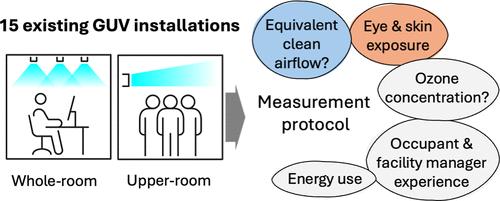
Germicidal ultraviolet (GUV) radiation is used in various building types and indoor applications across the U.S. to mitigate the risk of infection from airborne pathogens. However, to date, few studies have evaluated the in situ effectiveness, safety, and occupant’s experience with these installations. To address this gap, we developed and applied a protocol for evaluating in situ performance of whole-room (far UV-C) and upper-room GUV installations. Radiometric and electrical measurements were collected characterizing the spectrum, fluence rate, eye and skin exposure, and energy use of 15 installations. Additionally, a questionnaire asked facility managers and occupants about their satisfaction with the GUV installations. Most installations did not exceed time weighted average limits for eye and skin safety. Findings showed that GUV contributed between 3% to 150% toward meeting ASHRAE 241 equivalent clean airflow targets. These findings support further deployment of these GUV technologies to help inactivate airborne pathogens. The GUV system characterization reported in this article can be used to inform GUV system simulation assumptions.
期刊介绍:
Environmental Science & Technology (ES&T) is a co-sponsored academic and technical magazine by the Hubei Provincial Environmental Protection Bureau and the Hubei Provincial Academy of Environmental Sciences.
Environmental Science & Technology (ES&T) holds the status of Chinese core journals, scientific papers source journals of China, Chinese Science Citation Database source journals, and Chinese Academic Journal Comprehensive Evaluation Database source journals. This publication focuses on the academic field of environmental protection, featuring articles related to environmental protection and technical advancements.



 京公网安备 11010802042870号
京ICP备2023020795号-1
京公网安备 11010802042870号
京ICP备2023020795号-1

 分享
分享
 求助内容:
求助内容: 应助结果提醒方式:
 扫码关注我们
