Teng Wang, Xi Chen, Yuan Yao, Wu Chen, Haonan Li, Yifan Xu, Tianjia Guan, Jicheng Gong, Xinghua Qiu, Tong Zhu
{"title":"Pro-Thrombotic Changes in Response to Ambient Ozone Exposure Exacerbated by Temperatures","authors":"Teng Wang, Xi Chen, Yuan Yao, Wu Chen, Haonan Li, Yifan Xu, Tianjia Guan, Jicheng Gong, Xinghua Qiu, Tong Zhu","doi":"10.1021/acs.est.4c13457","DOIUrl":null,"url":null,"abstract":"Recent evidence links high temperatures to increased ozone-related cardiovascular mortality in a changing climate, but the underlying biological mechanisms remain unclear. We investigated the associations between short-term ozone exposure and pro-thrombosis, a key process in the pathophysiology of cardiovascular diseases across varying temperatures (5–30 °C) in a longitudinal panel study of 135 participants in Beijing, China. Pro-thrombotic biomarkers and whole blood transcriptome data were measured repeatedly. Bayesian kernel machine regression revealed that higher serum thromboxane (Tx)B<sub>2</sub> levels were associated with increasing levels of joint exposure to air pollutants over 1 week when ozone rather than other pollutants contributed most to the overall effect. Causal mediation analyses found 715 transcripts associated with an increase in TxB<sub>2</sub> following ozone exposure, which were enriched in pathways, including ribosome, thermogenesis, oxidative phosphorylation, and pathways of neurodegeneration. As the temperature increased, we observed a stronger association between ozone exposure and TxB<sub>2</sub> increase. The TxB<sub>2</sub> increments per interquartile range increase in the one-week average of ozone were 6.6, 13.2, 14.8, 16.6, and 18.4 units when the temperatures were 6.5, 15.0, 17.6, 21.4, and 26.7 °C, respectively. The number of mediating transcripts enriched in pathways related to translation, environmental adaptation, energy metabolism, and human diseases was also greater at higher temperatures than at lower ones. This study suggests that higher temperatures exacerbate ozone-related pro-thrombotic response, providing a biological basis for the increased risk of ozone-associated cardiovascular mortality at high temperatures.","PeriodicalId":36,"journal":{"name":"环境科学与技术","volume":"32 1","pages":""},"PeriodicalIF":11.3000,"publicationDate":"2025-04-22","publicationTypes":"Journal Article","fieldsOfStudy":null,"isOpenAccess":false,"openAccessPdf":"","citationCount":"0","resultStr":null,"platform":"Semanticscholar","paperid":null,"PeriodicalName":"环境科学与技术","FirstCategoryId":"1","ListUrlMain":"https://doi.org/10.1021/acs.est.4c13457","RegionNum":1,"RegionCategory":"环境科学与生态学","ArticlePicture":[],"TitleCN":null,"AbstractTextCN":null,"PMCID":null,"EPubDate":"","PubModel":"","JCR":"Q1","JCRName":"ENGINEERING, ENVIRONMENTAL","Score":null,"Total":0}
引用次数: 0
Abstract
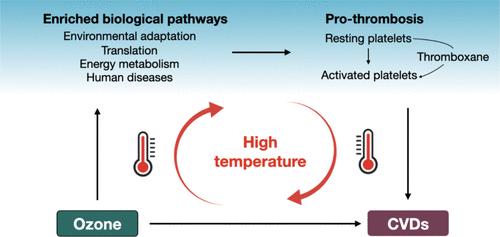
Recent evidence links high temperatures to increased ozone-related cardiovascular mortality in a changing climate, but the underlying biological mechanisms remain unclear. We investigated the associations between short-term ozone exposure and pro-thrombosis, a key process in the pathophysiology of cardiovascular diseases across varying temperatures (5–30 °C) in a longitudinal panel study of 135 participants in Beijing, China. Pro-thrombotic biomarkers and whole blood transcriptome data were measured repeatedly. Bayesian kernel machine regression revealed that higher serum thromboxane (Tx)B2 levels were associated with increasing levels of joint exposure to air pollutants over 1 week when ozone rather than other pollutants contributed most to the overall effect. Causal mediation analyses found 715 transcripts associated with an increase in TxB2 following ozone exposure, which were enriched in pathways, including ribosome, thermogenesis, oxidative phosphorylation, and pathways of neurodegeneration. As the temperature increased, we observed a stronger association between ozone exposure and TxB2 increase. The TxB2 increments per interquartile range increase in the one-week average of ozone were 6.6, 13.2, 14.8, 16.6, and 18.4 units when the temperatures were 6.5, 15.0, 17.6, 21.4, and 26.7 °C, respectively. The number of mediating transcripts enriched in pathways related to translation, environmental adaptation, energy metabolism, and human diseases was also greater at higher temperatures than at lower ones. This study suggests that higher temperatures exacerbate ozone-related pro-thrombotic response, providing a biological basis for the increased risk of ozone-associated cardiovascular mortality at high temperatures.
期刊介绍:
Environmental Science & Technology (ES&T) is a co-sponsored academic and technical magazine by the Hubei Provincial Environmental Protection Bureau and the Hubei Provincial Academy of Environmental Sciences.
Environmental Science & Technology (ES&T) holds the status of Chinese core journals, scientific papers source journals of China, Chinese Science Citation Database source journals, and Chinese Academic Journal Comprehensive Evaluation Database source journals. This publication focuses on the academic field of environmental protection, featuring articles related to environmental protection and technical advancements.




 京公网安备 11010802042870号
京ICP备2023020795号-1
京公网安备 11010802042870号
京ICP备2023020795号-1

 分享
分享
 求助内容:
求助内容: 应助结果提醒方式:
 扫码关注我们
