{"title":"New Psychoactive Substance Esketamine Causes Endocrine-Disrupting Effects and Developmental Toxicity","authors":"Si-Ying Li, Dongdong Ma, Wen-Jun Shi, Jin-Ge Zhang, Bo Tang, Zhi-Jie Lu, Chong-Rui Yao, Xiao-Bing Long, Xin Liu, Chu-Shu Huang, Guang-Guo Ying","doi":"10.1021/acs.est.5c00589","DOIUrl":null,"url":null,"abstract":"Esketamine (ESK), a new psychoactive substance known for its strong hallucinogenic effect, has been detected in surface water worldwide. The toxicity of ESK to fish at a certain environmental concentration remains unclear. In this study, zebrafish embryos and ZF4 cells were exposed to ESK (0, 0.12, 1.02, and 10.6 μg L<sup>–1</sup>, marked by SC, LC, MC, and HC, respectively) for 14 days post fertilization (dpf) and 24 h, respectively. Biphasic dose responses induced by ESK were observed after 24 h of exposure. ESK-LC and ESK-MC obviously increased embryo area and length, height, and volume of yolk sac, whereas ESK-HC had the opposite effect. ESK-LC and ESK-MC appreciably upregulated the transcription and expression levels of <i>vtg</i>, disrupting the cell cycle after 24 h of exposure. After 14 dpf exposure, KEGG analysis indicated that circadian rhythm, nucleotide excision repair, and estrogen signaling pathways were the top three impacted pathways, with ESK significantly enhancing gene transcription in these three pathways, except for <i>cyp7a1</i> and <i>bh1he41</i>. Correspondingly, ESK notably increased the VTG level, aligning with the relatively high affinity of estrogen receptors, as analyzed through molecular docking. Our research demonstrated that ESK exhibits developmental toxicity and endocrine-disrupting effects in zebrafish, highlighting the need to address its ecological toxicity in fish.","PeriodicalId":36,"journal":{"name":"环境科学与技术","volume":"67 1","pages":""},"PeriodicalIF":11.3000,"publicationDate":"2025-04-22","publicationTypes":"Journal Article","fieldsOfStudy":null,"isOpenAccess":false,"openAccessPdf":"","citationCount":"0","resultStr":null,"platform":"Semanticscholar","paperid":null,"PeriodicalName":"环境科学与技术","FirstCategoryId":"1","ListUrlMain":"https://doi.org/10.1021/acs.est.5c00589","RegionNum":1,"RegionCategory":"环境科学与生态学","ArticlePicture":[],"TitleCN":null,"AbstractTextCN":null,"PMCID":null,"EPubDate":"","PubModel":"","JCR":"Q1","JCRName":"ENGINEERING, ENVIRONMENTAL","Score":null,"Total":0}
引用次数: 0
Abstract
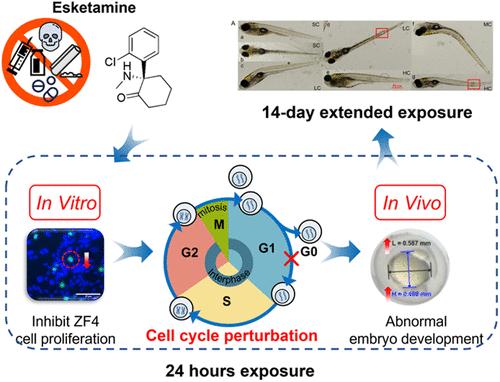
Esketamine (ESK), a new psychoactive substance known for its strong hallucinogenic effect, has been detected in surface water worldwide. The toxicity of ESK to fish at a certain environmental concentration remains unclear. In this study, zebrafish embryos and ZF4 cells were exposed to ESK (0, 0.12, 1.02, and 10.6 μg L–1, marked by SC, LC, MC, and HC, respectively) for 14 days post fertilization (dpf) and 24 h, respectively. Biphasic dose responses induced by ESK were observed after 24 h of exposure. ESK-LC and ESK-MC obviously increased embryo area and length, height, and volume of yolk sac, whereas ESK-HC had the opposite effect. ESK-LC and ESK-MC appreciably upregulated the transcription and expression levels of vtg, disrupting the cell cycle after 24 h of exposure. After 14 dpf exposure, KEGG analysis indicated that circadian rhythm, nucleotide excision repair, and estrogen signaling pathways were the top three impacted pathways, with ESK significantly enhancing gene transcription in these three pathways, except for cyp7a1 and bh1he41. Correspondingly, ESK notably increased the VTG level, aligning with the relatively high affinity of estrogen receptors, as analyzed through molecular docking. Our research demonstrated that ESK exhibits developmental toxicity and endocrine-disrupting effects in zebrafish, highlighting the need to address its ecological toxicity in fish.
期刊介绍:
Environmental Science & Technology (ES&T) is a co-sponsored academic and technical magazine by the Hubei Provincial Environmental Protection Bureau and the Hubei Provincial Academy of Environmental Sciences.
Environmental Science & Technology (ES&T) holds the status of Chinese core journals, scientific papers source journals of China, Chinese Science Citation Database source journals, and Chinese Academic Journal Comprehensive Evaluation Database source journals. This publication focuses on the academic field of environmental protection, featuring articles related to environmental protection and technical advancements.



 京公网安备 11010802042870号
京ICP备2023020795号-1
京公网安备 11010802042870号
京ICP备2023020795号-1

 分享
分享
 求助内容:
求助内容: 应助结果提醒方式:
 扫码关注我们
