{"title":"Xenometabolomics in Ecotoxicology: Concepts and Applications","authors":"Phillip Ankley, Hannah Mahoney, Markus Brinkmann","doi":"10.1021/acs.est.4c13689","DOIUrl":null,"url":null,"abstract":"Nontargeted high-resolution mass spectrometry (HRMS) allows for the characterization of a large fraction of the exposome, i.e., the entirety of chemicals an organism is exposed to, and helps detect important exogenous chemical compounds that could be key drivers of toxicological impact. Along with these chemical compounds occur endogenous metabolites that are essential for the health of the host organism. Chemical compounds derived from the biotransformation of xenobiotics present in the exposome are referred to as the xenometabolome, while endogenous metabolites derived from the host organism are referred to as the endometabolome. Recent advancements in HRMS technology allow for the detection of chemical features of biological and ecological importance in the context of chemical safety assessments with unprecedented sensitivity and resolution. In this perspective, we highlight the application of HRMS-based metabolomics of organisms in the context of ecotoxicology, the complexity of comprehensively characterizing the endometabolome, and distinguishing chemical compounds of the xenometabolome.","PeriodicalId":36,"journal":{"name":"环境科学与技术","volume":"108 1","pages":""},"PeriodicalIF":11.3000,"publicationDate":"2025-04-22","publicationTypes":"Journal Article","fieldsOfStudy":null,"isOpenAccess":false,"openAccessPdf":"","citationCount":"0","resultStr":null,"platform":"Semanticscholar","paperid":null,"PeriodicalName":"环境科学与技术","FirstCategoryId":"1","ListUrlMain":"https://doi.org/10.1021/acs.est.4c13689","RegionNum":1,"RegionCategory":"环境科学与生态学","ArticlePicture":[],"TitleCN":null,"AbstractTextCN":null,"PMCID":null,"EPubDate":"","PubModel":"","JCR":"Q1","JCRName":"ENGINEERING, ENVIRONMENTAL","Score":null,"Total":0}
引用次数: 0
Abstract
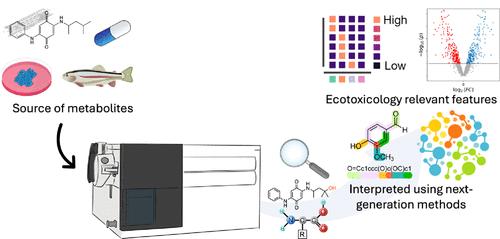
Nontargeted high-resolution mass spectrometry (HRMS) allows for the characterization of a large fraction of the exposome, i.e., the entirety of chemicals an organism is exposed to, and helps detect important exogenous chemical compounds that could be key drivers of toxicological impact. Along with these chemical compounds occur endogenous metabolites that are essential for the health of the host organism. Chemical compounds derived from the biotransformation of xenobiotics present in the exposome are referred to as the xenometabolome, while endogenous metabolites derived from the host organism are referred to as the endometabolome. Recent advancements in HRMS technology allow for the detection of chemical features of biological and ecological importance in the context of chemical safety assessments with unprecedented sensitivity and resolution. In this perspective, we highlight the application of HRMS-based metabolomics of organisms in the context of ecotoxicology, the complexity of comprehensively characterizing the endometabolome, and distinguishing chemical compounds of the xenometabolome.
期刊介绍:
Environmental Science & Technology (ES&T) is a co-sponsored academic and technical magazine by the Hubei Provincial Environmental Protection Bureau and the Hubei Provincial Academy of Environmental Sciences.
Environmental Science & Technology (ES&T) holds the status of Chinese core journals, scientific papers source journals of China, Chinese Science Citation Database source journals, and Chinese Academic Journal Comprehensive Evaluation Database source journals. This publication focuses on the academic field of environmental protection, featuring articles related to environmental protection and technical advancements.



 京公网安备 11010802042870号
京ICP备2023020795号-1
京公网安备 11010802042870号
京ICP备2023020795号-1

 分享
分享
 求助内容:
求助内容: 应助结果提醒方式:
 扫码关注我们
