{"title":"Accelerating Nitrite Reduction to Ammonia: The Synergistic Effect of Dual Active Site Pt–Ir Catalysts","authors":"Huimin Xu, Yaoyu Zhang, Yuxiong Wang, Xuanhao Wu, Xiaoqiang Wang, Yue Liu, Zhongbiao Wu","doi":"10.1021/acs.est.5c02608","DOIUrl":null,"url":null,"abstract":"Ir-based catalysts have been demonstrated as promising catalysts for the reduction of NO<sub>2</sub><sup>–</sup> to ammonia (NRA). However, the strong competitive adsorption of NO<sub>2</sub><sup>–</sup> over H<sub>2</sub> on Ir sites, leading to H* deficiency at high NO<sub>2</sub><sup>–</sup> concentrations, would hinder its real application. Here, we proposed an effective strategy to solve this problem by constructing dual active site Ir–Pt/TiO<sub>2</sub> composite catalysts with physical mixing (Ir+Pt/TiO<sub>2</sub>) and co-impregnation (IrPt/TiO<sub>2</sub>) methods. On such catalysts, the hydrogen spillover effect on Pt sites could alleviate H* insufficiency on Ir sites, thereby accelerating the NRA reaction. Specifically, the optimal dry-mixed Ir+Pt/TiO<sub>2</sub> catalyst exhibited an NRA rate constant of 12.4 L·g<sub>Ir+Pt</sub><sup>–1</sup>·min<sup>–1</sup>, approximately twice that of the Ir/TiO<sub>2</sub> sample. Moreover, Ir+Pt/TiO<sub>2</sub> catalysts showed first-order reaction kinetics rather than competitive reaction kinetics, confirming the alleviation of the H* deficiency limitation. Various characterization methods revealed that H* derived from H<sub>2</sub> dissociated adsorption on Pt sites could migrate through the TiO<sub>2</sub> support to Ir sites. DFT calculations also proved the thermodynamic feasibility of H* migration on TiO<sub>2</sub>. Moreover, to further improve NRA activity, IrPt/TiO<sub>2</sub> alloy catalysts were employed to enhance Pt–Ir synergy, exhibiting the highest NRA rate constant of 17.0 L·g<sub>Ir+Pt</sub><sup>–1</sup>·min<sup>–1</sup>.","PeriodicalId":36,"journal":{"name":"环境科学与技术","volume":"39 1","pages":""},"PeriodicalIF":11.3000,"publicationDate":"2025-04-22","publicationTypes":"Journal Article","fieldsOfStudy":null,"isOpenAccess":false,"openAccessPdf":"","citationCount":"0","resultStr":null,"platform":"Semanticscholar","paperid":null,"PeriodicalName":"环境科学与技术","FirstCategoryId":"1","ListUrlMain":"https://doi.org/10.1021/acs.est.5c02608","RegionNum":1,"RegionCategory":"环境科学与生态学","ArticlePicture":[],"TitleCN":null,"AbstractTextCN":null,"PMCID":null,"EPubDate":"","PubModel":"","JCR":"Q1","JCRName":"ENGINEERING, ENVIRONMENTAL","Score":null,"Total":0}
引用次数: 0
Abstract
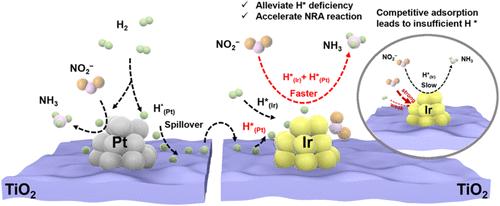
Ir-based catalysts have been demonstrated as promising catalysts for the reduction of NO2– to ammonia (NRA). However, the strong competitive adsorption of NO2– over H2 on Ir sites, leading to H* deficiency at high NO2– concentrations, would hinder its real application. Here, we proposed an effective strategy to solve this problem by constructing dual active site Ir–Pt/TiO2 composite catalysts with physical mixing (Ir+Pt/TiO2) and co-impregnation (IrPt/TiO2) methods. On such catalysts, the hydrogen spillover effect on Pt sites could alleviate H* insufficiency on Ir sites, thereby accelerating the NRA reaction. Specifically, the optimal dry-mixed Ir+Pt/TiO2 catalyst exhibited an NRA rate constant of 12.4 L·gIr+Pt–1·min–1, approximately twice that of the Ir/TiO2 sample. Moreover, Ir+Pt/TiO2 catalysts showed first-order reaction kinetics rather than competitive reaction kinetics, confirming the alleviation of the H* deficiency limitation. Various characterization methods revealed that H* derived from H2 dissociated adsorption on Pt sites could migrate through the TiO2 support to Ir sites. DFT calculations also proved the thermodynamic feasibility of H* migration on TiO2. Moreover, to further improve NRA activity, IrPt/TiO2 alloy catalysts were employed to enhance Pt–Ir synergy, exhibiting the highest NRA rate constant of 17.0 L·gIr+Pt–1·min–1.
期刊介绍:
Environmental Science & Technology (ES&T) is a co-sponsored academic and technical magazine by the Hubei Provincial Environmental Protection Bureau and the Hubei Provincial Academy of Environmental Sciences.
Environmental Science & Technology (ES&T) holds the status of Chinese core journals, scientific papers source journals of China, Chinese Science Citation Database source journals, and Chinese Academic Journal Comprehensive Evaluation Database source journals. This publication focuses on the academic field of environmental protection, featuring articles related to environmental protection and technical advancements.



 京公网安备 11010802042870号
京ICP备2023020795号-1
京公网安备 11010802042870号
京ICP备2023020795号-1

 分享
分享
 求助内容:
求助内容: 应助结果提醒方式:
 扫码关注我们
