{"title":"Quantifying the Effect of Dietary Microplastics on the Potential for Biological Uptake of Environmental Contaminants and Polymer Additives","authors":"Desmond Ng, Yuhao Chen, Ying Duan Lei, Wanzhen Chen, Hui Peng, Sarra Gourlie, Frank Wania","doi":"10.1021/acs.est.5c02616","DOIUrl":null,"url":null,"abstract":"The pervasive presence of microplastic in food raises the question of how this presence influences the uptake of organic contaminants from the gastrointestinal tract. Depending on the relative contamination of diet and microplastics, the latter can act either as a vector of contaminants facilitating biological uptake or as a contaminant sink whose sorptive capacity does not diminish during digestion. A comprehensive understanding of these effects ultimately requires the quantification of the effect of microplastics on the thermodynamic driving force responsible for diffusion from the gut lumen to the tissues of an organism. Using silicone-based equilibrium sampling, we quantified the effect of polyvinyl chloride (PVC) microplastics on the fugacity of polychlorinated biphenyls (PCBs) and two polymer additives in dietary and fecal samples of a zoo-housed polar bear. Although PVC microplastics at concentrations well above current observations reduced the fugacities of spiked isotopically labeled PCBs in the polar bear diet and feces slightly, but significantly, leaching from these microplastics greatly elevated fugacities of the additives UV-328 and octabenzone in these samples. The impact of microplastics in the diet on the biological uptake of environmental hydrophobic organic contaminants is likely to be negligible. Microplastics have the potential to be effective vectors for the dietary uptake of polymer additives.","PeriodicalId":36,"journal":{"name":"环境科学与技术","volume":"32 1","pages":""},"PeriodicalIF":11.3000,"publicationDate":"2025-04-22","publicationTypes":"Journal Article","fieldsOfStudy":null,"isOpenAccess":false,"openAccessPdf":"","citationCount":"0","resultStr":null,"platform":"Semanticscholar","paperid":null,"PeriodicalName":"环境科学与技术","FirstCategoryId":"1","ListUrlMain":"https://doi.org/10.1021/acs.est.5c02616","RegionNum":1,"RegionCategory":"环境科学与生态学","ArticlePicture":[],"TitleCN":null,"AbstractTextCN":null,"PMCID":null,"EPubDate":"","PubModel":"","JCR":"Q1","JCRName":"ENGINEERING, ENVIRONMENTAL","Score":null,"Total":0}
引用次数: 0
Abstract
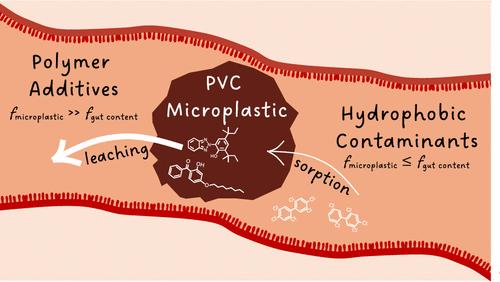
The pervasive presence of microplastic in food raises the question of how this presence influences the uptake of organic contaminants from the gastrointestinal tract. Depending on the relative contamination of diet and microplastics, the latter can act either as a vector of contaminants facilitating biological uptake or as a contaminant sink whose sorptive capacity does not diminish during digestion. A comprehensive understanding of these effects ultimately requires the quantification of the effect of microplastics on the thermodynamic driving force responsible for diffusion from the gut lumen to the tissues of an organism. Using silicone-based equilibrium sampling, we quantified the effect of polyvinyl chloride (PVC) microplastics on the fugacity of polychlorinated biphenyls (PCBs) and two polymer additives in dietary and fecal samples of a zoo-housed polar bear. Although PVC microplastics at concentrations well above current observations reduced the fugacities of spiked isotopically labeled PCBs in the polar bear diet and feces slightly, but significantly, leaching from these microplastics greatly elevated fugacities of the additives UV-328 and octabenzone in these samples. The impact of microplastics in the diet on the biological uptake of environmental hydrophobic organic contaminants is likely to be negligible. Microplastics have the potential to be effective vectors for the dietary uptake of polymer additives.
期刊介绍:
Environmental Science & Technology (ES&T) is a co-sponsored academic and technical magazine by the Hubei Provincial Environmental Protection Bureau and the Hubei Provincial Academy of Environmental Sciences.
Environmental Science & Technology (ES&T) holds the status of Chinese core journals, scientific papers source journals of China, Chinese Science Citation Database source journals, and Chinese Academic Journal Comprehensive Evaluation Database source journals. This publication focuses on the academic field of environmental protection, featuring articles related to environmental protection and technical advancements.



 京公网安备 11010802042870号
京ICP备2023020795号-1
京公网安备 11010802042870号
京ICP备2023020795号-1

 分享
分享
 求助内容:
求助内容: 应助结果提醒方式:
 扫码关注我们
