Enhancing work hardening capacity of B2-ordered Ti3Zr1.5NbVAl0.75 light refractory complex concentrated alloy via heterogeneous precipitation of C14 Laves phase
{"title":"Enhancing work hardening capacity of B2-ordered Ti3Zr1.5NbVAl0.75 light refractory complex concentrated alloy via heterogeneous precipitation of C14 Laves phase","authors":"Shuai Zeng, Yongkang Zhou, Bowen Zhao, Jingqian Chen, Xiaoya Liu, Bang Xiao, Aimin Wang, Huameng Fu, Haifeng Zhang, Zhengwang Zhu","doi":"10.1016/j.jmst.2025.02.068","DOIUrl":null,"url":null,"abstract":"The inherent high strength and low density of Al-containing refractory complex concentrate alloys (RCCAs) stand as significant advantages, yet their susceptibility to brittleness and early onset of plastic instability persist as critical limitations. The paper describes that, by tailoring the annealing process, the strength and strain hardening capacity can be synergistically optimized in a B2-ordered Ti<sub>3</sub>Zr<sub>1.5</sub>NbVAl<sub>0.75</sub> lightweight RCCA. Following a 50% cold rolling and subsequent annealing at 1000°C, the alloy developed a completely recrystallized organization, whilst maintaining its original BCC+B2 structure. The tensile behavior exhibited minimal variance in comparison to its as-cast condition. Notably, upon undergoing an annealing treatment at 800°C, the precipitation of C14 Laves phase on the submicron scale alongside the formation of heterogeneous sub-grain structure endowed the alloy with an exceptional synergy of a tensile strength of ∼ 1200 MPa and a fracture elongation of ∼ 7%, together with a high work-hardening rate over 1 GPa. The sub-grain boundaries enhance dislocation multiplication and promote multiple slips, while the C14 Laves phase effectively hinders the propagation of slip bands, thus mitigating localized plastic flow. Dislocation accumulation at the phase interface subsequently promotes the formation of stacking faults in the Laves phase, which alleviates the stress concentration at the mismatched interface. This coordinated deformation within the heterogeneous structure ultimately imparts the alloy with superior mechanical properties. These findings provide critical insights for optimizing the properties of RCCAs through microstructural engineering and fostering their application in advanced manufacturing.","PeriodicalId":16154,"journal":{"name":"Journal of Materials Science & Technology","volume":"138 1","pages":""},"PeriodicalIF":14.3000,"publicationDate":"2025-04-23","publicationTypes":"Journal Article","fieldsOfStudy":null,"isOpenAccess":false,"openAccessPdf":"","citationCount":"0","resultStr":null,"platform":"Semanticscholar","paperid":null,"PeriodicalName":"Journal of Materials Science & Technology","FirstCategoryId":"88","ListUrlMain":"https://doi.org/10.1016/j.jmst.2025.02.068","RegionNum":1,"RegionCategory":"材料科学","ArticlePicture":[],"TitleCN":null,"AbstractTextCN":null,"PMCID":null,"EPubDate":"","PubModel":"","JCR":"Q1","JCRName":"MATERIALS SCIENCE, MULTIDISCIPLINARY","Score":null,"Total":0}
引用次数: 0
Abstract
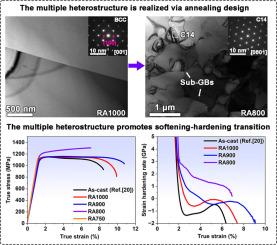
The inherent high strength and low density of Al-containing refractory complex concentrate alloys (RCCAs) stand as significant advantages, yet their susceptibility to brittleness and early onset of plastic instability persist as critical limitations. The paper describes that, by tailoring the annealing process, the strength and strain hardening capacity can be synergistically optimized in a B2-ordered Ti3Zr1.5NbVAl0.75 lightweight RCCA. Following a 50% cold rolling and subsequent annealing at 1000°C, the alloy developed a completely recrystallized organization, whilst maintaining its original BCC+B2 structure. The tensile behavior exhibited minimal variance in comparison to its as-cast condition. Notably, upon undergoing an annealing treatment at 800°C, the precipitation of C14 Laves phase on the submicron scale alongside the formation of heterogeneous sub-grain structure endowed the alloy with an exceptional synergy of a tensile strength of ∼ 1200 MPa and a fracture elongation of ∼ 7%, together with a high work-hardening rate over 1 GPa. The sub-grain boundaries enhance dislocation multiplication and promote multiple slips, while the C14 Laves phase effectively hinders the propagation of slip bands, thus mitigating localized plastic flow. Dislocation accumulation at the phase interface subsequently promotes the formation of stacking faults in the Laves phase, which alleviates the stress concentration at the mismatched interface. This coordinated deformation within the heterogeneous structure ultimately imparts the alloy with superior mechanical properties. These findings provide critical insights for optimizing the properties of RCCAs through microstructural engineering and fostering their application in advanced manufacturing.
期刊介绍:
Journal of Materials Science & Technology strives to promote global collaboration in the field of materials science and technology. It primarily publishes original research papers, invited review articles, letters, research notes, and summaries of scientific achievements. The journal covers a wide range of materials science and technology topics, including metallic materials, inorganic nonmetallic materials, and composite materials.



 京公网安备 11010802042870号
京ICP备2023020795号-1
京公网安备 11010802042870号
京ICP备2023020795号-1

 分享
分享
 求助内容:
求助内容: 应助结果提醒方式:
 扫码关注我们
