Xinjie Yuan, Pengfei Qiu, Chuanyao Sun, Shiqi Yang, Yi Wu, Yumeng Wang, Ming Gu, Lidong Chen and Xun Shi
{"title":"Screening thermoelectric materials for high-output performance in wearable electronics†","authors":"Xinjie Yuan, Pengfei Qiu, Chuanyao Sun, Shiqi Yang, Yi Wu, Yumeng Wang, Ming Gu, Lidong Chen and Xun Shi","doi":"10.1039/D5EE00216H","DOIUrl":null,"url":null,"abstract":"<p >Thermoelectric (TE) technology provides a promising self-powered solution for wearable electronics and the Internet of Things (IoT), but the output voltage density and power density of current TE devices remain far below the target values required for practical use. In this work, instead of the commonly used TE figure-of-merit (<em>zT</em> = <em>S</em><small><sup>2</sup></small><em>σ</em>/<em>κT</em>, where <em>S</em> is the Seebeck coefficient, <em>σ</em> is the electrical conductivity, <em>κ</em> is the thermal conductivity, and <em>T</em> is the absolute temperature), we proposed that |<em>S</em>|/<em>κ</em> and <em>S</em><small><sup>2</sup></small><em>σ</em>/<em>κ</em><small><sup>2</sup></small> were more effective indicators for screening TE materials for the development of high-performance TE devices for use in the exacting working conditions (<em>e.g.</em>, windless indoor environments and extremely limited space) of wearable electronics and the IoT. As a case study, both simulations and experiments were performed and clearly demonstrated that the TE device consisting of n-type Ag<small><sub>1.995</sub></small>Au<small><sub>0.005</sub></small>Te<small><sub>0.7</sub></small>S<small><sub>0.3</sub></small> and p-type Ag<small><sub>0.9</sub></small>Sb<small><sub>1.1</sub></small>Te<small><sub>2.1</sub></small> with high |<em>S</em>|/<em>κ</em> and <em>S</em><small><sup>2</sup></small><em>σ</em>/<em>κ</em><small><sup>2</sup></small> values achieved higher output performance than the Bi<small><sub>2</sub></small>Te<small><sub>3</sub></small>-based TE device. When the Ag<small><sub>1.995</sub></small>Au<small><sub>0.005</sub></small>Te<small><sub>0.7</sub></small>S<small><sub>0.3</sub></small>/Ag<small><sub>0.9</sub></small>Sb<small><sub>1.1</sub></small>Te<small><sub>2.1</sub></small> TE device was worn on the human wrist, a record-high voltage density and power density were achieved. This work provides new insight into the development of advanced TE devices for wearable electronics and the IoT.</p>","PeriodicalId":72,"journal":{"name":"Energy & Environmental Science","volume":" 11","pages":" 5416-5423"},"PeriodicalIF":30.8000,"publicationDate":"2025-04-23","publicationTypes":"Journal Article","fieldsOfStudy":null,"isOpenAccess":false,"openAccessPdf":"","citationCount":"0","resultStr":null,"platform":"Semanticscholar","paperid":null,"PeriodicalName":"Energy & Environmental Science","FirstCategoryId":"88","ListUrlMain":"https://pubs.rsc.org/en/content/articlelanding/2025/ee/d5ee00216h","RegionNum":1,"RegionCategory":"材料科学","ArticlePicture":[],"TitleCN":null,"AbstractTextCN":null,"PMCID":null,"EPubDate":"","PubModel":"","JCR":"Q1","JCRName":"CHEMISTRY, MULTIDISCIPLINARY","Score":null,"Total":0}
引用次数: 0
Abstract
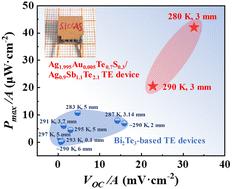
Thermoelectric (TE) technology provides a promising self-powered solution for wearable electronics and the Internet of Things (IoT), but the output voltage density and power density of current TE devices remain far below the target values required for practical use. In this work, instead of the commonly used TE figure-of-merit (zT = S2σ/κT, where S is the Seebeck coefficient, σ is the electrical conductivity, κ is the thermal conductivity, and T is the absolute temperature), we proposed that |S|/κ and S2σ/κ2 were more effective indicators for screening TE materials for the development of high-performance TE devices for use in the exacting working conditions (e.g., windless indoor environments and extremely limited space) of wearable electronics and the IoT. As a case study, both simulations and experiments were performed and clearly demonstrated that the TE device consisting of n-type Ag1.995Au0.005Te0.7S0.3 and p-type Ag0.9Sb1.1Te2.1 with high |S|/κ and S2σ/κ2 values achieved higher output performance than the Bi2Te3-based TE device. When the Ag1.995Au0.005Te0.7S0.3/Ag0.9Sb1.1Te2.1 TE device was worn on the human wrist, a record-high voltage density and power density were achieved. This work provides new insight into the development of advanced TE devices for wearable electronics and the IoT.
期刊介绍:
Energy & Environmental Science, a peer-reviewed scientific journal, publishes original research and review articles covering interdisciplinary topics in the (bio)chemical and (bio)physical sciences, as well as chemical engineering disciplines. Published monthly by the Royal Society of Chemistry (RSC), a not-for-profit publisher, Energy & Environmental Science is recognized as a leading journal. It boasts an impressive impact factor of 8.500 as of 2009, ranking 8th among 140 journals in the category "Chemistry, Multidisciplinary," second among 71 journals in "Energy & Fuels," second among 128 journals in "Engineering, Chemical," and first among 181 scientific journals in "Environmental Sciences."
Energy & Environmental Science publishes various types of articles, including Research Papers (original scientific work), Review Articles, Perspectives, and Minireviews (feature review-type articles of broad interest), Communications (original scientific work of an urgent nature), Opinions (personal, often speculative viewpoints or hypotheses on current topics), and Analysis Articles (in-depth examination of energy-related issues).



 京公网安备 11010802042870号
京ICP备2023020795号-1
京公网安备 11010802042870号
京ICP备2023020795号-1

 分享
分享
 求助内容:
求助内容: 应助结果提醒方式:
 扫码关注我们
