Hong Lee , Yeonhwa Kim , Yuji Cho , Eun Jung Jeon , Sang Hoon Jeong , Ju-Han Lee , Suhyun Kim
{"title":"Nociceptive effects and gene alterations of CMIT/MIT mixture in zebrafish embryos and larvae","authors":"Hong Lee , Yeonhwa Kim , Yuji Cho , Eun Jung Jeon , Sang Hoon Jeong , Ju-Han Lee , Suhyun Kim","doi":"10.1016/j.jhazmat.2025.138392","DOIUrl":null,"url":null,"abstract":"<div><div>Nociception is a critical biological process that facilitates detecting and avoiding harmful stimuli. Methylisothiazolinone (MIT) and methylchloroisothiazolinone (CMIT) are biocidal agents widely used in disinfectants and cosmetics, however, their effects on nociceptive pathways and neurotoxicity remain insufficiently understood. This study investigated the neurotoxic and nociceptive effects of CMIT/MIT mixtures in zebrafish models. Zebrafish embryos were exposed to CMIT/MIT, and their behavioral and molecular responses to nociceptive stimuli were assessed. Acute exposure (4 −72 h post-fertilization) to CMIT/MIT (15 and 30 μg/L) led to heightened behavioral responses to noxious stimuli, significantly increasing velocity and neuronal activity. Molecular analysis revealed the upregulated expression of nociception-related and inflammatory markers. Subchronic exposure (4 hpf to 28 days post-fertilization) to lower CMIT/MIT concentrations resulted in prolonged freezing responses and reduced the movement in zebrafish larvae. Protein-protein interaction analysis further identified key pathways, including calcium signaling, MAPK, and neuroinflammation, affected by CMIT/MIT exposure. This study provides evidence that even low levels of CMIT/MIT exposure can enhance nociceptive responses by activating sensory neurons and modulating inflammatory pathways, raising concerns about the neurotoxic potential of these widely used biocidal compounds.</div></div>","PeriodicalId":361,"journal":{"name":"Journal of Hazardous Materials","volume":"493 ","pages":"Article 138392"},"PeriodicalIF":11.3000,"publicationDate":"2025-08-05","publicationTypes":"Journal Article","fieldsOfStudy":null,"isOpenAccess":false,"openAccessPdf":"","citationCount":"0","resultStr":null,"platform":"Semanticscholar","paperid":null,"PeriodicalName":"Journal of Hazardous Materials","FirstCategoryId":"93","ListUrlMain":"https://www.sciencedirect.com/science/article/pii/S030438942501307X","RegionNum":1,"RegionCategory":"环境科学与生态学","ArticlePicture":[],"TitleCN":null,"AbstractTextCN":null,"PMCID":null,"EPubDate":"2025/4/23 0:00:00","PubModel":"Epub","JCR":"Q1","JCRName":"ENGINEERING, ENVIRONMENTAL","Score":null,"Total":0}
引用次数: 0
Abstract
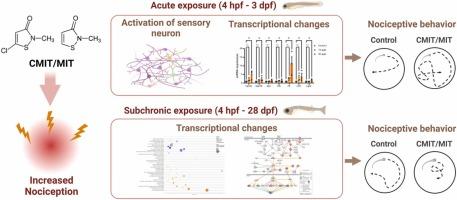
Nociception is a critical biological process that facilitates detecting and avoiding harmful stimuli. Methylisothiazolinone (MIT) and methylchloroisothiazolinone (CMIT) are biocidal agents widely used in disinfectants and cosmetics, however, their effects on nociceptive pathways and neurotoxicity remain insufficiently understood. This study investigated the neurotoxic and nociceptive effects of CMIT/MIT mixtures in zebrafish models. Zebrafish embryos were exposed to CMIT/MIT, and their behavioral and molecular responses to nociceptive stimuli were assessed. Acute exposure (4 −72 h post-fertilization) to CMIT/MIT (15 and 30 μg/L) led to heightened behavioral responses to noxious stimuli, significantly increasing velocity and neuronal activity. Molecular analysis revealed the upregulated expression of nociception-related and inflammatory markers. Subchronic exposure (4 hpf to 28 days post-fertilization) to lower CMIT/MIT concentrations resulted in prolonged freezing responses and reduced the movement in zebrafish larvae. Protein-protein interaction analysis further identified key pathways, including calcium signaling, MAPK, and neuroinflammation, affected by CMIT/MIT exposure. This study provides evidence that even low levels of CMIT/MIT exposure can enhance nociceptive responses by activating sensory neurons and modulating inflammatory pathways, raising concerns about the neurotoxic potential of these widely used biocidal compounds.
期刊介绍:
The Journal of Hazardous Materials serves as a global platform for promoting cutting-edge research in the field of Environmental Science and Engineering. Our publication features a wide range of articles, including full-length research papers, review articles, and perspectives, with the aim of enhancing our understanding of the dangers and risks associated with various materials concerning public health and the environment. It is important to note that the term "environmental contaminants" refers specifically to substances that pose hazardous effects through contamination, while excluding those that do not have such impacts on the environment or human health. Moreover, we emphasize the distinction between wastes and hazardous materials in order to provide further clarity on the scope of the journal. We have a keen interest in exploring specific compounds and microbial agents that have adverse effects on the environment.



 京公网安备 11010802042870号
京ICP备2023020795号-1
京公网安备 11010802042870号
京ICP备2023020795号-1

 分享
分享
 求助内容:
求助内容: 应助结果提醒方式:
 扫码关注我们
