Changcheng Chen , Na Zheng , Huicheng Zhu , Qirui An , Xiaoqian Li , Liyuan Peng , Zhifei Xiu
{"title":"Polylactic acid microplastics and earthworms drive cadmium bioaccumulation and toxicity in the soil–radish health community","authors":"Changcheng Chen , Na Zheng , Huicheng Zhu , Qirui An , Xiaoqian Li , Liyuan Peng , Zhifei Xiu","doi":"10.1016/j.jhazmat.2025.138391","DOIUrl":null,"url":null,"abstract":"<div><div>Recent studies underscored the toxicity of microplastics (MPs) as vectors for cadmium (Cd) in soil-plant systems, yet the driven potential of soil fauna in real-world environments remains overlooked. This study examined the interactive effects of earthworms and polylactic acid (PLA) MPs (0.5 % <em>w</em>/<em>w</em>) on rhizosphere biochemistry and Cd (2 mg/kg)-induced phytotoxicity in radish. The combined treatment of earthworms and PLA MPs significantly increased the soil available Cd (diethylenetriaminepentaacetic acid -extractable Cd) from 0.79 mg/kg to 1.01 mg/kg compared to the Cd treatment (<em>p</em> < 0.05) and enhanced the bacterial network stability. Cd accumulation in radish was significantly elevated under the combined treatment (roots: 2.04 mg/kg; leaves: 12.31 mg/kg) compared to the Cd treatment (roots: 1.59 mg/kg; leaves: 8.82 mg/kg) (<em>p</em> < 0.05). The combined treatment activated the radish antioxidant system. The combined treatment (roots: 6.08 g; leaves: 1.65 g) significantly reduced radish biomass compared to the Cd treatment (roots: 24.41 g; leaves: 4.45 g) (<em>p</em> < 0.05). Metabolic pathways involving lipid and carbohydrate metabolism, membrane transport, and secondary metabolite biosynthesis were disrupted. Structural equation modeling identified rhizosphere soil properties (pH, SOM, and CEC) as well as Cd and antioxidant systems in the leaf as major contributors to radish growth inhibition.</div></div>","PeriodicalId":361,"journal":{"name":"Journal of Hazardous Materials","volume":"493 ","pages":"Article 138391"},"PeriodicalIF":11.3000,"publicationDate":"2025-08-05","publicationTypes":"Journal Article","fieldsOfStudy":null,"isOpenAccess":false,"openAccessPdf":"","citationCount":"0","resultStr":null,"platform":"Semanticscholar","paperid":null,"PeriodicalName":"Journal of Hazardous Materials","FirstCategoryId":"93","ListUrlMain":"https://www.sciencedirect.com/science/article/pii/S0304389425013068","RegionNum":1,"RegionCategory":"环境科学与生态学","ArticlePicture":[],"TitleCN":null,"AbstractTextCN":null,"PMCID":null,"EPubDate":"2025/4/23 0:00:00","PubModel":"Epub","JCR":"Q1","JCRName":"ENGINEERING, ENVIRONMENTAL","Score":null,"Total":0}
引用次数: 0
Abstract
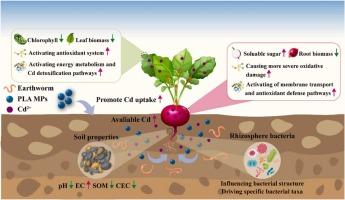
Recent studies underscored the toxicity of microplastics (MPs) as vectors for cadmium (Cd) in soil-plant systems, yet the driven potential of soil fauna in real-world environments remains overlooked. This study examined the interactive effects of earthworms and polylactic acid (PLA) MPs (0.5 % w/w) on rhizosphere biochemistry and Cd (2 mg/kg)-induced phytotoxicity in radish. The combined treatment of earthworms and PLA MPs significantly increased the soil available Cd (diethylenetriaminepentaacetic acid -extractable Cd) from 0.79 mg/kg to 1.01 mg/kg compared to the Cd treatment (p < 0.05) and enhanced the bacterial network stability. Cd accumulation in radish was significantly elevated under the combined treatment (roots: 2.04 mg/kg; leaves: 12.31 mg/kg) compared to the Cd treatment (roots: 1.59 mg/kg; leaves: 8.82 mg/kg) (p < 0.05). The combined treatment activated the radish antioxidant system. The combined treatment (roots: 6.08 g; leaves: 1.65 g) significantly reduced radish biomass compared to the Cd treatment (roots: 24.41 g; leaves: 4.45 g) (p < 0.05). Metabolic pathways involving lipid and carbohydrate metabolism, membrane transport, and secondary metabolite biosynthesis were disrupted. Structural equation modeling identified rhizosphere soil properties (pH, SOM, and CEC) as well as Cd and antioxidant systems in the leaf as major contributors to radish growth inhibition.
期刊介绍:
The Journal of Hazardous Materials serves as a global platform for promoting cutting-edge research in the field of Environmental Science and Engineering. Our publication features a wide range of articles, including full-length research papers, review articles, and perspectives, with the aim of enhancing our understanding of the dangers and risks associated with various materials concerning public health and the environment. It is important to note that the term "environmental contaminants" refers specifically to substances that pose hazardous effects through contamination, while excluding those that do not have such impacts on the environment or human health. Moreover, we emphasize the distinction between wastes and hazardous materials in order to provide further clarity on the scope of the journal. We have a keen interest in exploring specific compounds and microbial agents that have adverse effects on the environment.




 京公网安备 11010802042870号
京ICP备2023020795号-1
京公网安备 11010802042870号
京ICP备2023020795号-1

 分享
分享
 求助内容:
求助内容: 应助结果提醒方式:
 扫码关注我们
