Tianshuo Lan , Xinna Yu , Yiping Du , Tianyuan Liu , Meizhen Huang
{"title":"Hetero-charge-based surface enhanced Raman spectroscopy: An in situ rapid detection strategy for real marine nanoplastics","authors":"Tianshuo Lan , Xinna Yu , Yiping Du , Tianyuan Liu , Meizhen Huang","doi":"10.1016/j.jhazmat.2025.138390","DOIUrl":null,"url":null,"abstract":"<div><div>As a worldwide pollution problem, the investigation and detection of marine nanoplastics (plastics <strong><</strong>1 µm) have attracted considerable attention. However, current detection methods for marine nanoplastic specimens require membrane filtration or drying enrichment as a pretreatment procedure. Developing a rapid detection method to directly detect nanoplastics in aqueous solutions without any pretreatment is an enormous challenge. In this study, an in situ rapid hetero-charge-based surface-enhanced Raman spectroscopy (SERS) nanoplastics detection strategy is proposed, and two modulated charged gold nano sphere particles (AuNPs) are designed for nanoplastics detection in situ. According to the electric charge attraction effect and the customized AuNPs, the SERS characteristic peak signal of the polystyrene nanoplastics (PS NPs) was clearly identified, and the lowest detected concentration was 0.1 µg/mL in artificial seawater. Meanwhile, this detection strategy was utilized for a real marine specimen which was successfully detected and identified the existence of PS, and the estimated concentration of this specimen was 1.544E-4 µg/mL. These results indicate that this in situ SERS detection strategy could be utilized for the further analysis of both charged nanoplastics under real marine conditions.</div></div>","PeriodicalId":361,"journal":{"name":"Journal of Hazardous Materials","volume":"493 ","pages":"Article 138390"},"PeriodicalIF":11.3000,"publicationDate":"2025-08-05","publicationTypes":"Journal Article","fieldsOfStudy":null,"isOpenAccess":false,"openAccessPdf":"","citationCount":"0","resultStr":null,"platform":"Semanticscholar","paperid":null,"PeriodicalName":"Journal of Hazardous Materials","FirstCategoryId":"93","ListUrlMain":"https://www.sciencedirect.com/science/article/pii/S0304389425013056","RegionNum":1,"RegionCategory":"环境科学与生态学","ArticlePicture":[],"TitleCN":null,"AbstractTextCN":null,"PMCID":null,"EPubDate":"2025/4/22 0:00:00","PubModel":"Epub","JCR":"Q1","JCRName":"ENGINEERING, ENVIRONMENTAL","Score":null,"Total":0}
引用次数: 0
Abstract
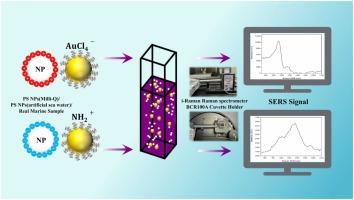
As a worldwide pollution problem, the investigation and detection of marine nanoplastics (plastics <1 µm) have attracted considerable attention. However, current detection methods for marine nanoplastic specimens require membrane filtration or drying enrichment as a pretreatment procedure. Developing a rapid detection method to directly detect nanoplastics in aqueous solutions without any pretreatment is an enormous challenge. In this study, an in situ rapid hetero-charge-based surface-enhanced Raman spectroscopy (SERS) nanoplastics detection strategy is proposed, and two modulated charged gold nano sphere particles (AuNPs) are designed for nanoplastics detection in situ. According to the electric charge attraction effect and the customized AuNPs, the SERS characteristic peak signal of the polystyrene nanoplastics (PS NPs) was clearly identified, and the lowest detected concentration was 0.1 µg/mL in artificial seawater. Meanwhile, this detection strategy was utilized for a real marine specimen which was successfully detected and identified the existence of PS, and the estimated concentration of this specimen was 1.544E-4 µg/mL. These results indicate that this in situ SERS detection strategy could be utilized for the further analysis of both charged nanoplastics under real marine conditions.
期刊介绍:
The Journal of Hazardous Materials serves as a global platform for promoting cutting-edge research in the field of Environmental Science and Engineering. Our publication features a wide range of articles, including full-length research papers, review articles, and perspectives, with the aim of enhancing our understanding of the dangers and risks associated with various materials concerning public health and the environment. It is important to note that the term "environmental contaminants" refers specifically to substances that pose hazardous effects through contamination, while excluding those that do not have such impacts on the environment or human health. Moreover, we emphasize the distinction between wastes and hazardous materials in order to provide further clarity on the scope of the journal. We have a keen interest in exploring specific compounds and microbial agents that have adverse effects on the environment.



 京公网安备 11010802042870号
京ICP备2023020795号-1
京公网安备 11010802042870号
京ICP备2023020795号-1

 分享
分享
 求助内容:
求助内容: 应助结果提醒方式:
 扫码关注我们
