Hao Chang , Kun Pan , Xi Zhang , Zhonghua Lu , Yihui Wang , Di Liu , Yafen Lin , Yan Wu , Yi Lin , Qingyu Huang , Junchao Duan , Zhiwei Sun , Jinzhuo Zhao , Heqing Shen
{"title":"Ambient PM2.5 exposure, physical activity, and cardiovascular dysfunction: Analysis of CHARLS data and experimental study in mice","authors":"Hao Chang , Kun Pan , Xi Zhang , Zhonghua Lu , Yihui Wang , Di Liu , Yafen Lin , Yan Wu , Yi Lin , Qingyu Huang , Junchao Duan , Zhiwei Sun , Jinzhuo Zhao , Heqing Shen","doi":"10.1016/j.jhazmat.2025.138377","DOIUrl":null,"url":null,"abstract":"<div><div>Previous studies have confirmed ambient fine particulate matter (PM<sub>2.5</sub>) as a major environmental risk factor for cardiovascular diseases (CVDs), yet the specific molecular pathways remain poorly understood. Furthermore, while physical activity benefits cardiovascular health, its protective effects against PM<sub>2.5</sub>-induced damage need further explored. We aimed to investigate the relationship between long-term PM<sub>2.5</sub> exposure, physical activity, and cardiovascular health, and explore the potential molecular mechanisms. This research combined epidemiological and experimental approaches. The epidemiological study analyzed data from the China Health and Retirement Longitudinal Study (CHARLS) to investigate the associations among long-term PM<sub>2.5</sub> exposure, physical activity, and CVDs. For the experimental study, C57BL/6 male mice were assigned to either regular physical activity or sedentary behavior, and were exposed to PM<sub>2.5</sub> or filtered air (FA) for 2, 4, and 6 months. We observed that long-term PM<sub>2.5</sub> exposure significantly increased cardiovascular disease risk, while physical activity exhibited protective effects and can partially mitigate the adverse impacts of PM<sub>2.5</sub> on heart disease and dyslipidemia. In animal study, mice with long-term exposure to PM<sub>2.5</sub> demonstrated elevated blood pressure, disrupted adipokine levels, altered lipid profiles, and mitochondrial damage. Regular physical activity partially mitigated these adverse effects. Lipidomics and proteomics analyses revealed that PM<sub>2.5</sub> exposure disrupted lipid metabolism networks and protein regulatory pathways, while regular physical activity mitigated these perturbations through the modulation of lipid metabolism, the coagulation cascade, and immune responses. These findings underscore the importance of regular physical activity in public health strategies, while prioritizing PM<sub>2.5</sub> reduction measures for cardiovascular disease prevention.</div></div>","PeriodicalId":361,"journal":{"name":"Journal of Hazardous Materials","volume":"493 ","pages":"Article 138377"},"PeriodicalIF":11.3000,"publicationDate":"2025-08-05","publicationTypes":"Journal Article","fieldsOfStudy":null,"isOpenAccess":false,"openAccessPdf":"","citationCount":"0","resultStr":null,"platform":"Semanticscholar","paperid":null,"PeriodicalName":"Journal of Hazardous Materials","FirstCategoryId":"93","ListUrlMain":"https://www.sciencedirect.com/science/article/pii/S0304389425012920","RegionNum":1,"RegionCategory":"环境科学与生态学","ArticlePicture":[],"TitleCN":null,"AbstractTextCN":null,"PMCID":null,"EPubDate":"2025/4/22 0:00:00","PubModel":"Epub","JCR":"Q1","JCRName":"ENGINEERING, ENVIRONMENTAL","Score":null,"Total":0}
引用次数: 0
Abstract
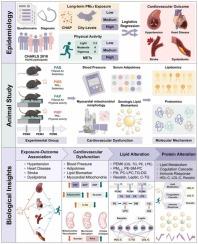
Previous studies have confirmed ambient fine particulate matter (PM2.5) as a major environmental risk factor for cardiovascular diseases (CVDs), yet the specific molecular pathways remain poorly understood. Furthermore, while physical activity benefits cardiovascular health, its protective effects against PM2.5-induced damage need further explored. We aimed to investigate the relationship between long-term PM2.5 exposure, physical activity, and cardiovascular health, and explore the potential molecular mechanisms. This research combined epidemiological and experimental approaches. The epidemiological study analyzed data from the China Health and Retirement Longitudinal Study (CHARLS) to investigate the associations among long-term PM2.5 exposure, physical activity, and CVDs. For the experimental study, C57BL/6 male mice were assigned to either regular physical activity or sedentary behavior, and were exposed to PM2.5 or filtered air (FA) for 2, 4, and 6 months. We observed that long-term PM2.5 exposure significantly increased cardiovascular disease risk, while physical activity exhibited protective effects and can partially mitigate the adverse impacts of PM2.5 on heart disease and dyslipidemia. In animal study, mice with long-term exposure to PM2.5 demonstrated elevated blood pressure, disrupted adipokine levels, altered lipid profiles, and mitochondrial damage. Regular physical activity partially mitigated these adverse effects. Lipidomics and proteomics analyses revealed that PM2.5 exposure disrupted lipid metabolism networks and protein regulatory pathways, while regular physical activity mitigated these perturbations through the modulation of lipid metabolism, the coagulation cascade, and immune responses. These findings underscore the importance of regular physical activity in public health strategies, while prioritizing PM2.5 reduction measures for cardiovascular disease prevention.
期刊介绍:
The Journal of Hazardous Materials serves as a global platform for promoting cutting-edge research in the field of Environmental Science and Engineering. Our publication features a wide range of articles, including full-length research papers, review articles, and perspectives, with the aim of enhancing our understanding of the dangers and risks associated with various materials concerning public health and the environment. It is important to note that the term "environmental contaminants" refers specifically to substances that pose hazardous effects through contamination, while excluding those that do not have such impacts on the environment or human health. Moreover, we emphasize the distinction between wastes and hazardous materials in order to provide further clarity on the scope of the journal. We have a keen interest in exploring specific compounds and microbial agents that have adverse effects on the environment.



 京公网安备 11010802042870号
京ICP备2023020795号-1
京公网安备 11010802042870号
京ICP备2023020795号-1

 分享
分享
 求助内容:
求助内容: 应助结果提醒方式:
 扫码关注我们
