Enhanced removal of carbamazepine by microalgal-fungal symbiotic systems in the presence of Mn(II): Synergistic mechanisms and microbial community dynamics
Dan Ai , Tao Wu , Deying Huang , Zeguo Ying , Jibiao Zhang
{"title":"Enhanced removal of carbamazepine by microalgal-fungal symbiotic systems in the presence of Mn(II): Synergistic mechanisms and microbial community dynamics","authors":"Dan Ai , Tao Wu , Deying Huang , Zeguo Ying , Jibiao Zhang","doi":"10.1016/j.jhazmat.2025.138342","DOIUrl":null,"url":null,"abstract":"<div><div>Microalgal-fungal symbiotic systems (MFSS) have emerged as a promising approach for wastewater treatment, yet the mechanisms driving reactive oxygen species (ROS) generation and pharmaceutical pollutant removal remain underexplored. This study investigates the synergistic interactions within MFSS and their role in Mn(II) oxidation, with a focus on enhancing carbamazepine (CBZ) degradation and microbial community dynamics. The results reveal that microalgal-fungal interactions inhibit Fe-S cluster activity, disrupting electron transport chains and promoting extracellular superoxide production. This superoxide surge directly accelerates Mn(II) oxidation, while Mn(III) and ROS drive synergistic effects to amplify CBZ removal efficiency. Notably, system-specific variations in superoxide generation were observed across different MFSS configurations, determining their degradation performance. Water quality factors, such as microbial community complexity and nitrate concentration, play crucial roles in CBZ degradation in natural water systems. High-throughput sequencing reveals dynamic shifts in bacterial and eukaryotic communities, highlighting their synergistic interactions in pollutant degradation. Temporal and spatial changes in microbial community structure suggest that the system evolves into a more adaptive configuration during pollutant treatment, enhancing long-term stability. These findings advance the mechanistic understanding of ROS-mediated pollutant degradation in MFSS and provide actionable strategies for optimizing bioremediation systems in engineered and natural water environments.</div></div>","PeriodicalId":361,"journal":{"name":"Journal of Hazardous Materials","volume":"493 ","pages":"Article 138342"},"PeriodicalIF":10.6000,"publicationDate":"2025-08-05","publicationTypes":"Journal Article","fieldsOfStudy":null,"isOpenAccess":false,"openAccessPdf":"","citationCount":"0","resultStr":null,"platform":"Semanticscholar","paperid":null,"PeriodicalName":"Journal of Hazardous Materials","FirstCategoryId":"93","ListUrlMain":"https://www.sciencedirect.com/science/article/pii/S0304389425012579","RegionNum":1,"RegionCategory":"环境科学与生态学","ArticlePicture":[],"TitleCN":null,"AbstractTextCN":null,"PMCID":null,"EPubDate":"2025/4/22 0:00:00","PubModel":"Epub","JCR":"Q1","JCRName":"ENGINEERING, ENVIRONMENTAL","Score":null,"Total":0}
引用次数: 0
Abstract
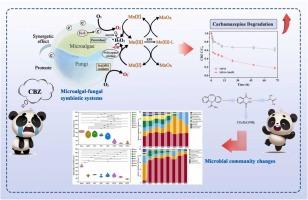
Microalgal-fungal symbiotic systems (MFSS) have emerged as a promising approach for wastewater treatment, yet the mechanisms driving reactive oxygen species (ROS) generation and pharmaceutical pollutant removal remain underexplored. This study investigates the synergistic interactions within MFSS and their role in Mn(II) oxidation, with a focus on enhancing carbamazepine (CBZ) degradation and microbial community dynamics. The results reveal that microalgal-fungal interactions inhibit Fe-S cluster activity, disrupting electron transport chains and promoting extracellular superoxide production. This superoxide surge directly accelerates Mn(II) oxidation, while Mn(III) and ROS drive synergistic effects to amplify CBZ removal efficiency. Notably, system-specific variations in superoxide generation were observed across different MFSS configurations, determining their degradation performance. Water quality factors, such as microbial community complexity and nitrate concentration, play crucial roles in CBZ degradation in natural water systems. High-throughput sequencing reveals dynamic shifts in bacterial and eukaryotic communities, highlighting their synergistic interactions in pollutant degradation. Temporal and spatial changes in microbial community structure suggest that the system evolves into a more adaptive configuration during pollutant treatment, enhancing long-term stability. These findings advance the mechanistic understanding of ROS-mediated pollutant degradation in MFSS and provide actionable strategies for optimizing bioremediation systems in engineered and natural water environments.
期刊介绍:
The Journal of Hazardous Materials serves as a global platform for promoting cutting-edge research in the field of Environmental Science and Engineering. Our publication features a wide range of articles, including full-length research papers, review articles, and perspectives, with the aim of enhancing our understanding of the dangers and risks associated with various materials concerning public health and the environment. It is important to note that the term "environmental contaminants" refers specifically to substances that pose hazardous effects through contamination, while excluding those that do not have such impacts on the environment or human health. Moreover, we emphasize the distinction between wastes and hazardous materials in order to provide further clarity on the scope of the journal. We have a keen interest in exploring specific compounds and microbial agents that have adverse effects on the environment.




 京公网安备 11010802042870号
京ICP备2023020795号-1
京公网安备 11010802042870号
京ICP备2023020795号-1

 分享
分享
 求助内容:
求助内容: 应助结果提醒方式:
 扫码关注我们
