Minghan Wu, Siqi Hao, Linfeng Qi, Yu Shi, Wei Yang, Jingjing Bao, Min Du, Zhengyu Mo, Licheng Sun
{"title":"An N-Type Thermogalvanic Cell with a High Temperature Coefficient Based on the Cu/Cu(en)22+ Redox Couple","authors":"Minghan Wu, Siqi Hao, Linfeng Qi, Yu Shi, Wei Yang, Jingjing Bao, Min Du, Zhengyu Mo, Licheng Sun","doi":"10.1021/acsami.5c03375","DOIUrl":null,"url":null,"abstract":"Thermogalvanic cells (TGCs) are at the forefront of effective thermoelectric conversion methods, but the practical utilization of their integrated devices is hindered by the suboptimal performance of N-type TGCs. Herein, a novel redox couple of Cu/Cu(en)<sub>2</sub><sup>2+</sup> is proposed to construct a liquid-state N-type TGC. The electrochemical reaction involving the Cu electrode, ethylenediamine (en), and their chelated compound Cu(en)<sub>2</sub><sup>2+</sup> exhibits a significant reaction entropy change, resulting in an enhanced temperature coefficient (α). We reveal that the α of the Cu/Cu(en)<sub>2</sub><sup>2+</sup>-based TGC reaches 1.64 mV K<sup>–1</sup>. Furthermore, by optimizing the concentrations of Cu<sup>2+</sup>, ethylenediamine, and (NH<sub>4</sub>)<sub>2</sub>SO<sub>4</sub> in the electrolyte, both α and normalized power density can be significantly improved, achieving values of 2.12 mV K<sup>–1</sup> and 676 μW m<sup>–2</sup> K<sup>–2</sup>, respectively. Moreover, by constructing a P–N junction with P-type and N-type TGC, we achieve a high potential of 121 mV under a temperature gradient of 35 K. This work expands the available redox couple options for N-type TGCs and offers a new pathway for efficient thermoelectric conversion.","PeriodicalId":5,"journal":{"name":"ACS Applied Materials & Interfaces","volume":"18 1","pages":""},"PeriodicalIF":8.2000,"publicationDate":"2025-04-22","publicationTypes":"Journal Article","fieldsOfStudy":null,"isOpenAccess":false,"openAccessPdf":"","citationCount":"0","resultStr":null,"platform":"Semanticscholar","paperid":null,"PeriodicalName":"ACS Applied Materials & Interfaces","FirstCategoryId":"88","ListUrlMain":"https://doi.org/10.1021/acsami.5c03375","RegionNum":2,"RegionCategory":"材料科学","ArticlePicture":[],"TitleCN":null,"AbstractTextCN":null,"PMCID":null,"EPubDate":"","PubModel":"","JCR":"Q1","JCRName":"MATERIALS SCIENCE, MULTIDISCIPLINARY","Score":null,"Total":0}
引用次数: 0
Abstract
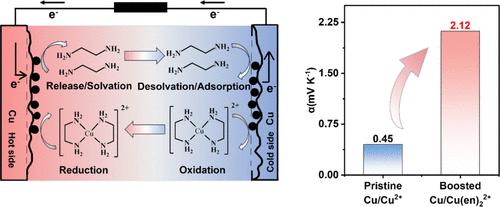
Thermogalvanic cells (TGCs) are at the forefront of effective thermoelectric conversion methods, but the practical utilization of their integrated devices is hindered by the suboptimal performance of N-type TGCs. Herein, a novel redox couple of Cu/Cu(en)22+ is proposed to construct a liquid-state N-type TGC. The electrochemical reaction involving the Cu electrode, ethylenediamine (en), and their chelated compound Cu(en)22+ exhibits a significant reaction entropy change, resulting in an enhanced temperature coefficient (α). We reveal that the α of the Cu/Cu(en)22+-based TGC reaches 1.64 mV K–1. Furthermore, by optimizing the concentrations of Cu2+, ethylenediamine, and (NH4)2SO4 in the electrolyte, both α and normalized power density can be significantly improved, achieving values of 2.12 mV K–1 and 676 μW m–2 K–2, respectively. Moreover, by constructing a P–N junction with P-type and N-type TGC, we achieve a high potential of 121 mV under a temperature gradient of 35 K. This work expands the available redox couple options for N-type TGCs and offers a new pathway for efficient thermoelectric conversion.
期刊介绍:
ACS Applied Materials & Interfaces is a leading interdisciplinary journal that brings together chemists, engineers, physicists, and biologists to explore the development and utilization of newly-discovered materials and interfacial processes for specific applications. Our journal has experienced remarkable growth since its establishment in 2009, both in terms of the number of articles published and the impact of the research showcased. We are proud to foster a truly global community, with the majority of published articles originating from outside the United States, reflecting the rapid growth of applied research worldwide.




 京公网安备 11010802042870号
京ICP备2023020795号-1
京公网安备 11010802042870号
京ICP备2023020795号-1

 分享
分享
 求助内容:
求助内容: 应助结果提醒方式:
 扫码关注我们
