{"title":"Constructing high activity Cu/Cu2O via nitrate-assisted directed evolution for enhanced electro catalytic nitrate-to-ammonia conversion","authors":"Zhun You, Jiao Shen, Senhao Wang, Yuan Wang, Ying Liang, Shaojun Yuan","doi":"10.1016/j.seppur.2025.133165","DOIUrl":null,"url":null,"abstract":"The electrochemical reduction of nitrate (NO<sub>3</sub><sup>−</sup>RR) is a promising strategy for producing value-added ammonia while addressing water pollution and promoting sustainable nitrogen management. Inspired by the reduction process from CuO to Cu, we proposed a novel electrochemically driven NO<sub>3</sub><sup>−</sup>-assisted directed evolution strategy to construct Cu/Cu<sub>2</sub>O heterojunctions for enhanced NO<sub>3</sub><sup>−</sup>RR performance. A copper foam-supported copper oxides (Cu<sub>x</sub>O) catalyst was synthesized via an electrochemical reconstruction method in the presence of nitrate. Comprehensive characterization using SEM, XPS, and XRD demonstrated that nitrate concentration plays a crucial role in tuning the structure, surface chemistry, and oxidation state of Cu<sub>x</sub>O/CF. In a 0.5 M Na<sub>2</sub>SO<sub>4</sub> solution containing 0.01 M KNO<sub>3</sub>, the optimized Cu-0.1 catalyst exhibited significantly enhanced NO<sub>3</sub><sup>−</sup>RR activity, achieving a high NH<sub>4</sub><sup>+</sup> yield rate of 4.33 mg·h<sup>−1</sup>·cm<sup>−2</sup> at –1.0 V vs. RHE and a Faradaic efficiency of 78.0 % at –0.8 V vs. RHE. Furthermore, DFT calculations revealed that nitrate concentration was the critical factor in regulating Cu<sub>2</sub>O content and controlling its growth during the formation of Cu/Cu<sub>2</sub>O heterojunctions. The enhanced NO<sub>3</sub><sup>−</sup>RR activity was attributed to the synergistic effect between NO<sub>3</sub><sup>−</sup> adsorption on the Cu<sub>2</sub>O(111) crystal plane and NH<sub>3</sub> desorption on the Cu(111) plane.","PeriodicalId":427,"journal":{"name":"Separation and Purification Technology","volume":"32 1","pages":""},"PeriodicalIF":9.0000,"publicationDate":"2025-04-22","publicationTypes":"Journal Article","fieldsOfStudy":null,"isOpenAccess":false,"openAccessPdf":"","citationCount":"0","resultStr":null,"platform":"Semanticscholar","paperid":null,"PeriodicalName":"Separation and Purification Technology","FirstCategoryId":"5","ListUrlMain":"https://doi.org/10.1016/j.seppur.2025.133165","RegionNum":1,"RegionCategory":"工程技术","ArticlePicture":[],"TitleCN":null,"AbstractTextCN":null,"PMCID":null,"EPubDate":"","PubModel":"","JCR":"Q1","JCRName":"ENGINEERING, CHEMICAL","Score":null,"Total":0}
引用次数: 0
Abstract
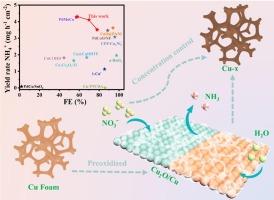
The electrochemical reduction of nitrate (NO3−RR) is a promising strategy for producing value-added ammonia while addressing water pollution and promoting sustainable nitrogen management. Inspired by the reduction process from CuO to Cu, we proposed a novel electrochemically driven NO3−-assisted directed evolution strategy to construct Cu/Cu2O heterojunctions for enhanced NO3−RR performance. A copper foam-supported copper oxides (CuxO) catalyst was synthesized via an electrochemical reconstruction method in the presence of nitrate. Comprehensive characterization using SEM, XPS, and XRD demonstrated that nitrate concentration plays a crucial role in tuning the structure, surface chemistry, and oxidation state of CuxO/CF. In a 0.5 M Na2SO4 solution containing 0.01 M KNO3, the optimized Cu-0.1 catalyst exhibited significantly enhanced NO3−RR activity, achieving a high NH4+ yield rate of 4.33 mg·h−1·cm−2 at –1.0 V vs. RHE and a Faradaic efficiency of 78.0 % at –0.8 V vs. RHE. Furthermore, DFT calculations revealed that nitrate concentration was the critical factor in regulating Cu2O content and controlling its growth during the formation of Cu/Cu2O heterojunctions. The enhanced NO3−RR activity was attributed to the synergistic effect between NO3− adsorption on the Cu2O(111) crystal plane and NH3 desorption on the Cu(111) plane.
期刊介绍:
Separation and Purification Technology is a premier journal committed to sharing innovative methods for separation and purification in chemical and environmental engineering, encompassing both homogeneous solutions and heterogeneous mixtures. Our scope includes the separation and/or purification of liquids, vapors, and gases, as well as carbon capture and separation techniques. However, it's important to note that methods solely intended for analytical purposes are not within the scope of the journal. Additionally, disciplines such as soil science, polymer science, and metallurgy fall outside the purview of Separation and Purification Technology. Join us in advancing the field of separation and purification methods for sustainable solutions in chemical and environmental engineering.



 京公网安备 11010802042870号
京ICP备2023020795号-1
京公网安备 11010802042870号
京ICP备2023020795号-1

 分享
分享
 求助内容:
求助内容: 应助结果提醒方式:
 扫码关注我们
