Mingyue Luo , Delphine Jenny Vandeputte , Sybrien Lievens , Guanlei Li , Yiqi Su , Marijke Huysmans , Marc Elskens , Willy Baeyens , Yue Gao
{"title":"Understanding the availability of metals in agricultural soils and the impact of manure application","authors":"Mingyue Luo , Delphine Jenny Vandeputte , Sybrien Lievens , Guanlei Li , Yiqi Su , Marijke Huysmans , Marc Elskens , Willy Baeyens , Yue Gao","doi":"10.1016/j.jhazmat.2025.138386","DOIUrl":null,"url":null,"abstract":"<div><div>Metal concentrations and distributions in a Belgian agricultural soil and the impact of manure application were studied. Most metal contaminants, except Pb and Co, reached their highest levels in winter (between 1.7 and 5.3 times higher than in other seasons) due to manure application. The vertical metal profiles in the soil also varied seasonally because of agricultural activities and plant growth. Meanwhile, sequential extraction on the soil solid phase pointed out that on an annual basis, Cd, Co, and Mn were primarily present in the exchangeable fraction at 42, 34 and 41 % respectively (also Ni was quite present in the exchangeable fraction at 20 %), that Pb was in the reducible fraction at 52 %, while Cr and Fe were more enriched in the residual fraction at 66 and 64 %, respectively. In addition, metal interactions between soil porewater and solid phase were investigated by using the passive sampling technique of Diffusive Gradients in Thin-films (DGT) and the one-dimensional DGT-induced flux in sediments (1D-DIFS) model. These results suggest a high release rate of Cd, Co, Mn and Ni from the soil solid phase to the pore water, and a low release rate of Cr, Cu, Fe and Pb. Therefore, the first group of metals poses a much greater risk for plant uptake and intoxication than the second group of metals.</div></div>","PeriodicalId":361,"journal":{"name":"Journal of Hazardous Materials","volume":"493 ","pages":"Article 138386"},"PeriodicalIF":11.3000,"publicationDate":"2025-08-05","publicationTypes":"Journal Article","fieldsOfStudy":null,"isOpenAccess":false,"openAccessPdf":"","citationCount":"0","resultStr":null,"platform":"Semanticscholar","paperid":null,"PeriodicalName":"Journal of Hazardous Materials","FirstCategoryId":"93","ListUrlMain":"https://www.sciencedirect.com/science/article/pii/S0304389425013019","RegionNum":1,"RegionCategory":"环境科学与生态学","ArticlePicture":[],"TitleCN":null,"AbstractTextCN":null,"PMCID":null,"EPubDate":"2025/4/22 0:00:00","PubModel":"Epub","JCR":"Q1","JCRName":"ENGINEERING, ENVIRONMENTAL","Score":null,"Total":0}
引用次数: 0
Abstract
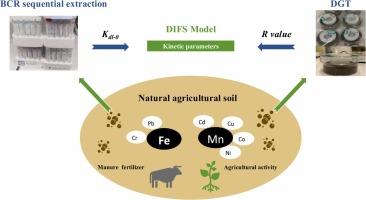
Metal concentrations and distributions in a Belgian agricultural soil and the impact of manure application were studied. Most metal contaminants, except Pb and Co, reached their highest levels in winter (between 1.7 and 5.3 times higher than in other seasons) due to manure application. The vertical metal profiles in the soil also varied seasonally because of agricultural activities and plant growth. Meanwhile, sequential extraction on the soil solid phase pointed out that on an annual basis, Cd, Co, and Mn were primarily present in the exchangeable fraction at 42, 34 and 41 % respectively (also Ni was quite present in the exchangeable fraction at 20 %), that Pb was in the reducible fraction at 52 %, while Cr and Fe were more enriched in the residual fraction at 66 and 64 %, respectively. In addition, metal interactions between soil porewater and solid phase were investigated by using the passive sampling technique of Diffusive Gradients in Thin-films (DGT) and the one-dimensional DGT-induced flux in sediments (1D-DIFS) model. These results suggest a high release rate of Cd, Co, Mn and Ni from the soil solid phase to the pore water, and a low release rate of Cr, Cu, Fe and Pb. Therefore, the first group of metals poses a much greater risk for plant uptake and intoxication than the second group of metals.
期刊介绍:
The Journal of Hazardous Materials serves as a global platform for promoting cutting-edge research in the field of Environmental Science and Engineering. Our publication features a wide range of articles, including full-length research papers, review articles, and perspectives, with the aim of enhancing our understanding of the dangers and risks associated with various materials concerning public health and the environment. It is important to note that the term "environmental contaminants" refers specifically to substances that pose hazardous effects through contamination, while excluding those that do not have such impacts on the environment or human health. Moreover, we emphasize the distinction between wastes and hazardous materials in order to provide further clarity on the scope of the journal. We have a keen interest in exploring specific compounds and microbial agents that have adverse effects on the environment.



 京公网安备 11010802042870号
京ICP备2023020795号-1
京公网安备 11010802042870号
京ICP备2023020795号-1

 分享
分享
 求助内容:
求助内容: 应助结果提醒方式:
 扫码关注我们
