Hanxun Zou , Guoming Lin , Yuxuan Bao , Jie Liang , Yunyun Li , Lifeng Cai , Han-Ying Wu , Fan Yang , Hang Chen , Xiuchun Lin , Yi-Hong Xiao , Lei Yang , Jianhui Huang , Yu Hai
{"title":"Dual-emission fluorescent probe with sequential two-step ESIPT activation mechanism for selective hydrazine detection and multifunctional applications","authors":"Hanxun Zou , Guoming Lin , Yuxuan Bao , Jie Liang , Yunyun Li , Lifeng Cai , Han-Ying Wu , Fan Yang , Hang Chen , Xiuchun Lin , Yi-Hong Xiao , Lei Yang , Jianhui Huang , Yu Hai","doi":"10.1016/j.jhazmat.2025.138388","DOIUrl":null,"url":null,"abstract":"<div><div>Hydrazine is a commonly used chemical in various industries, including pharmaceuticals, agriculture, and aerospace. However, its high toxicity may cause serious harm to the natural environments and human health. The development of new methods for sensitive and selective detection of hydrazine is of great significance. In this study, we present a fluorescent probe that employs a unique two-step excited-state intramolecular proton transfer (ESIPT) activation mechanism for hydrazine detection. This probe integrates a phthalimide group into benzothiazole scaffold with its fluorescence initially quenched due to the inhibition of ESIPT process and photo-induced electron transfer (OFF state). Upon exposure to hydrazine, the nucleophilic cleavage of the phthalimide group activates the first ESIPT process, yielding yellow emission (ON1 state). A subsequent deprotection step triggers the second ESIPT process, producing blue fluorescence (ON2 state). These three states fluorescent change along with dual-emission signal output provide a highly sensitive and reliable method for hydrazine detection and monitoring, with a limit of detection (LOD) of 18 nM. Moreover, this probe showed versatile applications in environmental monitoring, food sample analysis, plant imaging, and bioimaging, including a convenient smartphone-assisted quantitative assay. The dual-activation mechanism offers valuable insights for the design of novel ESIPT probes, paving the way for promoting their applications in chemical, biological, and environmental fields.</div></div>","PeriodicalId":361,"journal":{"name":"Journal of Hazardous Materials","volume":"493 ","pages":"Article 138388"},"PeriodicalIF":11.3000,"publicationDate":"2025-08-05","publicationTypes":"Journal Article","fieldsOfStudy":null,"isOpenAccess":false,"openAccessPdf":"","citationCount":"0","resultStr":null,"platform":"Semanticscholar","paperid":null,"PeriodicalName":"Journal of Hazardous Materials","FirstCategoryId":"93","ListUrlMain":"https://www.sciencedirect.com/science/article/pii/S0304389425013032","RegionNum":1,"RegionCategory":"环境科学与生态学","ArticlePicture":[],"TitleCN":null,"AbstractTextCN":null,"PMCID":null,"EPubDate":"2025/4/22 0:00:00","PubModel":"Epub","JCR":"Q1","JCRName":"ENGINEERING, ENVIRONMENTAL","Score":null,"Total":0}
引用次数: 0
Abstract
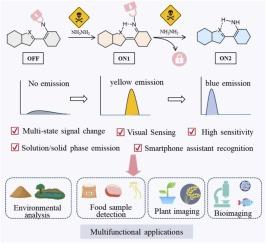
Hydrazine is a commonly used chemical in various industries, including pharmaceuticals, agriculture, and aerospace. However, its high toxicity may cause serious harm to the natural environments and human health. The development of new methods for sensitive and selective detection of hydrazine is of great significance. In this study, we present a fluorescent probe that employs a unique two-step excited-state intramolecular proton transfer (ESIPT) activation mechanism for hydrazine detection. This probe integrates a phthalimide group into benzothiazole scaffold with its fluorescence initially quenched due to the inhibition of ESIPT process and photo-induced electron transfer (OFF state). Upon exposure to hydrazine, the nucleophilic cleavage of the phthalimide group activates the first ESIPT process, yielding yellow emission (ON1 state). A subsequent deprotection step triggers the second ESIPT process, producing blue fluorescence (ON2 state). These three states fluorescent change along with dual-emission signal output provide a highly sensitive and reliable method for hydrazine detection and monitoring, with a limit of detection (LOD) of 18 nM. Moreover, this probe showed versatile applications in environmental monitoring, food sample analysis, plant imaging, and bioimaging, including a convenient smartphone-assisted quantitative assay. The dual-activation mechanism offers valuable insights for the design of novel ESIPT probes, paving the way for promoting their applications in chemical, biological, and environmental fields.
期刊介绍:
The Journal of Hazardous Materials serves as a global platform for promoting cutting-edge research in the field of Environmental Science and Engineering. Our publication features a wide range of articles, including full-length research papers, review articles, and perspectives, with the aim of enhancing our understanding of the dangers and risks associated with various materials concerning public health and the environment. It is important to note that the term "environmental contaminants" refers specifically to substances that pose hazardous effects through contamination, while excluding those that do not have such impacts on the environment or human health. Moreover, we emphasize the distinction between wastes and hazardous materials in order to provide further clarity on the scope of the journal. We have a keen interest in exploring specific compounds and microbial agents that have adverse effects on the environment.




 京公网安备 11010802042870号
京ICP备2023020795号-1
京公网安备 11010802042870号
京ICP备2023020795号-1

 分享
分享
 求助内容:
求助内容: 应助结果提醒方式:
 扫码关注我们
