{"title":"Textile Recycling’s Hidden Problem: Surface-Modified Fiber Fragments Emitted at Every Stage","authors":"Arun Chandra Manivannan, Logeshwaran Panneerselvan, Raji Kandaiah, Akila Ravindran, Gunasekhar Nachimuthu, Meredith Conaty, Thava Palanisami","doi":"10.1021/acs.est.5c01854","DOIUrl":null,"url":null,"abstract":"Chemical recycling methods for post-consumer textile waste are effective for sustainable textile waste management. However, recycling synthetic and blended (cotton and synthetic) textiles can contribute to the release of microplastic fibers (MPFs) into the environment. This study investigated MPF release across different stages of two chemical recycling approaches, acid and alkaline hydrolysis, of polyester/cotton-blended textiles. Recycling involves various stages, including dye removal, treatment stage, and product. In the treatment stage, acid hydrolysis breaks down cotton into cellulose, leaving the polyester (PET) intact, whereas alkaline hydrolysis degrades PET, allowing cotton recovery. Across all stages, dye removal generated the highest MPF count, averaging nearly 10,055 MPFs g<sup>–1</sup> of textile waste. Statistical analysis confirmed that the recycling approach significantly affected MPF release (<i>p</i> < 0.05), whereas the fabric type did not (<i>p</i> > 0.05). Alkaline hydrolysis reduced MPF release during the treatment stage by 87.55% compared to acid hydrolysis, indicating that recovering cotton and chemically degrading PET can significantly minimize MPF emissions during recycling. Ridge regression analysis identified the reaction conditions as key factors in MPF fragmentation, with blend ratios influencing the number of released MPFs. Surface characterization revealed treatment-induced fiber alterations, raising concerns regarding MPF emissions throughout the process. These findings highlight the textile recycling industries can be a source of MPF release into the environment, but recovering PET through degradation or dissolution can help minimize this impact of the treatment stage.","PeriodicalId":36,"journal":{"name":"环境科学与技术","volume":"3 1","pages":""},"PeriodicalIF":11.3000,"publicationDate":"2025-04-23","publicationTypes":"Journal Article","fieldsOfStudy":null,"isOpenAccess":false,"openAccessPdf":"","citationCount":"0","resultStr":null,"platform":"Semanticscholar","paperid":null,"PeriodicalName":"环境科学与技术","FirstCategoryId":"1","ListUrlMain":"https://doi.org/10.1021/acs.est.5c01854","RegionNum":1,"RegionCategory":"环境科学与生态学","ArticlePicture":[],"TitleCN":null,"AbstractTextCN":null,"PMCID":null,"EPubDate":"","PubModel":"","JCR":"Q1","JCRName":"ENGINEERING, ENVIRONMENTAL","Score":null,"Total":0}
引用次数: 0
Abstract
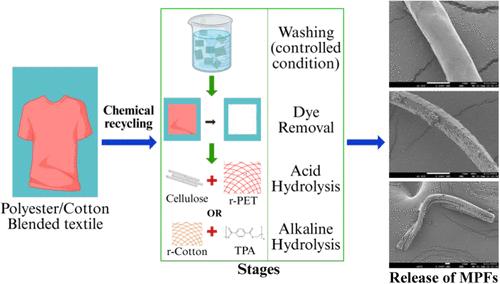
Chemical recycling methods for post-consumer textile waste are effective for sustainable textile waste management. However, recycling synthetic and blended (cotton and synthetic) textiles can contribute to the release of microplastic fibers (MPFs) into the environment. This study investigated MPF release across different stages of two chemical recycling approaches, acid and alkaline hydrolysis, of polyester/cotton-blended textiles. Recycling involves various stages, including dye removal, treatment stage, and product. In the treatment stage, acid hydrolysis breaks down cotton into cellulose, leaving the polyester (PET) intact, whereas alkaline hydrolysis degrades PET, allowing cotton recovery. Across all stages, dye removal generated the highest MPF count, averaging nearly 10,055 MPFs g–1 of textile waste. Statistical analysis confirmed that the recycling approach significantly affected MPF release (p < 0.05), whereas the fabric type did not (p > 0.05). Alkaline hydrolysis reduced MPF release during the treatment stage by 87.55% compared to acid hydrolysis, indicating that recovering cotton and chemically degrading PET can significantly minimize MPF emissions during recycling. Ridge regression analysis identified the reaction conditions as key factors in MPF fragmentation, with blend ratios influencing the number of released MPFs. Surface characterization revealed treatment-induced fiber alterations, raising concerns regarding MPF emissions throughout the process. These findings highlight the textile recycling industries can be a source of MPF release into the environment, but recovering PET through degradation or dissolution can help minimize this impact of the treatment stage.
期刊介绍:
Environmental Science & Technology (ES&T) is a co-sponsored academic and technical magazine by the Hubei Provincial Environmental Protection Bureau and the Hubei Provincial Academy of Environmental Sciences.
Environmental Science & Technology (ES&T) holds the status of Chinese core journals, scientific papers source journals of China, Chinese Science Citation Database source journals, and Chinese Academic Journal Comprehensive Evaluation Database source journals. This publication focuses on the academic field of environmental protection, featuring articles related to environmental protection and technical advancements.



 京公网安备 11010802042870号
京ICP备2023020795号-1
京公网安备 11010802042870号
京ICP备2023020795号-1

 分享
分享
 求助内容:
求助内容: 应助结果提醒方式:
 扫码关注我们
