Vishnu G Nath, Shalini Tomar, Nikhil N. Rao, Muhammed Safeer Naduvil Kovilakath, Neena S. John, Satadeep Bhattacharjee, Seung-Cheol Lee, Angappane Subramanian
{"title":"Unraveling the Synergy of Interfacial Engineering in In Situ Prepared NiO/NdNiO3 for ppb-Level SO2 Sensing: Mechanistic and First-Principles Insights","authors":"Vishnu G Nath, Shalini Tomar, Nikhil N. Rao, Muhammed Safeer Naduvil Kovilakath, Neena S. John, Satadeep Bhattacharjee, Seung-Cheol Lee, Angappane Subramanian","doi":"10.1002/smll.202502192","DOIUrl":null,"url":null,"abstract":"<p>Interfacial engineering of semiconductor metal oxides offers a plethora of features to overcome the limitations of chemiresistive gas sensors, thereby increasing their practical viability. Herein, the SO<sub>2</sub> sensing characteristics of NiO are modulated through the incorporation of NdNiO<sub>3</sub>, via a facile in situ synthesis of NiO/NdNiO<sub>3</sub> nanostructures that significantly enhance the sensor performance. To this end, systematic control of the Nd/Ni molar ratio is employed during the synthesis of NiO/NdNiO<sub>3</sub>, enabling the regulation of structural properties and interfacial interactions. The optimized NiO/NdNiO<sub>3</sub>-based sensor demonstrates superior SO<sub>2</sub> detection at 140 °C, outperforming pristine NiO, owing to tunable charge carrier dynamics at the heterointerface during gas adsorption. The sensor showcases an extensive dynamic response range from 450 ppb to 200 ppm and an impressive detection limit (320 ppb), along with remarkable selectivity and excellent stability. First-principles calculations reveal NiO and NdNiO<sub>3</sub> play distinct roles in SO<sub>2</sub> adsorption, with NiO functioning as the receptor, selectively interacting with SO<sub>2</sub> through dissociated oxygen, and NdNiO<sub>3</sub> serving as the transducer, facilitating signal conversion by inhibiting oxygen dissociation. Additionally, the designed portable, threshold-triggered sensor prototype, integrating the developed NiO/NdNiO<sub>3</sub> sensor with enhanced SO<sub>2</sub> detection, presents a promising avenue for applications in industrial and environmental monitoring.</p>","PeriodicalId":228,"journal":{"name":"Small","volume":"21 24","pages":""},"PeriodicalIF":12.1000,"publicationDate":"2025-04-23","publicationTypes":"Journal Article","fieldsOfStudy":null,"isOpenAccess":false,"openAccessPdf":"","citationCount":"0","resultStr":null,"platform":"Semanticscholar","paperid":null,"PeriodicalName":"Small","FirstCategoryId":"88","ListUrlMain":"https://onlinelibrary.wiley.com/doi/10.1002/smll.202502192","RegionNum":2,"RegionCategory":"材料科学","ArticlePicture":[],"TitleCN":null,"AbstractTextCN":null,"PMCID":null,"EPubDate":"","PubModel":"","JCR":"Q1","JCRName":"CHEMISTRY, MULTIDISCIPLINARY","Score":null,"Total":0}
引用次数: 0
Abstract
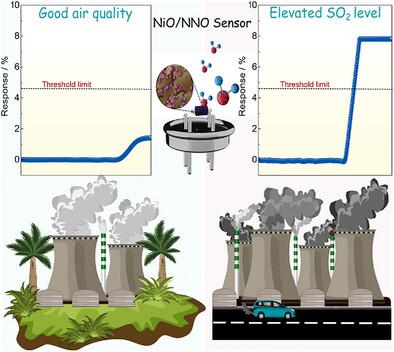
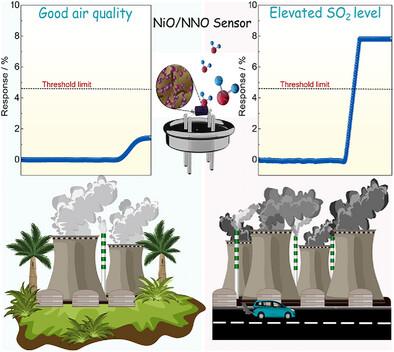
Interfacial engineering of semiconductor metal oxides offers a plethora of features to overcome the limitations of chemiresistive gas sensors, thereby increasing their practical viability. Herein, the SO2 sensing characteristics of NiO are modulated through the incorporation of NdNiO3, via a facile in situ synthesis of NiO/NdNiO3 nanostructures that significantly enhance the sensor performance. To this end, systematic control of the Nd/Ni molar ratio is employed during the synthesis of NiO/NdNiO3, enabling the regulation of structural properties and interfacial interactions. The optimized NiO/NdNiO3-based sensor demonstrates superior SO2 detection at 140 °C, outperforming pristine NiO, owing to tunable charge carrier dynamics at the heterointerface during gas adsorption. The sensor showcases an extensive dynamic response range from 450 ppb to 200 ppm and an impressive detection limit (320 ppb), along with remarkable selectivity and excellent stability. First-principles calculations reveal NiO and NdNiO3 play distinct roles in SO2 adsorption, with NiO functioning as the receptor, selectively interacting with SO2 through dissociated oxygen, and NdNiO3 serving as the transducer, facilitating signal conversion by inhibiting oxygen dissociation. Additionally, the designed portable, threshold-triggered sensor prototype, integrating the developed NiO/NdNiO3 sensor with enhanced SO2 detection, presents a promising avenue for applications in industrial and environmental monitoring.
期刊介绍:
Small serves as an exceptional platform for both experimental and theoretical studies in fundamental and applied interdisciplinary research at the nano- and microscale. The journal offers a compelling mix of peer-reviewed Research Articles, Reviews, Perspectives, and Comments.
With a remarkable 2022 Journal Impact Factor of 13.3 (Journal Citation Reports from Clarivate Analytics, 2023), Small remains among the top multidisciplinary journals, covering a wide range of topics at the interface of materials science, chemistry, physics, engineering, medicine, and biology.
Small's readership includes biochemists, biologists, biomedical scientists, chemists, engineers, information technologists, materials scientists, physicists, and theoreticians alike.




 京公网安备 11010802042870号
京ICP备2023020795号-1
京公网安备 11010802042870号
京ICP备2023020795号-1

 分享
分享
 求助内容:
求助内容: 应助结果提醒方式:
 扫码关注我们
