Metagenomics analysis unraveled the dynamics of microbial community and antibiotic resistance genes during the composting of spiramycin fermentation residue following acidic hydrothermal treatment
Quancheng Shu , Jinzhi Sun , Xiaoyong Yang , Yucan Liu , Jing Ding , Yanxiang Zhang , Lijuan Lan , Picheng Gong , Hongwei Sun , Gang Wang
{"title":"Metagenomics analysis unraveled the dynamics of microbial community and antibiotic resistance genes during the composting of spiramycin fermentation residue following acidic hydrothermal treatment","authors":"Quancheng Shu , Jinzhi Sun , Xiaoyong Yang , Yucan Liu , Jing Ding , Yanxiang Zhang , Lijuan Lan , Picheng Gong , Hongwei Sun , Gang Wang","doi":"10.1016/j.jclepro.2025.145561","DOIUrl":null,"url":null,"abstract":"<div><div>The sustainable management of spiramycin fermentation residue (SFR), classified as hazardous waste, is a significant challenge. Due to its high organic matter content, composting for transforming SFR into organic fertilizer is a promising disposal approach. Acidic hydrothermal treatment (AHT) has been demonstrated to effectively eliminate residual spiramycin (SPM) from SFR, enhancing its biodegradability. This study conducted a comprehensive investigation into the effects of AHT on the maturation process, microbial community structure, antibiotic resistance genes (ARGs), and metabolic mechanisms during SFR composting. AHT elevated the composting temperature and promoted the degradation of organic matter, increasing maturity (as indicated by the NH<sub>4</sub><sup>+</sup>-N/NO<sub>3</sub><sup>−</sup>-N ratio) by 12.2 %–24.5 %. AHT significantly influenced community composition during composting and facilitated the enhancement of species diversity. Additionally, it significantly reduced the abundance of ARGs (38.0 %–54.0 %) and mobile genetic elements (MGEs) (16.0 %–28.0 %), exhibiting a pronounced inhibitory effect on high-risk ARGs. The predominant hosts of ARGs and MGEs were <em>Bacillota</em> (47.5 %) and <em>Proteobacteria</em> (16.1 %). Additionally, AHT significantly diminished the relative abundance of virulence factor genes (VFGs) (6.6 %–11.6 %) while enhancing microbial metabolism, particularly within carbohydrate and amino acid pathways. These findings indicate that combining AHT with composting represents an effective pathway for resource utilization of SFR.</div></div>","PeriodicalId":349,"journal":{"name":"Journal of Cleaner Production","volume":"507 ","pages":"Article 145561"},"PeriodicalIF":10.0000,"publicationDate":"2025-05-20","publicationTypes":"Journal Article","fieldsOfStudy":null,"isOpenAccess":false,"openAccessPdf":"","citationCount":"0","resultStr":null,"platform":"Semanticscholar","paperid":null,"PeriodicalName":"Journal of Cleaner Production","FirstCategoryId":"93","ListUrlMain":"https://www.sciencedirect.com/science/article/pii/S0959652625009114","RegionNum":1,"RegionCategory":"环境科学与生态学","ArticlePicture":[],"TitleCN":null,"AbstractTextCN":null,"PMCID":null,"EPubDate":"2025/4/22 0:00:00","PubModel":"Epub","JCR":"Q1","JCRName":"ENGINEERING, ENVIRONMENTAL","Score":null,"Total":0}
引用次数: 0
Abstract
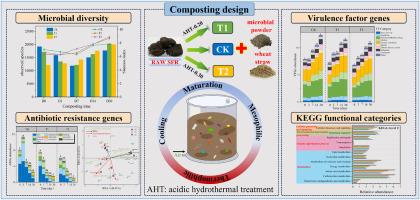
The sustainable management of spiramycin fermentation residue (SFR), classified as hazardous waste, is a significant challenge. Due to its high organic matter content, composting for transforming SFR into organic fertilizer is a promising disposal approach. Acidic hydrothermal treatment (AHT) has been demonstrated to effectively eliminate residual spiramycin (SPM) from SFR, enhancing its biodegradability. This study conducted a comprehensive investigation into the effects of AHT on the maturation process, microbial community structure, antibiotic resistance genes (ARGs), and metabolic mechanisms during SFR composting. AHT elevated the composting temperature and promoted the degradation of organic matter, increasing maturity (as indicated by the NH4+-N/NO3−-N ratio) by 12.2 %–24.5 %. AHT significantly influenced community composition during composting and facilitated the enhancement of species diversity. Additionally, it significantly reduced the abundance of ARGs (38.0 %–54.0 %) and mobile genetic elements (MGEs) (16.0 %–28.0 %), exhibiting a pronounced inhibitory effect on high-risk ARGs. The predominant hosts of ARGs and MGEs were Bacillota (47.5 %) and Proteobacteria (16.1 %). Additionally, AHT significantly diminished the relative abundance of virulence factor genes (VFGs) (6.6 %–11.6 %) while enhancing microbial metabolism, particularly within carbohydrate and amino acid pathways. These findings indicate that combining AHT with composting represents an effective pathway for resource utilization of SFR.
期刊介绍:
The Journal of Cleaner Production is an international, transdisciplinary journal that addresses and discusses theoretical and practical Cleaner Production, Environmental, and Sustainability issues. It aims to help societies become more sustainable by focusing on the concept of 'Cleaner Production', which aims at preventing waste production and increasing efficiencies in energy, water, resources, and human capital use. The journal serves as a platform for corporations, governments, education institutions, regions, and societies to engage in discussions and research related to Cleaner Production, environmental, and sustainability practices.




 京公网安备 11010802042870号
京ICP备2023020795号-1
京公网安备 11010802042870号
京ICP备2023020795号-1

 分享
分享
 求助内容:
求助内容: 应助结果提醒方式:
 扫码关注我们
