Zheng Zhang , Can Chen , Pengyu Chen , Jiguang Huang , Heng Zhang , Dan Gao , Haiping Chen
{"title":"Design optimization for evaporation property of coal fly ash-based evaporator during solar-driven interfacial evaporation process","authors":"Zheng Zhang , Can Chen , Pengyu Chen , Jiguang Huang , Heng Zhang , Dan Gao , Haiping Chen","doi":"10.1016/j.watres.2025.123704","DOIUrl":null,"url":null,"abstract":"<div><div>Solar-driven interfacial evaporation has recently attracted many attentions due to its energy-saving and environmentally friendly advantages. Researches on structural parameters optimization for the ceramic interfacial evaporators to improve their evaporation performance are lack. In this work, ceramic evaporators with different structural parameters are prepared using coal fly ash as the main material. A comparative experimental study was carried out under natural light. Water transport rate and maximum water transport volume of evaporators are introduced to explain the effect of structural parameters on the evaporation performance. Results indicate that smaller pore size and higher porosity can enhance the water transport and improve the evaporation rate. Evaporators with higher porosity has higher maximum water transport volume, thus the evaporation rate can be reduced due to the increase of the thermal conductivity of the evaporator. The optimized evaporator shows a high average evaporation rate of 4.72 kg·<em>m</em><sup>−2</sup>·<em>h</em><sup>−1</sup> under a solar irradiation of 0.66 kW·<em>m</em><sup>−2</sup>, and an average evaporation rate of 5.85 kg·<em>m</em><sup>−2</sup>·<em>h</em><sup>−1</sup> under one sun irradiation, with the mean pore size of 0.2204 μm and the porosity of 0.2855. This work provides a direction for structural parameters optimization in designing high-performance ceramic evaporators.</div></div>","PeriodicalId":443,"journal":{"name":"Water Research","volume":"281 ","pages":"Article 123704"},"PeriodicalIF":12.4000,"publicationDate":"2025-08-01","publicationTypes":"Journal Article","fieldsOfStudy":null,"isOpenAccess":false,"openAccessPdf":"","citationCount":"0","resultStr":null,"platform":"Semanticscholar","paperid":null,"PeriodicalName":"Water Research","FirstCategoryId":"93","ListUrlMain":"https://www.sciencedirect.com/science/article/pii/S004313542500613X","RegionNum":1,"RegionCategory":"环境科学与生态学","ArticlePicture":[],"TitleCN":null,"AbstractTextCN":null,"PMCID":null,"EPubDate":"2025/4/22 0:00:00","PubModel":"Epub","JCR":"Q1","JCRName":"ENGINEERING, ENVIRONMENTAL","Score":null,"Total":0}
引用次数: 0
Abstract
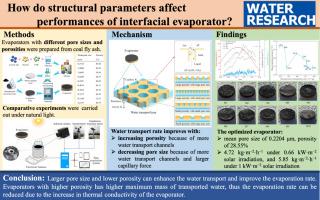
Solar-driven interfacial evaporation has recently attracted many attentions due to its energy-saving and environmentally friendly advantages. Researches on structural parameters optimization for the ceramic interfacial evaporators to improve their evaporation performance are lack. In this work, ceramic evaporators with different structural parameters are prepared using coal fly ash as the main material. A comparative experimental study was carried out under natural light. Water transport rate and maximum water transport volume of evaporators are introduced to explain the effect of structural parameters on the evaporation performance. Results indicate that smaller pore size and higher porosity can enhance the water transport and improve the evaporation rate. Evaporators with higher porosity has higher maximum water transport volume, thus the evaporation rate can be reduced due to the increase of the thermal conductivity of the evaporator. The optimized evaporator shows a high average evaporation rate of 4.72 kg·m−2·h−1 under a solar irradiation of 0.66 kW·m−2, and an average evaporation rate of 5.85 kg·m−2·h−1 under one sun irradiation, with the mean pore size of 0.2204 μm and the porosity of 0.2855. This work provides a direction for structural parameters optimization in designing high-performance ceramic evaporators.
期刊介绍:
Water Research, along with its open access companion journal Water Research X, serves as a platform for publishing original research papers covering various aspects of the science and technology related to the anthropogenic water cycle, water quality, and its management worldwide. The audience targeted by the journal comprises biologists, chemical engineers, chemists, civil engineers, environmental engineers, limnologists, and microbiologists. The scope of the journal include:
•Treatment processes for water and wastewaters (municipal, agricultural, industrial, and on-site treatment), including resource recovery and residuals management;
•Urban hydrology including sewer systems, stormwater management, and green infrastructure;
•Drinking water treatment and distribution;
•Potable and non-potable water reuse;
•Sanitation, public health, and risk assessment;
•Anaerobic digestion, solid and hazardous waste management, including source characterization and the effects and control of leachates and gaseous emissions;
•Contaminants (chemical, microbial, anthropogenic particles such as nanoparticles or microplastics) and related water quality sensing, monitoring, fate, and assessment;
•Anthropogenic impacts on inland, tidal, coastal and urban waters, focusing on surface and ground waters, and point and non-point sources of pollution;
•Environmental restoration, linked to surface water, groundwater and groundwater remediation;
•Analysis of the interfaces between sediments and water, and between water and atmosphere, focusing specifically on anthropogenic impacts;
•Mathematical modelling, systems analysis, machine learning, and beneficial use of big data related to the anthropogenic water cycle;
•Socio-economic, policy, and regulations studies.




 京公网安备 11010802042870号
京ICP备2023020795号-1
京公网安备 11010802042870号
京ICP备2023020795号-1

 分享
分享
 求助内容:
求助内容: 应助结果提醒方式:
 扫码关注我们
