Hollow fiber layout matters the denitrification performance and mechanism of H2-based membrane biofilm reactor: A comprehensive study of hydrodynamics, bioecology and biokinetics
{"title":"Hollow fiber layout matters the denitrification performance and mechanism of H2-based membrane biofilm reactor: A comprehensive study of hydrodynamics, bioecology and biokinetics","authors":"Junjian Zheng , Minmin Jiang , Yuchao Chen , Yuanyuan Zhang , Qiaoyan Wei , Mei Chen , Xingran Zhang , Xuehong Zhang , Haixiang Li","doi":"10.1016/j.watres.2025.123708","DOIUrl":null,"url":null,"abstract":"<div><div>As a promising technology for water treatment, the decontamination performance of membrane-biofilm reactor (MBfR) is largely affected by its flow distribution, which regulates the biofilm structure and activity. Herein, we firstly optimized the hydraulic conditions to ameliorate the denitrification performance of H<sub>2</sub>-based MBfR through a rational design of hollow fiber membrane (HFM) layout. Two MBfRs, assembled by bundled and dispersed modules (termed as B-MBfR and D-MBfR, respectively), were constructed to investigate their process performance and mechanism, from a multi-perspective analysis of flow characteristics, biofilm ecology and microbial kinetics. The results indicated that as the HFM spacing was enlarged from 0 to 4 mm, the shift of flow distribution from bias flow to homogeneous flow occured, leading to the development of annular biofilm and individual biofilms in B-MBfR and D-MBfR, respectively. The superior denitrification flux was attained by D-MBfR instead of B-MBfR (1.1 <em>vs.</em> 0.58 g N/m<sup>2</sup>·d) in long-term experiments, and so were the denitrification kinetics rates of the former in short-term tests. The biofilms in D-MBfR exhibited the stronger anti-shear capacity over annular biofilm, due to their more uniform distribution of proteins and polysaccharides. Benefiting from the thinner thicknesses of biofilms and narrowed hydrodynamic boundary layer, D-MBfR enabled the greater abundance and metabolic activity of hydrogenotrophic denitrifying bacteria than B-MBfR, which then resulted in the almost full exploitation of H<sub>2</sub> and NO<sub>3</sub><sup>-</sup>. The findings of this research can provide important scientific foundation for future design and management of MBfRs.</div></div>","PeriodicalId":443,"journal":{"name":"Water Research","volume":"281 ","pages":"Article 123708"},"PeriodicalIF":12.4000,"publicationDate":"2025-08-01","publicationTypes":"Journal Article","fieldsOfStudy":null,"isOpenAccess":false,"openAccessPdf":"","citationCount":"0","resultStr":null,"platform":"Semanticscholar","paperid":null,"PeriodicalName":"Water Research","FirstCategoryId":"93","ListUrlMain":"https://www.sciencedirect.com/science/article/pii/S0043135425006177","RegionNum":1,"RegionCategory":"环境科学与生态学","ArticlePicture":[],"TitleCN":null,"AbstractTextCN":null,"PMCID":null,"EPubDate":"2025/4/22 0:00:00","PubModel":"Epub","JCR":"Q1","JCRName":"ENGINEERING, ENVIRONMENTAL","Score":null,"Total":0}
引用次数: 0
Abstract
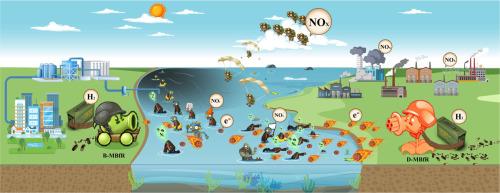
As a promising technology for water treatment, the decontamination performance of membrane-biofilm reactor (MBfR) is largely affected by its flow distribution, which regulates the biofilm structure and activity. Herein, we firstly optimized the hydraulic conditions to ameliorate the denitrification performance of H2-based MBfR through a rational design of hollow fiber membrane (HFM) layout. Two MBfRs, assembled by bundled and dispersed modules (termed as B-MBfR and D-MBfR, respectively), were constructed to investigate their process performance and mechanism, from a multi-perspective analysis of flow characteristics, biofilm ecology and microbial kinetics. The results indicated that as the HFM spacing was enlarged from 0 to 4 mm, the shift of flow distribution from bias flow to homogeneous flow occured, leading to the development of annular biofilm and individual biofilms in B-MBfR and D-MBfR, respectively. The superior denitrification flux was attained by D-MBfR instead of B-MBfR (1.1 vs. 0.58 g N/m2·d) in long-term experiments, and so were the denitrification kinetics rates of the former in short-term tests. The biofilms in D-MBfR exhibited the stronger anti-shear capacity over annular biofilm, due to their more uniform distribution of proteins and polysaccharides. Benefiting from the thinner thicknesses of biofilms and narrowed hydrodynamic boundary layer, D-MBfR enabled the greater abundance and metabolic activity of hydrogenotrophic denitrifying bacteria than B-MBfR, which then resulted in the almost full exploitation of H2 and NO3-. The findings of this research can provide important scientific foundation for future design and management of MBfRs.
期刊介绍:
Water Research, along with its open access companion journal Water Research X, serves as a platform for publishing original research papers covering various aspects of the science and technology related to the anthropogenic water cycle, water quality, and its management worldwide. The audience targeted by the journal comprises biologists, chemical engineers, chemists, civil engineers, environmental engineers, limnologists, and microbiologists. The scope of the journal include:
•Treatment processes for water and wastewaters (municipal, agricultural, industrial, and on-site treatment), including resource recovery and residuals management;
•Urban hydrology including sewer systems, stormwater management, and green infrastructure;
•Drinking water treatment and distribution;
•Potable and non-potable water reuse;
•Sanitation, public health, and risk assessment;
•Anaerobic digestion, solid and hazardous waste management, including source characterization and the effects and control of leachates and gaseous emissions;
•Contaminants (chemical, microbial, anthropogenic particles such as nanoparticles or microplastics) and related water quality sensing, monitoring, fate, and assessment;
•Anthropogenic impacts on inland, tidal, coastal and urban waters, focusing on surface and ground waters, and point and non-point sources of pollution;
•Environmental restoration, linked to surface water, groundwater and groundwater remediation;
•Analysis of the interfaces between sediments and water, and between water and atmosphere, focusing specifically on anthropogenic impacts;
•Mathematical modelling, systems analysis, machine learning, and beneficial use of big data related to the anthropogenic water cycle;
•Socio-economic, policy, and regulations studies.




 京公网安备 11010802042870号
京ICP备2023020795号-1
京公网安备 11010802042870号
京ICP备2023020795号-1

 分享
分享
 求助内容:
求助内容: 应助结果提醒方式:
 扫码关注我们
