Yanan Li, Jie Yang, Jiaqi Wang, Zhuo Feng, Kangjian Jing, Weiqin Wu, Meijing Yao, Xiaona Liu
{"title":"Oxidative degradation of fluoroquinolone antibiotics by ferrate(VI): Kinetics, reaction mechanism, and theoretical calculations","authors":"Yanan Li, Jie Yang, Jiaqi Wang, Zhuo Feng, Kangjian Jing, Weiqin Wu, Meijing Yao, Xiaona Liu","doi":"10.1016/j.cej.2025.162970","DOIUrl":null,"url":null,"abstract":"The extensive use of fluoroquinolone antibiotics (FQs) and their low degradation efficiency pose significant threats to aquatic ecosystems and human health. However, the species-specific reactions and the key reaction mechanisms underlying their degradation by ferrate (Fe(VI)) based on density functional theory (DFT) calculations remain unclear. This study systematically examines the oxidation mechanisms of four FQs (enoxacin (ENO), ofloxacin (OFL), gatifloxacin (GAT), and fleroxacin (FLE)) by Fe(VI), through combined experimental and DFT methods. The results showed that the oxidation of FQs by Fe(VI) conformed to secondary reaction kinetics with second-order reaction rate constants following FLE (1.57 mM<sup>−1</sup>·min<sup>−1</sup>) > GAT (0.99 mM<sup>−1</sup>·min<sup>−1</sup>) > OFL (0.96 mM<sup>−1</sup>·min<sup>−1</sup>) > ENO (0.79 mM<sup>−1</sup>·min<sup>−1</sup>). While Fe(VI) species dominated the reaction, specific contributions from Fe(V)/Fe(IV) and hydroxyl radicals (·OH) were quantitatively verified, and DFT further proved that FeO<sub>4</sub><sup>2-</sup>, as the predominant Fe(VI) species, governed the reaction at pH 8.0, the optimum reaction pH. Instrumental analysis detected the main products, and DFT predicted the reactive active sites, suggesting that the quinolone and piperazine rings cleavage on the FQs molecules was achieved through hydroxylation, decarboxylation, and other reactions, with the intermediates tending to be harmless. Both methods identified three distinct reaction mechanisms: ·OH attack, single-oxygen transfer (SOT), and double-oxygen transfer, with ·OH attack the most likely to occur and SOT the main reaction mechanism. This study combines DFT calculations with experimental observations to identify the mechanisms of Fe(VI)-mediated FQs degradation at the molecular structural level, and provide new insights into the treatment of FQs.","PeriodicalId":270,"journal":{"name":"Chemical Engineering Journal","volume":"32 1","pages":""},"PeriodicalIF":13.2000,"publicationDate":"2025-04-22","publicationTypes":"Journal Article","fieldsOfStudy":null,"isOpenAccess":false,"openAccessPdf":"","citationCount":"0","resultStr":null,"platform":"Semanticscholar","paperid":null,"PeriodicalName":"Chemical Engineering Journal","FirstCategoryId":"5","ListUrlMain":"https://doi.org/10.1016/j.cej.2025.162970","RegionNum":1,"RegionCategory":"工程技术","ArticlePicture":[],"TitleCN":null,"AbstractTextCN":null,"PMCID":null,"EPubDate":"","PubModel":"","JCR":"Q1","JCRName":"ENGINEERING, CHEMICAL","Score":null,"Total":0}
引用次数: 0
Abstract
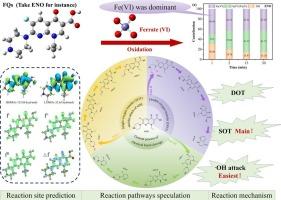
The extensive use of fluoroquinolone antibiotics (FQs) and their low degradation efficiency pose significant threats to aquatic ecosystems and human health. However, the species-specific reactions and the key reaction mechanisms underlying their degradation by ferrate (Fe(VI)) based on density functional theory (DFT) calculations remain unclear. This study systematically examines the oxidation mechanisms of four FQs (enoxacin (ENO), ofloxacin (OFL), gatifloxacin (GAT), and fleroxacin (FLE)) by Fe(VI), through combined experimental and DFT methods. The results showed that the oxidation of FQs by Fe(VI) conformed to secondary reaction kinetics with second-order reaction rate constants following FLE (1.57 mM−1·min−1) > GAT (0.99 mM−1·min−1) > OFL (0.96 mM−1·min−1) > ENO (0.79 mM−1·min−1). While Fe(VI) species dominated the reaction, specific contributions from Fe(V)/Fe(IV) and hydroxyl radicals (·OH) were quantitatively verified, and DFT further proved that FeO42-, as the predominant Fe(VI) species, governed the reaction at pH 8.0, the optimum reaction pH. Instrumental analysis detected the main products, and DFT predicted the reactive active sites, suggesting that the quinolone and piperazine rings cleavage on the FQs molecules was achieved through hydroxylation, decarboxylation, and other reactions, with the intermediates tending to be harmless. Both methods identified three distinct reaction mechanisms: ·OH attack, single-oxygen transfer (SOT), and double-oxygen transfer, with ·OH attack the most likely to occur and SOT the main reaction mechanism. This study combines DFT calculations with experimental observations to identify the mechanisms of Fe(VI)-mediated FQs degradation at the molecular structural level, and provide new insights into the treatment of FQs.
期刊介绍:
The Chemical Engineering Journal is an international research journal that invites contributions of original and novel fundamental research. It aims to provide an international platform for presenting original fundamental research, interpretative reviews, and discussions on new developments in chemical engineering. The journal welcomes papers that describe novel theory and its practical application, as well as those that demonstrate the transfer of techniques from other disciplines. It also welcomes reports on carefully conducted experimental work that is soundly interpreted. The main focus of the journal is on original and rigorous research results that have broad significance. The Catalysis section within the Chemical Engineering Journal focuses specifically on Experimental and Theoretical studies in the fields of heterogeneous catalysis, molecular catalysis, and biocatalysis. These studies have industrial impact on various sectors such as chemicals, energy, materials, foods, healthcare, and environmental protection.




 京公网安备 11010802042870号
京ICP备2023020795号-1
京公网安备 11010802042870号
京ICP备2023020795号-1

 分享
分享
 求助内容:
求助内容: 应助结果提醒方式:
 扫码关注我们
