{"title":"Pillar[5]arene@AuNP-Functionalized, Magnetically-Propelled helical micromotors for On-The-Fly electrochemical biosensing of p53 DNA sequence","authors":"Zhiyong Ran, Yue Li, Xiankun Lin, Qiang He","doi":"10.1016/j.cej.2025.162953","DOIUrl":null,"url":null,"abstract":"Electrochemical biosensors have promising applications such as the detection of biomarkers for cancer diagnosis, but their performance is still limited by the passive diffusion of molecules. Due to the autonomous and steerable motion capabilities, magnetically-driven micromotors display the advantages of enhancing diffusion and micro-mixing. However, developing micromotor-enhanced electrochemical biosensors is still challenging. Herein, we report magnetically-driven helical PANI-Fe<sub>3</sub>O<sub>4</sub>@SP-HP5@AuNPs (PFSHA) micromotors, in which the combination of the micromotor technology and host–guest recognition strategy enables sensitive detection of p53 DNA. The micromotors are fabricated by integrating gold nanoparticle-stabilized pillar[5]arenes (HP5@AuNPs), polyaniline (PANI), and iron oxide (Fe<sub>3</sub>O<sub>4</sub>) nanoparticles onto Spirulina (SP). Under a rotating magnetic field, the micromotors exhibit steerable motility with an average speed of 21.7 µm/s. Consequently, the micromotor-functionalized electrochemical biosensors achieve high sensitivity and a detection limit of 0.66 pM towards p53 DNA, with a linear range from 1 pM to 100 µM. The advantages of the micromotors, including autonomous motion, micro-mixing, enhanced diffusion, and improved mass transfer, enable significant improvement in the performance of electrochemical biosensing. Therefore, integrating micromotor technology into sensing analysis paves a promising way to address the limitations of existing electrochemical biosensors, offering new solutions for advanced clinical diagnosis.","PeriodicalId":270,"journal":{"name":"Chemical Engineering Journal","volume":"51 1","pages":""},"PeriodicalIF":13.2000,"publicationDate":"2025-04-22","publicationTypes":"Journal Article","fieldsOfStudy":null,"isOpenAccess":false,"openAccessPdf":"","citationCount":"0","resultStr":null,"platform":"Semanticscholar","paperid":null,"PeriodicalName":"Chemical Engineering Journal","FirstCategoryId":"5","ListUrlMain":"https://doi.org/10.1016/j.cej.2025.162953","RegionNum":1,"RegionCategory":"工程技术","ArticlePicture":[],"TitleCN":null,"AbstractTextCN":null,"PMCID":null,"EPubDate":"","PubModel":"","JCR":"Q1","JCRName":"ENGINEERING, CHEMICAL","Score":null,"Total":0}
引用次数: 0
Abstract
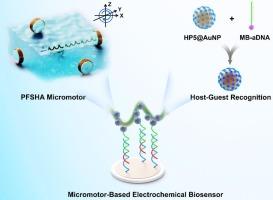
Electrochemical biosensors have promising applications such as the detection of biomarkers for cancer diagnosis, but their performance is still limited by the passive diffusion of molecules. Due to the autonomous and steerable motion capabilities, magnetically-driven micromotors display the advantages of enhancing diffusion and micro-mixing. However, developing micromotor-enhanced electrochemical biosensors is still challenging. Herein, we report magnetically-driven helical PANI-Fe3O4@SP-HP5@AuNPs (PFSHA) micromotors, in which the combination of the micromotor technology and host–guest recognition strategy enables sensitive detection of p53 DNA. The micromotors are fabricated by integrating gold nanoparticle-stabilized pillar[5]arenes (HP5@AuNPs), polyaniline (PANI), and iron oxide (Fe3O4) nanoparticles onto Spirulina (SP). Under a rotating magnetic field, the micromotors exhibit steerable motility with an average speed of 21.7 µm/s. Consequently, the micromotor-functionalized electrochemical biosensors achieve high sensitivity and a detection limit of 0.66 pM towards p53 DNA, with a linear range from 1 pM to 100 µM. The advantages of the micromotors, including autonomous motion, micro-mixing, enhanced diffusion, and improved mass transfer, enable significant improvement in the performance of electrochemical biosensing. Therefore, integrating micromotor technology into sensing analysis paves a promising way to address the limitations of existing electrochemical biosensors, offering new solutions for advanced clinical diagnosis.
期刊介绍:
The Chemical Engineering Journal is an international research journal that invites contributions of original and novel fundamental research. It aims to provide an international platform for presenting original fundamental research, interpretative reviews, and discussions on new developments in chemical engineering. The journal welcomes papers that describe novel theory and its practical application, as well as those that demonstrate the transfer of techniques from other disciplines. It also welcomes reports on carefully conducted experimental work that is soundly interpreted. The main focus of the journal is on original and rigorous research results that have broad significance. The Catalysis section within the Chemical Engineering Journal focuses specifically on Experimental and Theoretical studies in the fields of heterogeneous catalysis, molecular catalysis, and biocatalysis. These studies have industrial impact on various sectors such as chemicals, energy, materials, foods, healthcare, and environmental protection.



 京公网安备 11010802042870号
京ICP备2023020795号-1
京公网安备 11010802042870号
京ICP备2023020795号-1

 分享
分享
 求助内容:
求助内容: 应助结果提醒方式:
 扫码关注我们
